From the conversion glossary
Concepts referenced in this article, defined.
Concepts referenced in this article, defined.
Run rigorous A/B tests and personalize every visit on Shopify or any storefront — no engineers required.
AI copywriting lets ecommerce brands produce product descriptions, meta titles, ad copy, and email content at a scale that was previously impossible without a large team. Used well, it cuts content production time by 60–80% while maintaining quality. Used poorly, it floods your store with generic, inaccurate, or on-brand-for-nobody text that hurts conversions and search rankings. Here's how to use AI copywriting effectively for ecommerce.
Product descriptions at scale
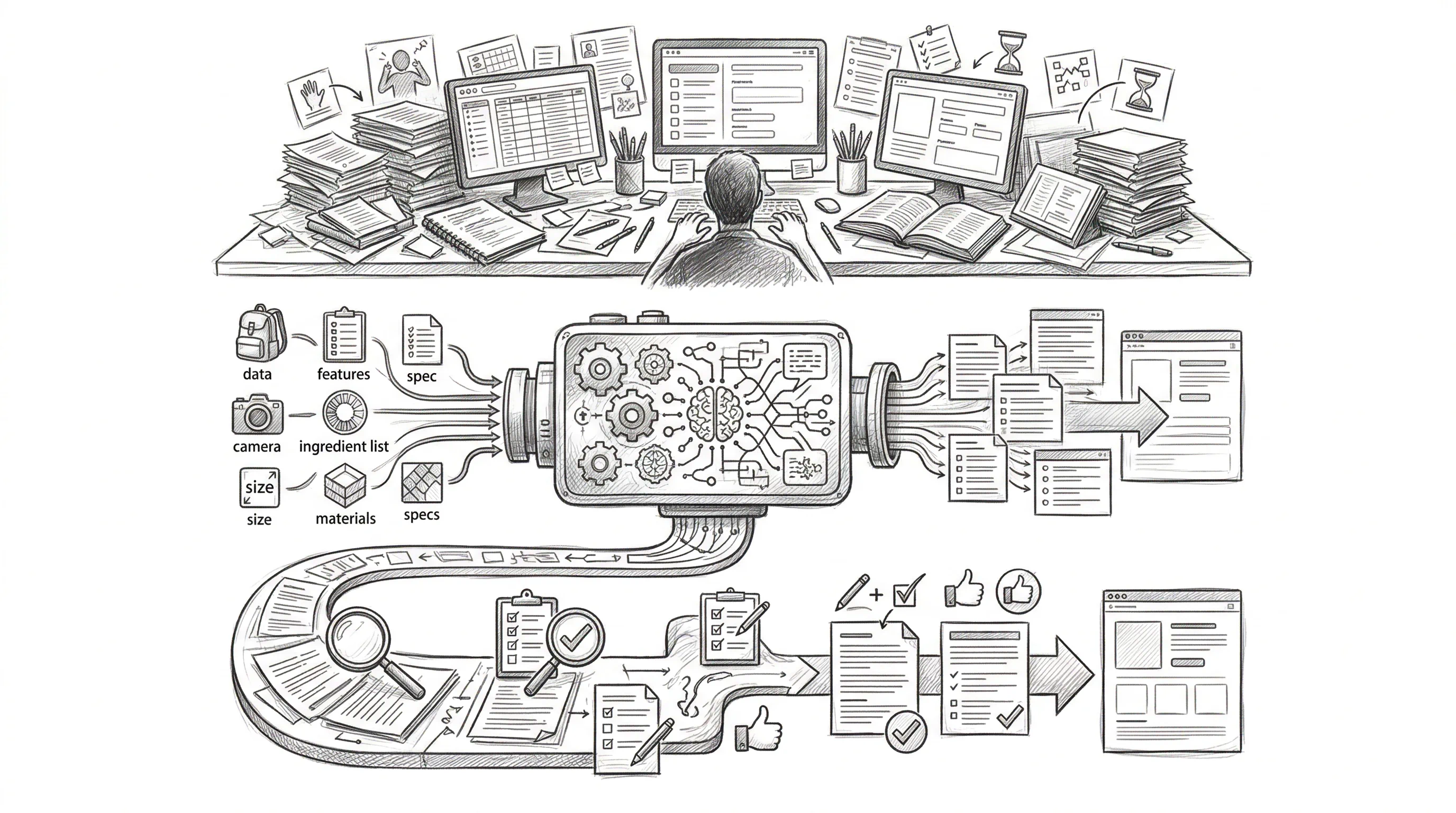
If you have 200 SKUs and each needs a unique product description, AI drafting is the only practical approach. You provide structured input (product name, key ingredients, benefits, target customer), the AI drafts a description, and a human edits for accuracy and voice. This workflow produces 10–15 product descriptions per hour vs. 1–2 from scratch.
Variation testing
AI makes it easy to produce 3–5 versions of a headline or product benefit statement. You can then A/B test which version converts better. For brands running tests with CustomFit.ai, AI-generated copy variants speed up the experimentation process dramatically—you're not waiting a week for a copywriter to deliver alternatives.
Meta titles and descriptions
Writing unique meta titles and descriptions for every product, collection, and blog page is the copywriting task that most D2C brands either skip or do badly. AI is genuinely useful here. Give it the page topic, primary keyword, and character limits; it produces solid first drafts in seconds.
Email subject lines
AI generates high-volume subject line options efficiently. For a single campaign, you can produce 20 subject line options in 5 minutes, test the top 3 with a small segment, and roll the winner to the full list.
Translating product jargon into benefits
Many D2C brands write features, not benefits. "500mg Ashwagandha" needs to become "Fall asleep faster and wake up less wired." AI is good at this transformation when given the right instruction.
Health and wellness claims
For Ayurveda, nutraceuticals, food supplements, or anything touching health outcomes, AI frequently generates claims that are either inaccurate, legally risky, or not backed by the product's actual formulation. Kapiva, WOW Skin Science, and similar brands must verify every health claim. AI is a drafting tool, not a regulatory review team.
Brand voice and tone
AI copy defaults to generic professional-friendly tone. If your brand sounds like a 25-year-old from Bengaluru who talks about skincare like a friend (not a doctor), AI will not capture that on its first draft. You need detailed brand voice guidelines in your AI prompts and a human editor who genuinely understands the brand.
Storytelling and origin narratives
Your founding story, sourcing narrative, or artisan craftsmanship story requires human authorship. AI can help structure it, but the authentic detail—the founder's actual experience, the specific village in Rajasthan where your artisans work—comes from real knowledge, not training data.
Culturally specific Indian context
Generic AI copy won't naturally incorporate the cultural nuances of Indian shopping: festival gifting occasions, Ayurvedic heritage, regional food traditions, COD shopper psychology, or WhatsApp-native communication styles. You need prompts that explicitly include Indian context or editors who add it.
Don't ask AI "write a product description for our protein powder." Instead, use a structured template:
Product: [Name]
Category: [Category]
Key ingredients/materials: [List]
Primary benefit: [One sentence]
Secondary benefits: [2-3 points]
Target customer: [Description]
Tone: [Brand voice description]
Word count: [Target]
Keywords to include: [Primary keyword]
Things to avoid: [Claims to exclude]
The more structured your input, the more usable the output.
Build a library of tested prompts for each content type:
Store these prompts in a shared doc. Anyone on the team can use them consistently.
Every AI output needs a human pass for:
This review takes 3–5 minutes per product vs. the 20–30 minutes it would take to write from scratch. You're editing, not creating, which is dramatically faster.
For your highest-traffic product pages, use AI to generate multiple headline and benefit statement variations, then test them. CustomFit.ai lets you run these tests on live traffic without developer help—you can swap headline copy between variants directly in the visual editor.
Brands running copy tests typically see 8–15% CVR differences between variants. That's a material impact on revenue from a text change.
Run your first copy A/B test with CustomFit.ai →
Include festive context explicitly: "Write a product description suitable for Diwali gifting. The customer is shopping for a gift for their mother-in-law. Tone: warm, celebratory."
Specify Indian language sensibility: "Write in Indian English—not British or American. The brand voice is friendly, knowledgeable, and uses everyday language that a 28-year-old urban Indian woman would use when recommending a product to a friend."
Include price anchoring context: "The product is priced at ₹1,299. Position it as a premium but accessible choice compared to international brands that cost ₹2,500+"
COD-specific copy: For brands with high COD orders, product pages sometimes need copy that addresses COD-specific concerns (delivery timeline, return policy). AI can generate these trust signals when prompted with: "Include a brief mention that we offer cash on delivery with free returns."
Using AI output without editing: The first draft is a starting point. Brands that publish unedited AI copy end up with descriptions that are technically correct but feel hollow and don't convert.
Ignoring duplicate content at scale: If you feed the same product template to AI 50 times with minor variations, the output may be too similar across pages. This creates duplicate content issues that hurt SEO. Vary your inputs and instructions.
Over-relying on AI for new product launches: When launching a new SKU, you need deep product knowledge to write accurate copy. AI doesn't have that knowledge. Brief your team on the product before using AI as a drafting tool.
Using generic AI copy for your hero products: Your best-selling products drive disproportionate revenue. Don't use AI-first copy for these—start human, use AI to generate test variants.
AI copywriting without measurement is just word production. Track:
Use CustomFit.ai to run copy experiments and measure which version drives the most add-to-carts and purchases, not just which sounds better in a meeting.