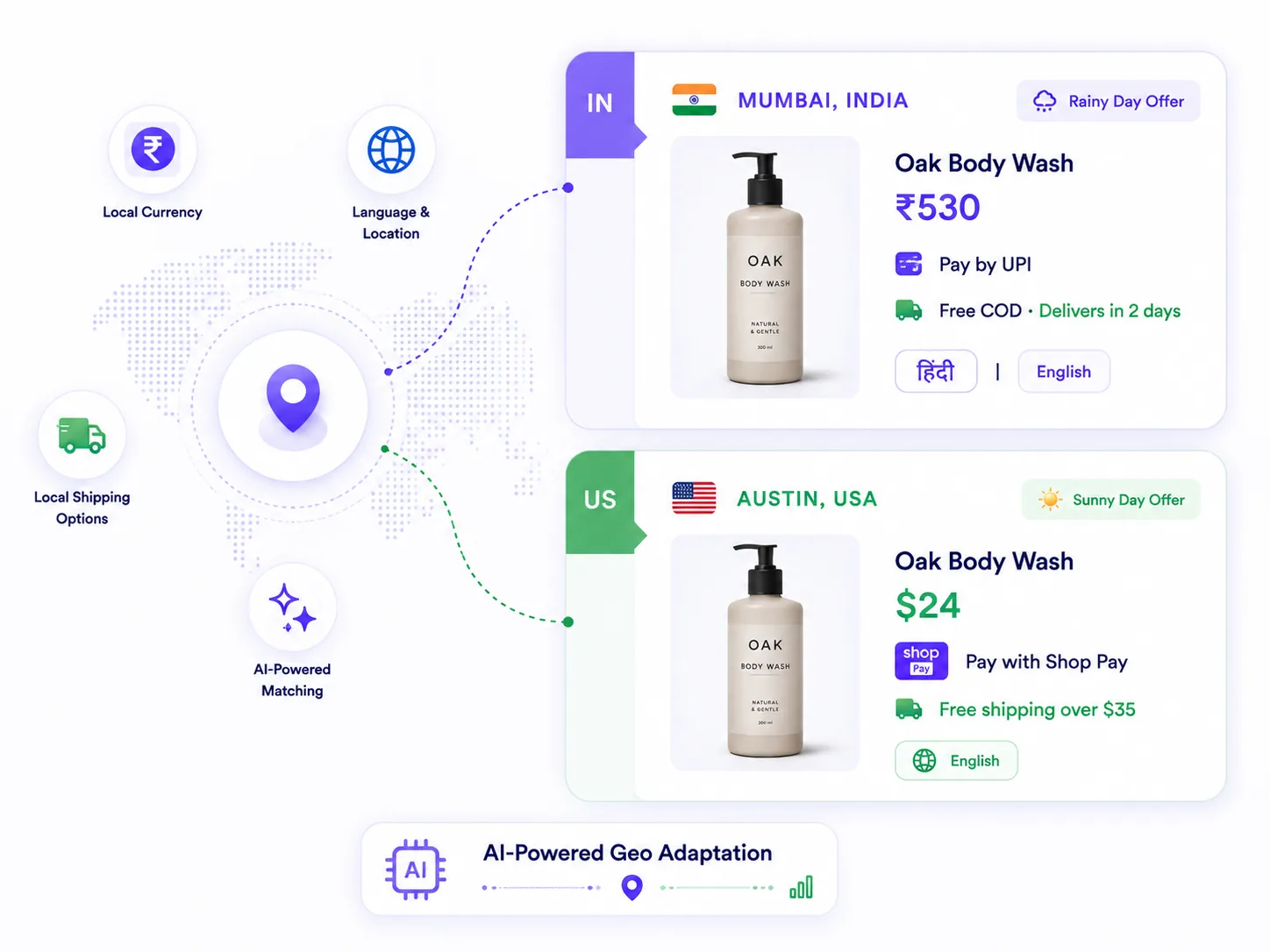
Greet every visitor in their currency, language, and shipping reality. CustomFit adapts your store by country, state, and city — even by the weather outside their window — so the offer always feels like it was built for where they are. AI matches every location to the experience most likely to convert it.

Auto-display local currency and translated copy so prices feel native — no mental conversion, no bounce.
Show the delivery window, free-shipping threshold, and payment methods that actually apply to their region.
Target country, state, or city — run a Mumbai-monsoon offer or a Texas-heatwave hero without touching the rest of the site.
Location is resolved at the edge from IP, timezone, and language headers before your page renders — so a visitor in Bengaluru never sees dollars flash to rupees. No spinner, no layout shift, no flicker.
Trigger experiences on regional context — a monsoon bundle in Mumbai, a heatwave hero in Texas, a Diwali offer in Delhi. Layer in live weather and local events so the storefront responds to what's actually happening where the visitor is.
Geo experiences run through the same experiment engine, so you can A/B a localized version against your default for a single country, read the segment-level verdict, and expand only where it actually lifts revenue.
Localizing the shipping promise and currency for India vs. Gulf traffic was the single highest-ROI change we made all year.
Geo personalization adapts your storefront to each visitor’s location — currency, language, shipping promise, payment methods, and regional offers — resolved at the edge before the page paints. It makes a global store feel native in every market without running separate sites.
Local currency and shipping promises remove the friction that bounces international traffic.
Showing accurate delivery windows by region lifts checkout confidence.
A monsoon kit in Mumbai or a Diwali offer in Delhi converts better than a generic hero.
Sell into many countries from one storefront.
Tune India vs. Gulf vs. US experiences independently.
Cut “where’s my order?” tickets with accurate ETAs.
Geo personalizationadapts your storefront to each visitor’s location — currency, language, shipping promise, payment methods, and regional offers — resolved at the edge before the page paints. It makes a global store feel native in every market without running separate sites for each country.
Location is one of the strongest conversion signals in ecommerce. A shopper in Mumbai who sees prices in rupees, a realistic delivery ETA, and UPI as a payment option converts far better than one shown dollars and a generic checkout. CustomFit resolves country, region, and city from IP and refines with timezone and language headers.
Beyond static localization, geo personalization can respond to live context — weather, local festivals, and regional inventory — so a monsoon bundle surfaces in Mumbai while a heatwave hero shows in Texas. Every geo experience runs through the same experiment engine, so you roll a region out only once it proves it lifts revenue.
No. Personalization is applied over your canonical pages so crawlers index your indexable content; you choose which elements localize and which stay constant.
CustomFit resolves country, region/state, and city from IP, refined by timezone and language headers, before first paint — accurate enough for currency, shipping, and regional offers.
CustomFit resolves location at the edge from IP down to country, region/state, and city, refined with timezone and language headers. Detection happens before first paint, so the localized version renders immediately with no flicker.
Yes. Localize displayed currency and run region-specific pricing, offers, and shipping promises. Pricing experiments run through the same engine, so you can prove the lift before rolling a region out.
No. Personalization is applied at the edge over your canonical pages, so crawlers still see your indexable content. You control which elements localize and which stay constant.
Anything — device, traffic source, returning vs. new, cart value, weather, local events. Geo is one of 40+ signals you can stack in the rule builder.
No. Marketers build experiments and personalized experiences in a no-code visual editor; developers can use the API and SDKs when they want deeper control.
Launch your first geo experience in minutes — free to start, live in 4 minutes.