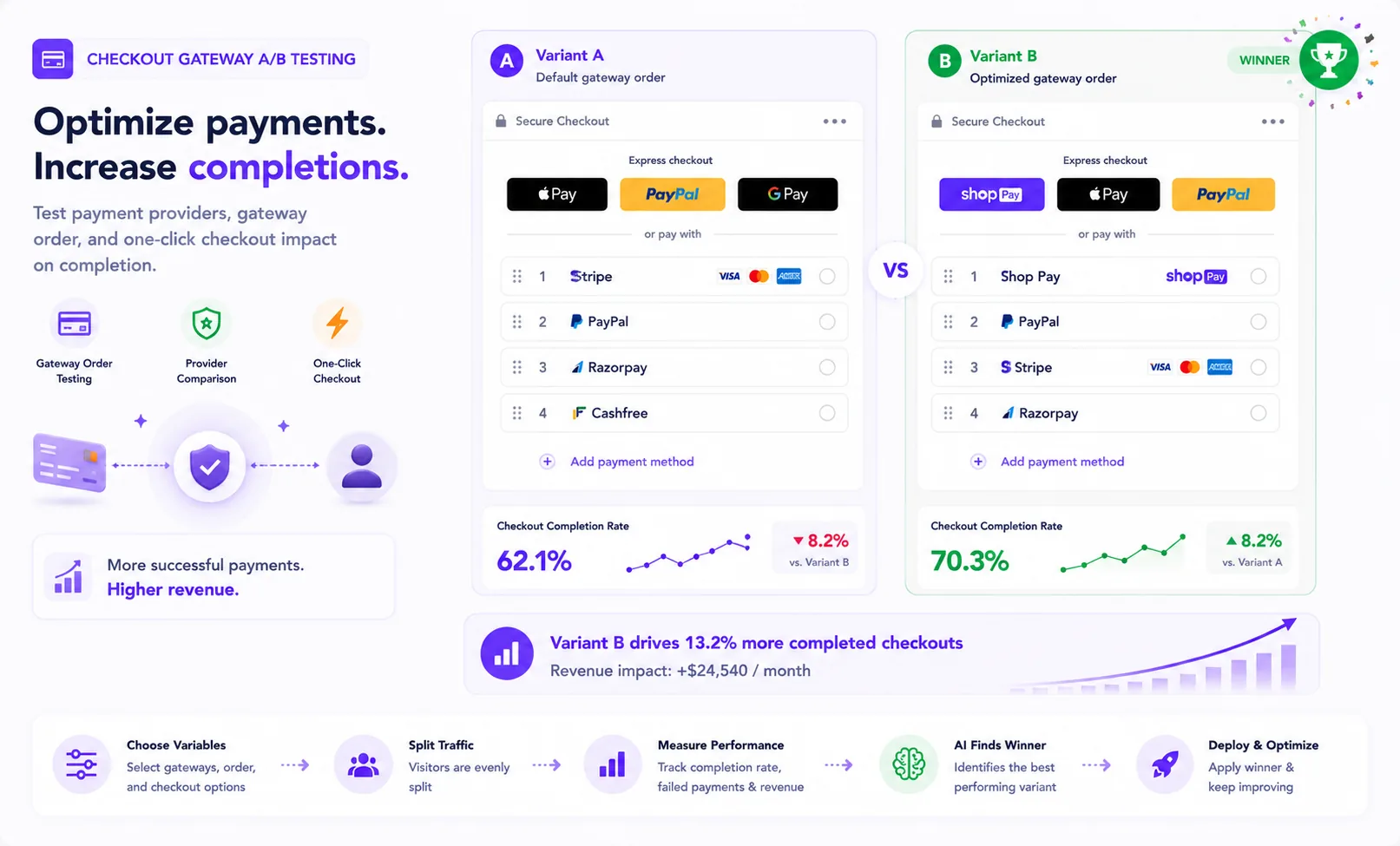
The payment step is where hard-won carts quietly die. CustomFit lets you A/B payment providers, the order methods appear in, and one-click checkout — measured on checkout completion and revenue per visitor — so you find the setup that turns intent into orders.

Compare payment gateways and which methods — cards, UPI, wallets, BNPL — appear, and in what order, at checkout.
Measure exactly how much express and one-click checkout lift completion versus a standard flow.
Every variant is measured on checkout completion and revenue per visitor — the metrics that decide whether a cart becomes an order.
A shopper who’s added to cart and reached checkout has shown maximum intent — yet a missing wallet, a slow gateway, or methods in the wrong order sheds a meaningful share of them right at the finish line. Testing the payment setup recovers orders you’ve already paid to acquire.
Checkout is the most sensitive surface on your store, so tests must be safe. CustomFit assigns each visitor a stable payment setup, never mixes flows mid-session, and lets you revert instantly — so you can optimize the pay step with confidence, not risk.
Putting UPI and wallets ahead of cards, with one-click on, lifted checkout completion 11 points. That's pure recovered revenue from carts we'd already won.
From a payment question to a completion-tested answer — safely.
Choose the providers, method order, and one-click options to compare.
Each visitor gets a stable setup; flows never mix mid-session.
We report checkout completion and revenue per visitor for each setup.
Roll out the best-converting payment setup — revert anytime.
Checkout gateway A/B testing compares payment configurations — which gateway or providers you use, the order payment methods appear in, and whether one-click/express checkout is on — on live traffic. Because the payment step is where high-intent carts are most likely to drop, each variant is measured on checkout completion and revenue per visitor, with safeguards that keep the sensitive checkout flow stable.
Carts that reach checkout are the most valuable to lose — small wins here are pure recovered revenue.
Surfacing the right express methods removes the typing that kills mobile completion.
Sticky assignment and instant revert let you test the most sensitive surface safely.
Recover revenue at the leakiest step in the funnel.
Validate gateway and provider changes with real completion data.
Compare providers on completion and cost, not assumptions.
Checkout gateway A/B testing compares payment configurations on live traffic — which gateway or set of providers you run, the order payment methods are presented in, and whether express or one-click checkout is enabled. It targets the single leakiest, highest-intent step in the funnel: the moment a ready-to-buy shopper has to actually pay.
Small changes here are unusually valuable because the traffic is so qualified. A shopper at checkout has already chosen a product and committed to buying — so a missing wallet, a slow or unfamiliar gateway, or methods in the wrong order can shed a meaningful share of orders you’ve already paid to acquire. Surfacing the right express methods, in the right order, recovers that revenue directly.
Because checkout is the most sensitive surface on a store, CustomFit runs these tests with strict safeguards: each visitor is assigned a stable payment setup that never changes mid-session, every variant is measured on checkout completion and revenue per visitor, and you can revert instantly if completion dips. That lets you optimize the pay step with the same rigor as any other experiment — without ever putting the checkout at risk.
Which payment gateway or providers you use, the order methods appear in (cards, UPI, wallets, BNPL), and whether express/one-click checkout is enabled.
CustomFit assigns each visitor a stable payment setup that never changes mid-session and lets you revert instantly, so you optimize the pay step without breaking it.
Checkout completion rate and revenue per visitor — the metrics that determine whether a high-intent cart actually becomes a paid order.
It varies by audience, but express and one-click flows typically lift completion meaningfully on mobile by removing manual data entry. The test measures the exact impact for your store.
No. Marketers configure checkout tests in a no-code editor; developers can use the API and SDKs when they want deeper control.
Test your checkout setup on completion this week — safe, reversible, free to start.