From the conversion glossary
Concepts referenced in this article, defined.
Concepts referenced in this article, defined.
Run rigorous A/B tests and personalize every visit on Shopify or any storefront — no engineers required.
AI-powered A/B testing uses machine learning to allocate traffic dynamically across variants, declare winners faster, and personalize experiences simultaneously — all without the weeks-long wait of classical split testing. For D2C ecommerce brands, this means your winning headline or CTA can start capturing revenue within days, not months. The core difference from traditional testing is that the algorithm learns as it goes, so you stop showing losing variants to most visitors the moment the data becomes meaningful.
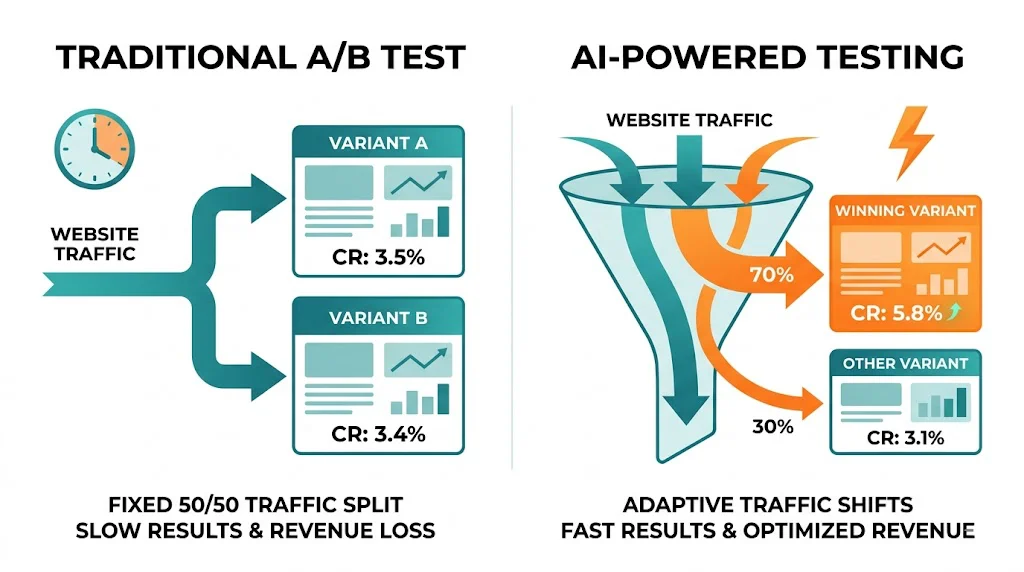
Classical A/B testing was designed for academic research, not revenue optimization. You split traffic 50/50, wait for a predetermined sample size, then declare a winner. The process is clean and statistically sound — but it has three costly problems for ecommerce:
1. You burn traffic on losers. If Variant B is clearly underperforming after day three, classical testing still sends half your visitors there until the experiment ends. Those are real sales you're missing.
2. It treats all visitors as the same. A single winning variant may convert well for mobile visitors from Instagram but poorly for desktop visitors from Google. A static A/B test averages across everyone, hiding these differences.
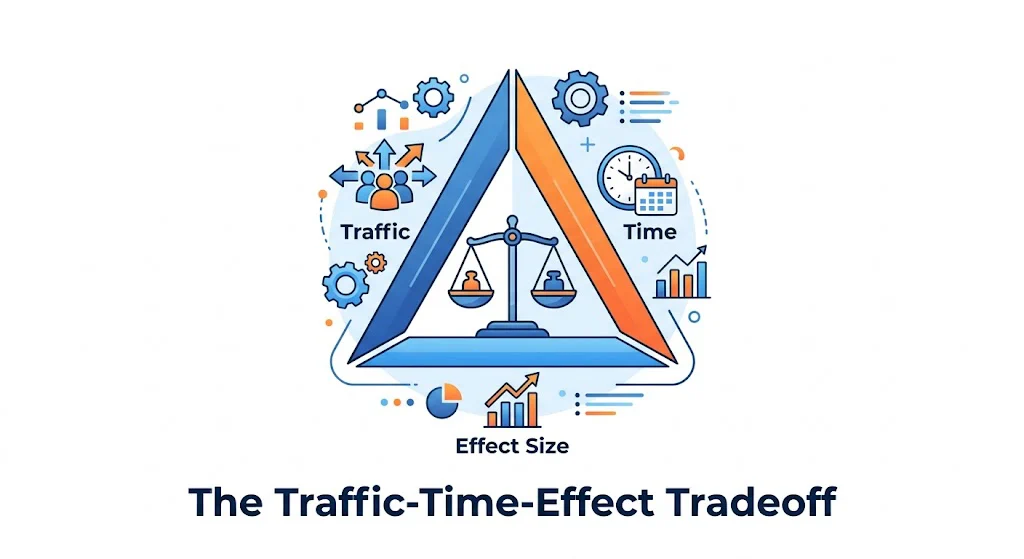
3. Slow results mean slow decisions. A store doing 3,000 sessions per month might need 6–8 weeks to reach statistical significance on a test. Most teams can't sustain that patience, so they call tests early — which produces false positives.
These gaps are where AI steps in.
AI-powered testing (also called multi-armed bandit testing or Bayesian A/B testing) replaces fixed traffic splits with adaptive algorithms. Here's the flow:
Instead of assuming both variants are equally likely to win, the AI starts with a prior belief based on historical data — your site's typical conversion rate, traffic patterns, device mix, and time-of-day behavior.
As the experiment runs, the algorithm continuously updates the probability that each variant is the true winner. Traffic shifts toward the winning variant automatically. If Variant A shows a 9% CVR and Variant B shows 7% after 500 sessions, the algorithm starts sending 70% of traffic to A — not 50%.
Every new session updates the statistical model. This is fundamentally different from classical testing, where you collect all data first, then analyze. Bayesian updating means the system is always learning and always improving allocation.
Advanced AI testing systems can go further and assign variants based on visitor segments — device type, traffic source, geo, behavior. A visitor from a Meta ad on mobile might see Variant A; a direct visitor on desktop sees Variant B. This is where AI testing edges into personalization.
Rather than waiting for a p-value below 0.05, AI systems use credible intervals — "there is a 95% probability that Variant A lifts CVR by 5–12%." This is often more useful for business decisions than binary statistical significance.
Skincare brands (like mCaffeine, Plum): Hero section copy variants — "Dermatologist-approved" vs. "Loved by 2M customers." The AI quickly discovers that first-time visitors convert better with social proof, while returning visitors respond to ingredient claims. A static A/B test would average these signals away.
Supplements (like Kapiva): CTA button tests — "Start Free Trial" vs. "Get My Pack" vs. "Shop Now." AI testing identified that "Start Free Trial" worked for subscription visitors while "Shop Now" outperformed for one-time buyers. Kapiva saw a 9.48% CVR lift with targeted messaging.
Fashion (like Sugar Cosmetics): Festive banner timing — showing Diwali-specific imagery only to visitors from Tier 1 cities who had browsed gifting categories. The AI identified the high-converting segment automatically.
Electronics (like Boat): Product image sequencing — lifestyle image first vs. specs-forward. The AI shifted to the lifestyle variant 3x faster than a traditional test would have.
Don't test for its own sake. Start with: "Changing X will increase Y because Z." Example: "Adding a 'Free shipping over ₹499' banner in the product page hero will increase add-to-cart rate because price anxiety is the primary drop-off signal from our funnel analysis."
| Scenario | Test Type |
|---|---|
| High-traffic pages (5k+ visits/month) | Bayesian A/B or multi-armed bandit |
| Low-traffic pages | Focus on fewer, higher-impact changes |
| Multiple variants (3+) | Multi-armed bandit |
| Segment-specific personalization | AI-powered personalization layer |
With a no-code tool like CustomFit.ai, the process is:
The whole setup takes under 30 minutes without developer involvement.
The most common mistake with AI testing is stopping experiments too early because you "see" a trend. Let the algorithm reach its credible interval threshold. Check results weekly, not daily.
For D2C ecommerce, tie every test to:
See the revenue per visitor and average order value glossary entries for calculation details.
Run one primary metric per test. Tracking 10 metrics simultaneously creates false discoveries. Pick one and treat the rest as secondary signals.
Don't test during unusual weeks. Sales events, festive periods (Diwali, Big Billion Days), or new ad campaigns pollute your results. Either include these periods intentionally or pause tests.
Segment your results after the fact. Even if you run a flat A/B test, slice results by device, traffic source, and new vs. returning. Often the overall winner is losing with a key segment.
Run tests long enough to capture weekly cycles. Consumer behavior on Monday is different from Saturday. Run every test for at least 7 days, even if the AI reaches significance sooner.
Build a test backlog, not a wishlist. Prioritize tests by: estimated impact × confidence ÷ effort. Use funnel analysis data to identify the highest-drop-off step first.
For a deeper dive into the broader experimentation strategy, see our A/B Testing Pillar and AI in Ecommerce guide.