From the conversion glossary
Concepts referenced in this article, defined.
Predictive segmentation uses machine learning to identify which visitors are likely to buy — before they reach the cart. Learn how to use buyer intent signals to personalize at scale.
Concepts referenced in this article, defined.
Run rigorous A/B tests and personalize every visit on Shopify or any storefront — no engineers required.
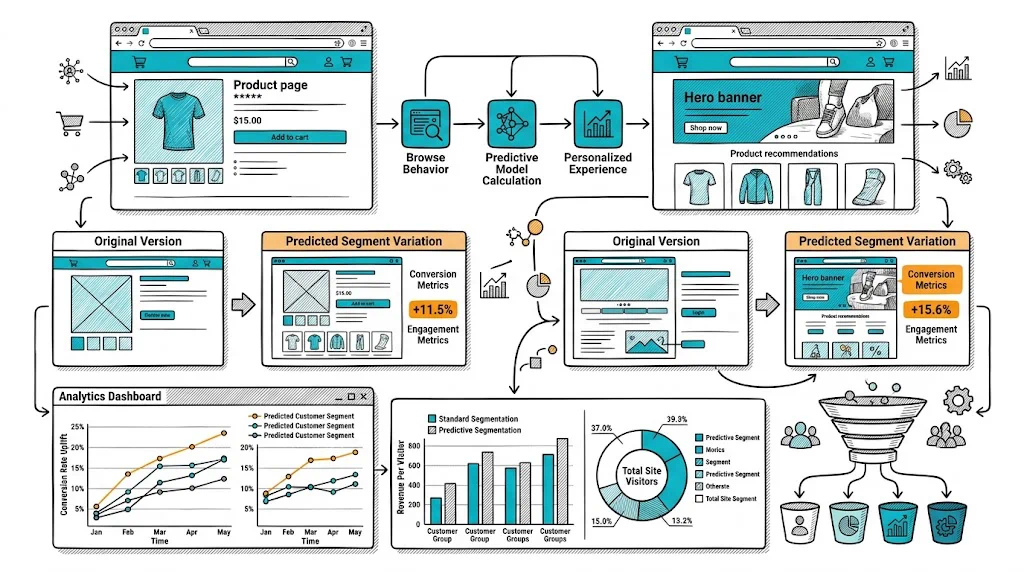
Predictive segmentation uses machine learning to identify which visitors are likely to buy — and which are just browsing — before they show obvious purchase signals like adding to cart. It lets you allocate your personalization effort where it will have the most impact and deliver the right experience at the right moment.
Traditional audience segmentation is backward-looking. You define rules based on what you know:
These rules are valid but limited. They tell you about broad patterns, not about individual visitor intent. A first-time visitor from organic search who has spent 7 minutes on product pages reading reviews is showing stronger purchase intent than a returning visitor who checked your homepage and bounced in 30 seconds.
Predictive segmentation captures this individual signal complexity.
Every visitor interaction generates signals: pages visited, time spent, scroll depth, clicks, searches, button interactions, and device/session metadata. CustomFit.ai's tracking pixel collects these signals without requiring a login or cookie.
The predictive model learns which combinations of signals correlated with conversion in your historical data. This is not simple correlation — it's learning complex, non-linear patterns: "Visitors who read more than 5 product reviews AND scrolled past the size chart AND visited during a Tuesday evening convert at 3.8% — compared to the baseline 2.1%."
For every active session, the model scores the visitor's current likelihood of converting. This score updates dynamically as the visitor's behavior evolves — every page view, every click refines the prediction.
Based on the score, visitors are assigned to a predicted segment:
Signals: 3+ product pages, viewed reviews section, viewed size/variant selector, session > 5 minutes, not first visit
Personalization: Move the CTA above the fold, add urgency signal ("Low stock"), highlight money-back guarantee, offer chat support.
Why it works: This visitor is close to buying. They don't need more product information — they need confidence and a clear path to purchase.
Signals: Visited sale/discount section, applied coupon in previous session, added to cart and removed, cart value below average, price comparison behavior (quick session, multiple product page visits)
Personalization: Show free shipping threshold, surface loyalty points or BNPL options, proactively offer a welcome discount for first-time buyers.
Why it works: Price sensitivity is a known barrier. Addressing it proactively is more effective than waiting for the visitor to abandon.
Signals: Long time on site, reading blog content, visiting FAQ and about pages, but zero cart activity
Personalization: Content-led CTAs ("Download our guide", "See how brands like yours use CustomFit.ai"), email capture offer, no aggressive purchase prompts.
Why it works: Pushing a purchase CTA on a research-phase visitor increases bounce rate. Matching the experience to the visitor's stage in the buying journey builds trust for the eventual conversion.
Signals: Previous purchaser, hasn't visited in 60+ days, on-site for less than 2 minutes, no cart activity
Personalization: Highlight new arrivals in their previously purchased category, surface a loyalty reward if available, show a "We've missed you" reactivation offer.
Why it works: Reactivating a lapsed customer has 5-7x higher ROI than acquiring a new one.
These terms are often used interchangeably but have a nuance:
CustomFit.ai implements both: intent scoring for real-time personalization decisions, and predictive segments for campaign and audience building.
What you need:
What you don't need:
CustomFit.ai's AI starts collecting signals from day one and begins making predictions as data accumulates.
Continue reading:
Add predictive segmentation to your personalization stack — start your free trial of CustomFit.ai.