CustomFit.ai โ€” Website personalization, A/B testing and CRO for Shopify and D2C
Product
Features
โœฑ
Website Personalization
Adapt to each visitor's behavior & intent
โง–
A/B & Multivariate Testing
Rigorous experimentation
โœจ
AI CopilotNEW
Personalize with a prompt
๐Ÿค–
AI WingmanNEW
Auto-optimize toward winners
๐ŸŽฏ
AI Conversion OptimizerNEW
GPT-grade test ideas
โœŽ
No-Code Visual Editor
Drag-and-drop edit any element
โ–ฆ
Product Recommendations
Personalized recs that lift AOV
โš‘
Feature Flags
Ship safely with kill-switches
โ—ง
Chrome Extension
Edit your store in the browser
โง‰
Shopify, WooCommerce & more
All platform integrations
View all features โ†’
Use Cases
$
Price A/B Testing
Test price points to maximize revenue
โ–ฆ
Theme A/B Testing
Compare whole layouts & designs
๐Ÿ—‚
Template A/B Testing
Test whole PDP/PLP templates
๐Ÿท
Discount A/B Testing
Find the offer that converts
๐Ÿšš
Shipping A/B Testing
Thresholds, speed & copy
โœ
Content A/B Testing
Copy, images & reviews
๐Ÿ’ณ
Checkout Gateway A/B
Payments & one-click
โŒ–
Geo-Based Personalization
Per-location content & offers
โšก
Buyer-Intent Nudges
Exit-intent & retargeting
โ†”
Split-URL / Redirection
Full-page redirect tests
View all use cases โ†’
Solutions & Guides
โคข
Conversion Rate Optimization
The complete CRO guide
โง–
A/B Testing Software
Buyer's guide for D2C
๐Ÿ›’
Cart Abandonment Recovery
Win back lost carts
๐Ÿ“ฐ
Landing Page Optimization
Convert more paid traffic
S
Shopify A/B Testing
Test your store, no code
S
Shopify Personalization
Tailor the store per shopper
โ—”
First-Time Visitor Offers
Convert new shoppers with trust & offers
โ˜…
Repeat-Customer Experiences
Reward and re-engage loyal buyers
โ—Ž
Campaign-Matched Pages
Match the landing page to the ad
โŒ–
Location-Based Experiences
Currency, language & regional offers
Explore CRO โ†’
Customer stories
GIVA
+32%
conversion via personalized recs
GIVA
Mamaearth
+18%
revenue lift from PDP A/B tests
ME
The Sleep Company
+24%
AOV from product recommendations
TSC
Read customer stories โ†’
Integrations
SWsfGA+15
โœฆ
Not sure where to start?
Let AI Copilot pick your first tests

โ€œWe wake up to evidence-backed tests ready to deploy โ€” not a backlog of maybe ideas.โ€

AN
Anirudh S.
Growth ยท Chargebee
โ˜…โ˜…โ˜…โ˜…โ˜…4.8on G2 ยท 2,400+ brands
Talk to our team โ†’
Widgets
Integrations
Ecommerce & Checkout
Shopify
Shopline
Shoplazza
GoKwik
ShopFlo
Razorpay Magic Checkout
Breeze
Shiprocket
View all integrations โ†’
Analytics & Behavior
Google Analytics 4
Microsoft Clarity
Hotjar
Mixpanel
Amplitude
Heap
Adobe Analytics
Segment (CDP)
View all integrations โ†’
Engagement, CRM & More
Klaviyo
MoEngage
CleverTap
WebEngage
HubSpot
Salesforce
Slack
Meta Ads
View all integrations โ†’
CustomersPricing
Resources
CRO
โ–ค
Playbooks
Proven strategies to boost conversions
๐ŸŽ™
Interviews
D2C leaders & marketing experts
โ–ถ
Webinars
Live deep dives & product sessions
Learn
โœŽ
Blog
Tips, experiments & best practices
๐Ÿ“•
Free E-Books
Mastering personalization
๐Ÿ“–
Conversion Glossary
Every CRO term, defined
โœฆAI CopilotNEWLog inBook a demo
Start free trial
Select your platform โ€” Install in 2 minsWe'll tailor the setup
โšก Risk-free 14-day trial ยท No credit card ยท Cancel anytime
S
Shopify
Install from Shopify App Store
โ€บ
W
WooCommerce
Install the WooCommerce plugin
โ€บ
B
BigCommerce
Install from BigCommerce App Marketplace
โ€บ
SL
Shopline
Install from Shopline App Store
โ€บ
M
Salesforce / Magento
Install from the marketplace
โ€บ
SZ
Shoplazza
Install from Shoplazza App Store
โ€บ
WP
WordPress / Webflow
Install plugin or paste the script
โ€บ
โ—ง
Others
Custom-built on React, Next.js, etc.
โ€บ
Tip: pick your platform โ€” we handle the restBook a demo โ†’
Product
Website PersonalizationA/B & Multivariate TestingAI CopilotAI WingmanAI Conversion OptimizerNo-Code Visual EditorProduct RecommendationsFeature FlagsView all features โ†’
Use Cases
Price A/B TestingTheme A/B TestingTemplate A/B TestingDiscount A/B TestingShipping A/B TestingContent A/B TestingCheckout Gateway A/BGeo-Based PersonalizationBuyer-Intent NudgesSplit-URL / Redirection
Solutions & Guides
Conversion Rate OptimizationA/B Testing SoftwareCart Abandonment RecoveryLanding Page OptimizationShopify A/B TestingShopify Personalization
Explore
WidgetsIntegrationsCustomersPricing
Resources
BlogPlaybooksWebinarsInterviewsE-BooksConversion Glossary
Platforms
ShopifyShoplineShoplazzaChrome ExtensionAll integrations
Start free trialBook a demo
Homeโ€บBlogโ€บanalyticsโ€บRFM Segmentation for D2C Brands

RFM Segmentation for D2C Brands

SKSharan KumarCo-Founder & CTO, CustomFit.aiJanuary 15, 20259 min read
On this page
  1. What Is RFM Segmentation?
  2. Calculating RFM Scores
  3. The RFM Segments Every D2C Brand Should Track
  4. Campaign Strategies by RFM Segment
  5. Champions (R5, F5, M5)
  6. At Risk (R2-3, F2-4, M2-5)
  7. Can't Lose Them (R1-2, F4-5, M4-5)
  8. Potential Loyalists (R4-5, F1-2, M1-3)
  9. Setting Up RFM Segmentation Without a Data Team
  10. RFM in the Context of Indian D2C
  11. Key Metrics to Track
  12. Tips and Best Practices
  13. Key Takeaways
0%
RFM Segmentation for D2C Brands

From the conversion glossary

Concepts referenced in this article, defined.

Definition
What Is Segmentation? Definition & Guide
Definition
What Is Subscription? Definition & Guide
Definition
What Is Winner? Definition, Formula & Guide
โ† Back to Analytics guide
Try CustomFit.ai

Run A/B tests and personalize your store without code. 14-day free trial, no credit card.

Start free trial โ†’
Share
XLinkedInEmail

Related articles

analytics

Tracking Setup for A/B Testing: Events & Goals

Sharan Kumarยท 8 min read
analytics

Google Analytics 4 for Ecommerce: Setup Guide

Sharan Kumarยท 10 min read
analytics

Ecommerce Dashboard: KPIs to Track Daily

Sharan Kumarยท 8 min read

Start lifting conversions today.

Run rigorous A/B tests and personalize every visit on Shopify or any storefront โ€” no engineers required.

Start free trialBook a demo

Built for every D2C category

๐Ÿงด
Skincare
๐Ÿ’„
Beauty
๐ŸŒฟ
Wellness
โ˜•
F&B
๐Ÿ‘Ÿ
Apparel
๐Ÿ’
Jewelry
๐Ÿ›‹๏ธ
Home
๐Ÿผ
Baby
Live ยท Right now
Mamaearth โ€” free-shipping band +12.4% AOVGIVA โ€” festive collection page +34% revenueBellavita โ€” PDP CTA test +27.4% CVRKapiva โ€” Quiz-driven recs +9.48% CTRThe Sleep Co โ€” landing personalized 2ร— capturesPlum โ€” Returning shopper swap +18.2% CVRMamaearth โ€” free-shipping band +12.4% AOVGIVA โ€” festive collection page +34% revenueBellavita โ€” PDP CTA test +27.4% CVRKapiva โ€” Quiz-driven recs +9.48% CTRThe Sleep Co โ€” landing personalized 2ร— capturesPlum โ€” Returning shopper swap +18.2% CVR
Get in touch

Tell us about your store.

We reply within an hour during business hours. No sales pitch, no spam โ€” just answers from someone who's seen 2,400+ D2C stores.

โœ“ Reply within 1 hourโœ“ No spam, everโœ“ Free demo & setup help
โœ“ Thanks! We'll be in touch shortly.
CustomFit.ai

The all-in-one website personalization, A/B testing & CRO platform for high-growth D2C brands. Made by marketers, fueled by coffee.

in๐•โ—Žโ–ถf
Product
  • Features
  • A/B Testing
  • Personalization
  • AI Copilot
  • AI Wingman
  • AI Conversion Optimizer
  • Feature Flags
  • Widgets
  • Integrations
  • ROI Calculator
Platforms
  • Shopify
  • Shopline
  • Shoplazza
  • Salesforce
  • Chrome Extension
  • All Integrations
Resources
  • Blog
  • Playbooks
  • Webinars
  • GrowthFit Interviews
  • Free E-Books
  • Conversion Glossary
  • Case Studies
Compare
  • vs VWO
  • vs Optimizely
  • vs Google Optimize
  • vs Mutiny
  • vs Intelligems
  • vs Shoplift
  • vs AB Tasty
  • vs Convert
  • vs Kameleoon
Company
  • About Us
  • Partners
  • CustomFit Awards
  • Recognition
  • Contact
  • Privacy Policy
  • Terms & Conditions
ยฉ 2026 CustomFit.ai ยท Valley Monks Pvt Ltd ยท Made by marketers, fueled by coffee, and obsessed with conversions.
SOC 2 Type II ยท GDPR ยท CCPA ยท ISO 27001

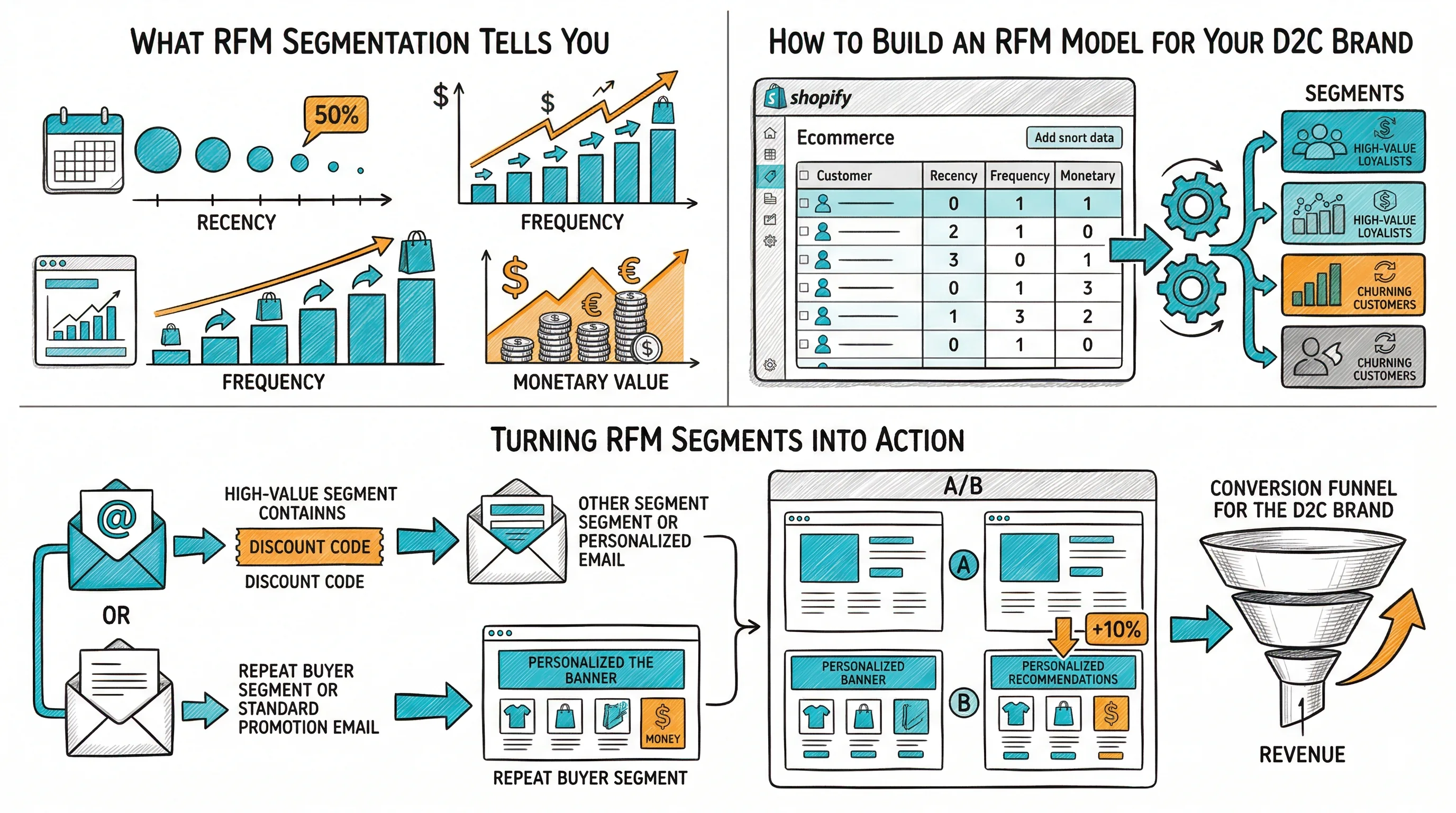
Most D2C brands treat their customer list as one audience. They send the same email to their best customer of 3 years and to someone who bought once during a Diwali sale. The result: best customers feel ignored, lapsed customers never come back, and promising new buyers get the same generic follow-up as everyone else. RFM segmentation fixes this. It's a straightforward, high-impact framework that lets D2C brands identify exactly who each customer is and treat them accordingly. This guide covers how RFM works, how to build it, and how to turn segments into revenue.

What Is RFM Segmentation?

RFM is a customer segmentation framework built on three behavioral dimensions:

Recency (R): How recently did the customer last purchase? A buyer who ordered 10 days ago is more likely to buy again than one who ordered 10 months ago.

Frequency (F): How many times has the customer purchased in a given period? A customer who has bought 8 times is more valuable and more loyal than one who has bought twice.

Monetary (M): How much has the customer spent in total or on average? High-spend customers have different needs and preferences than low-spend buyers.

Each customer gets a score on each dimension (typically 1โ€“5, with 5 being best). A customer who scores 5-5-5 is your ideal customer: bought very recently, buys frequently, and spends the most. A customer who scores 1-1-1 is dormant and low-value.

The power of RFM is that you can cluster similar scores into segments and run targeted campaigns for each segment โ€” instead of blasting your entire list with the same message.

Calculating RFM Scores

Step 1: Pull your order data

Export from your ecommerce platform (Shopify, WooCommerce, etc.) or CRM:

  • Customer ID / email
  • Order date for each purchase
  • Order value for each purchase

Define your analysis window โ€” typically the last 12โ€“24 months for D2C brands with monthly replenishment cycles.

Step 2: Calculate Recency

Recency = days since the customer's most recent order.

Rank customers by recency and divide into 5 equal groups (quintiles):

  • Score 5: most recent 20% of buyers
  • Score 4: next 20%
  • ...
  • Score 1: least recent 20% (longest since last purchase)

Step 3: Calculate Frequency

Frequency = total number of orders in the analysis window.

Rank and divide into 5 quintiles the same way. A customer who has ordered 12 times in 12 months scores 5; a customer who ordered once scores 1 or 2.

Step 4: Calculate Monetary

Monetary = total spend in the analysis window.

Rank and divide into 5 quintiles. Your top 20% spenders score 5.

Step 5: Combine into a score

Each customer now has an RFM score: R(1โ€“5), F(1โ€“5), M(1โ€“5). Combine as a 3-digit score (e.g., 5-4-3) or as a weighted sum if you want a single number.

The RFM Segments Every D2C Brand Should Track

SegmentRFM ProfileDescription
ChampionsR5, F5, M5Bought recently, buy often, highest spend
Loyal CustomersR4-5, F3-5, M3-5Regular buyers with solid spend
Potential LoyalistsR4-5, F1-2, M1-3Recent buyers who could become loyal
New CustomersR5, F1, any MFirst-time buyers โ€” need nurturing
PromisingR3-4, F2-3, M1-3Moderate recency and frequency, not yet VIP
Need AttentionR3, F2-3, M2-3Above average, but starting to slip
At RiskR2-3, F2-4, M2-5Were good customers; drifting away
Can't Lose ThemR1-2, F4-5, M4-5Were your best customers; now dormant
HibernatingR1-2, F1-2, M1-3Low activity across all dimensions
LostR1, F1, M1Bought once, long ago, never returned

For most D2C brands, the three highest-priority segments to act on immediately are: Champions (protect and reward), At Risk (re-engage before they're lost), and Potential Loyalists (nurture to Loyal status).

Campaign Strategies by RFM Segment

Champions (R5, F5, M5)

These are your most valuable customers. Treat them like VIPs:

  • Early access: First notification of new product launches, 24โ€“48 hours before general audience
  • Exclusive bundles: Products available only to Champions (a loyalty gate)
  • Referral amplification: Your Champions have the highest brand advocacy potential; give them a referral tool with a generous reward (โ‚น500 credit for every friend who orders)
  • Feedback loop: Ask for product feedback, involve them in naming decisions or new product development. They'll feel valued and stay.

What NOT to do: Send them the same discount email you send everyone else. Champions don't need discounts โ€” they need to feel seen.

At Risk (R2-3, F2-4, M2-5)

These were good customers who are starting to drift. You have a window to win them back:

  • Win-back email sequence: "We miss you" email 60 days after last purchase, "Here's what's new" at 90 days, a meaningful incentive at 120 days (โ‚น200 credit or free shipping)
  • Personalized product recommendation: Based on their purchase history, show them the next logical product in their journey
  • Survey: "What's changed?" โ€” a brief survey asking why they haven't bought recently gives you data and sometimes prompts a purchase

For D2C brands with RFM data, the At Risk win-back sequence is often the highest-ROI campaign they can run. You're spending retention budget on people who've already proven they'll buy.

Can't Lose Them (R1-2, F4-5, M4-5)

These were your best customers โ€” high frequency, high spend โ€” but they haven't bought recently. This is a fire-alarm situation:

  • Direct outreach: For your top 50โ€“100 "Can't Lose Them" customers, a personal email from the founder or brand head acknowledging their loyalty and asking what happened converts better than any automated sequence
  • Special comeback offer: A meaningful incentive (significant discount, free product, loyalty credit) specifically for this segment, framed as "We made something just for you"
  • Phone call (for high-LTV customers): D2C brands with subscription products and high LTV customers have found success with direct phone or WhatsApp outreach to their top dormant customers

Potential Loyalists (R4-5, F1-2, M1-3)

Recent buyers who haven't yet developed a habit:

  • Second purchase incentive: A post-purchase email at day 14 with "Complete your kit" or "Try this next" offer and a small discount
  • Education sequence: Help them get maximum value from their first purchase โ€” usage tips, how-to content, complementary product information
  • Community invitation: Invite them into your WhatsApp group or loyalty program. Buyers who join a community have significantly higher repeat purchase rates

Setting Up RFM Segmentation Without a Data Team

You don't need a data science team to run RFM. Here's how to do it at a D2C scale:

Using Shopify: Export orders to a CSV โ†’ use Google Sheets or Excel with COUNTIFS and SUMIFS formulas to calculate F and M โ†’ calculate R using date difference formulas โ†’ use PERCENTRANK to assign scores 1โ€“5.

Using Klaviyo or similar email tools: Most modern email marketing platforms (Klaviyo, MoEngage, WebEngage) have built-in segmentation that approximates RFM โ€” use their "purchase date," "order count," and "total spend" segment conditions without building the full RFM model manually.

Using a dedicated analytics tool: Tools like Putler, Metorik, or Glew build RFM dashboards automatically from your Shopify/WooCommerce data.

Once you have the segments, you can feed them into CustomFit.ai for on-site personalization โ€” Champions see a loyalty program CTA on the homepage, At Risk customers see a win-back offer, New Customers see the "Getting started" guide.

RFM in the Context of Indian D2C

Festive season volatility: Diwali and other major festive sales create a spike in one-time buyers who score high on Monetary but may never return. Separate your festive-acquisition cohort from your organic RFM segments for at least 60 days โ€” their behavior patterns are different.

COD order quality: COD orders in India have higher return and non-delivery rates. Consider excluding COD orders that resulted in returns from your Monetary score calculation, or creating a separate "confirmed purchase" Monetary metric.

Repeat purchase cycle by category: Adjust your Recency scoring based on the natural replenishment cycle of your product. A skincare brand where products run out in 45 days has a very different recency threshold than a home decor brand where repurchase is opportunistic. Your "At Risk" threshold should be calibrated to "one cycle beyond expected repurchase" โ€” not a fixed number of days.

Key Metrics to Track

After implementing RFM-based campaigns, track:

  • Segment size over time: Is your Champions segment growing or shrinking? Is At Risk segment growing (a warning sign)?
  • Win-back rate: What percentage of At Risk customers make a purchase within 30/60/90 days of receiving a win-back campaign?
  • Segment upgrade rate: How many Potential Loyalists become Loyal Customers in 60 days?
  • Revenue concentration: What percentage of revenue comes from Champions? (Healthy D2C brands have 25โ€“35% of revenue from Champions)

Tips and Best Practices

  • Update segments monthly โ€” customer behavior changes; stale segments lead to wrong messages at wrong times
  • Don't over-discount to Champions โ€” you'll train your best customers to wait for discounts; reward them with access and exclusivity instead
  • A/B test win-back incentive types โ€” for At Risk customers, test percentage discount vs. free shipping vs. free gift; the winner varies by category
  • Connect RFM to on-site personalization โ€” Champions who land on your homepage should see VIP messaging, not the same hero as a first-time visitor
  • Monitor cohort-level LTV, not just RFM โ€” a growing cohort with improving RFM scores tells you your retention is working; flat or declining cohort LTV tells you the opposite

Key Takeaways

  1. RFM (Recency, Frequency, Monetary) is the most actionable customer segmentation framework for D2C brands โ€” it tells you exactly which customers need which treatment
  2. Champions need VIP access and recognition, not discounts; At Risk customers need timely, personalized win-back sequences
  3. The "Can't Lose Them" segment (high F and M, low R) deserves direct, personal outreach โ€” these were your best customers and can often be recovered
  4. You don't need a data team: Klaviyo/MoEngage segment conditions or a Google Sheets export from Shopify are enough to build basic RFM
  5. In Indian D2C, calibrate Recency thresholds to your product's replenishment cycle โ€” not a fixed number of days
  6. Feed RFM segments into on-site personalization to ensure your website reflects each customer's relationship with your brand

Related reading: Analytics & Data Pillar | D2C Brand Growth Pillar | Customer Lifetime Value | Customer Acquisition Cost