From the conversion glossary
Concepts referenced in this article, defined.
Concepts referenced in this article, defined.
Run rigorous A/B tests and personalize every visit on Shopify or any storefront — no engineers required.
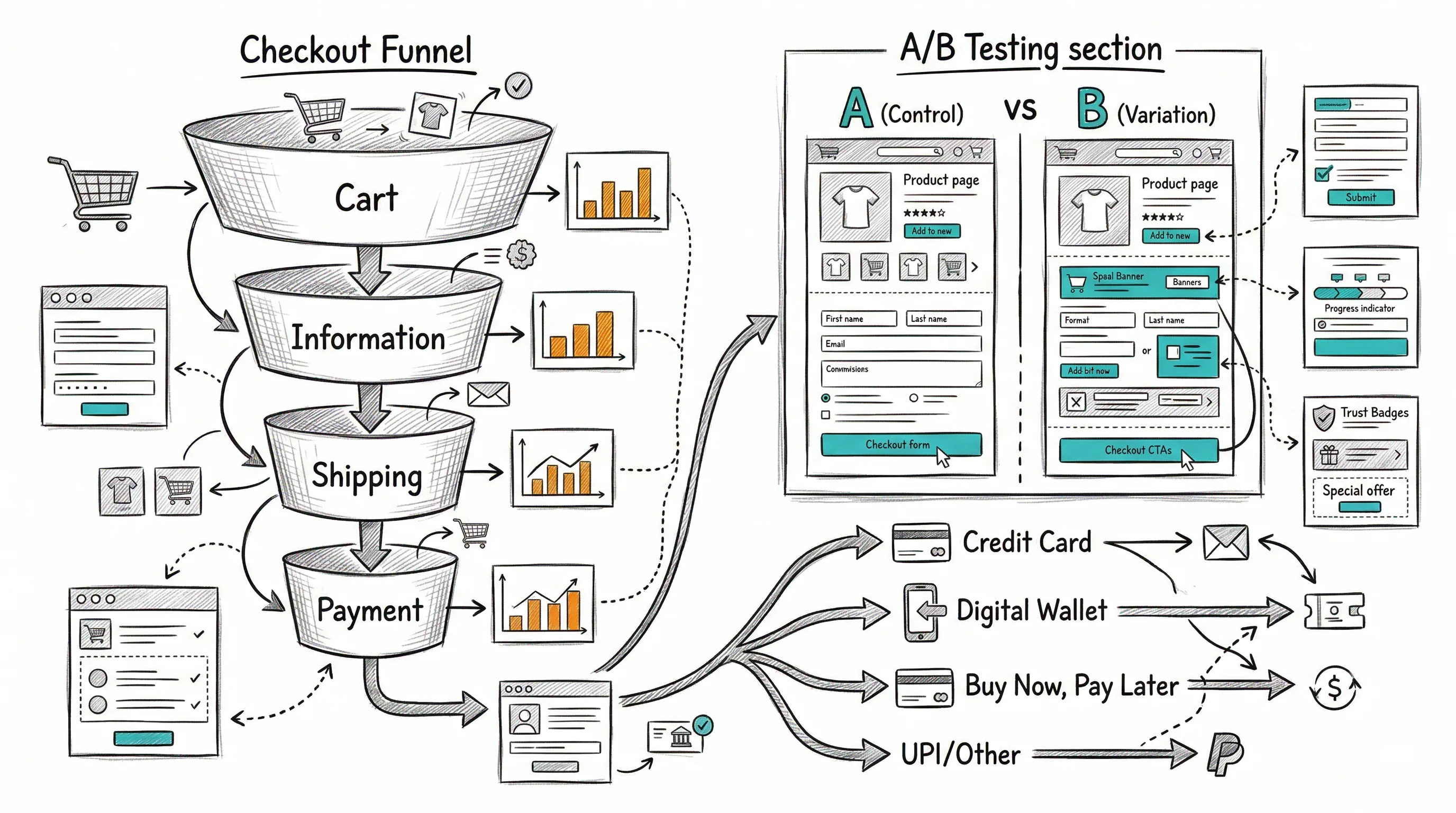
Checkout optimization is the process of removing friction, building trust, and reducing drop-off in the final steps of your purchase funnel — from cart to order confirmation. With average cart abandonment rates above 70%, checkout is the highest-leverage optimization opportunity in ecommerce. A 5-percentage-point improvement in checkout completion rate can generate the same revenue impact as a 50% increase in paid ad spend.
Checkout optimization covers every intervention — design, copy, UX, trust, payment — that increases the percentage of shoppers who complete a purchase once they have entered your checkout flow. This includes:
The metric that governs this entire process is checkout completion rate (also called checkout conversion rate): the percentage of sessions that initiated checkout and completed a purchase.
What checkout optimization covers:
The checkout stage is where your entire acquisition investment — ad spend, content, influencer partnerships — either converts into revenue or disappears. A visitor who reaches checkout has already demonstrated high intent. Losing them at this stage is one of the most expensive failures in ecommerce.
The revenue math: Consider a brand with 1,000 monthly checkout initiations and a 25% checkout completion rate (= 250 orders). Improving checkout completion to 30% generates 300 orders — 50 more orders at zero additional acquisition cost. At ₹800 AOV, that is ₹40,000 in additional monthly revenue without spending another rupee on advertising.
India-specific checkout challenges:
COD dominance. Cash on delivery accounts for 40–60% of D2C orders in India, particularly in Tier 2/3 cities and for first-time customers. A checkout that buries the COD option or makes it hard to find loses a substantial share of potential orders.
UPI ubiquity. UPI is the preferred digital payment method for a large and growing share of Indian shoppers. Checkouts that prominently feature UPI logos and link-based payment see higher completion rates among digitally native shoppers.
Mobile address entry friction. Over 78% of Indian D2C traffic is mobile. Address entry — particularly pincode lookup and state dropdown — is a high-friction step on mobile that causes measurable abandonment. Auto-fill and pin-code-based address completion are no longer optional.
Trust deficit for new brands. First-time customers buying from a brand they discovered through Instagram have legitimate trust concerns. Is this brand real? Will the product arrive? Can I return it easily? These anxieties peak at checkout and require explicit reassurance.
Unexpected shipping costs. Showing a shipping charge at checkout that was not communicated earlier is one of the leading causes of checkout abandonment globally. In India, where free shipping expectations are set by Amazon and Flipkart, unexpected delivery charges cause disproportionate drop-off.
Set up funnel tracking in your analytics to measure drop-off at each step:
Identify the step with the highest drop-off percentage. That is your first optimization target.
For each high-drop-off step, use:
Rank your hypotheses by expected impact (how much drop-off is occurring at this step), traffic volume (how many people hit this step), and ease of implementation. Address the single highest-drop-off step first.
Use CustomFit.ai's visual editor to test cart page and pre-checkout elements without developer involvement. For Shopify checkout page changes (on Shopify Plus), the checkout editor allows customisation of trust signals, payment button placement, and progress indicators.
A checkout test that reduces drop-off at the payment step should be measured by its impact on:
The cart page is the last stop before checkout. Key test variables:
1. Show shipping costs before checkout, not during. Unexpected shipping charges are the #1 cause of checkout abandonment globally. Display your shipping policy (free above ₹X, or flat ₹Y fee) on the product page, in the cart, and again in the checkout header. Shoppers who know the total cost before entering checkout complete at significantly higher rates.
2. Add a free shipping progress bar to the cart page. "You're ₹149 away from free shipping" is one of the most reliably effective cart page elements. It increases AOV (shoppers add another item to qualify) and reduces abandonment (shoppers feel progress toward a benefit). Test the progress bar's visual design and the threshold amount.
3. Offer guest checkout prominently. Requiring account creation before purchase is a conversion killer for cold audiences. Up to 35% of shoppers will abandon if forced to create an account. Show "Continue as Guest" as the first or most prominent option. You can invite account creation post-purchase on the confirmation page.
4. Make COD the easiest payment option to find. For Indian D2C brands, COD availability is a trust signal as much as a payment method. If shoppers cannot quickly find "Cash on Delivery" in your checkout, they assume it is not available — and many will abandon. List COD prominently, ideally first or in a separate highlighted section.
5. Optimise PIN code-based address fill. Indian shoppers completing checkout on mobile find manual address entry extremely tedious. Implement a PIN code auto-lookup that pre-fills city, state, and postal circle. This single change can reduce address form abandonment by 15–25%.
6. Add a visible progress indicator. Multi-step checkouts with a clear progress bar ("Step 2 of 3: Payment") reduce abandonment by reducing ambiguity about how much longer the process will take. Shoppers who know the end is near are more likely to complete the flow.
7. Place trust signals at the payment step specifically. Trust anxiety peaks when shoppers are asked to enter payment details. At this exact step, show: SSL security badge, "100% secure payment" assurance, your return policy in one line, and COD availability (even if they have not selected it). Reconfirm these rather than removing them.
8. Optimise for auto-fill and keyboard type. Email fields should trigger email keyboard. Phone fields should trigger numeric keyboard. ZIP/PIN code fields should trigger numeric keyboard. Each field's input type should be set correctly so mobile auto-fill works. These are often broken by default Shopify themes.
9. Test exit-intent recovery on the cart page. An exit-intent overlay that appears when a mobile shopper scrolls rapidly upward (a proxy for "about to close tab") can recover 3–8% of abandoning cart sessions. Test: discount offer ("Take 10% off, right now") vs. trust reassurance ("COD available, free returns") vs. urgency ("Only 2 left in stock").
10. A/B test the order confirmation page for upsells. The order confirmation page is an under-utilised revenue opportunity. A shopper who just converted has maximum brand trust. Testing a post-purchase upsell ("Add this to your order before we ship") on the confirmation page can generate incremental revenue with zero acquisition cost.
| Platform | Checkout Testing | Cart Page Tests | No-Code Editor | Shopify Native | Price |
|---|---|---|---|---|---|
| CustomFit.ai | Yes (Shopify) | Yes | Yes | Yes | From $99/mo |
| VWO | Partial | Yes | Partial | Partial | $200+/mo |
| Optimizely | Full | Yes | No | No | Enterprise |
| Klaviyo | Abandonment flows only | No | Yes (email) | Yes | From $45/mo |
| ReConvert | Post-purchase only | No | Yes | Yes | From $29/mo |
CustomFit.ai for checkout optimization:
Chargebee tested a post-cart upsell module that appeared on the order summary step of checkout, recommending a complementary add-on at a discounted bundle price. The variant that showed the upsell as "Complete your setup" rather than a generic "You might also like" produced a 40% AOV increase among customers who engaged with the module.
Lesson: Contextual, relevant upsells that feel like a natural completion of the purchase (not a random cross-sell) outperform generic recommendations at checkout.
A Tier 2-focused D2C apparel brand found through session recordings that mobile shoppers were abandoning at the payment step at a higher rate than desktop users. The hypothesis: COD was hard to find in the payment list (it appeared 5th, below 4 card/UPI options).
After moving COD to the top of the payment method list with a "No advance payment required" label, checkout completion for mobile sessions increased by 18%.
Lesson: For Indian brands with COD-heavy customer bases, payment method ordering is a high-impact test with minimal risk.
mCaffeine tested a free shipping progress bar on the cart page that dynamically updated as customers adjusted quantities. Control: standard cart with shipping cost shown statically. Variant: progress bar showing "Add ₹X more for free shipping."
AOV increased by 12% in the variant group as customers added lower-priced items (travel sizes, accessories) to qualify for free shipping.
Lesson: The free shipping progress bar works best when the threshold is within a realistic incremental spend for your typical basket — generally 15–25% above average cart value.
A D2C home décor brand during Diwali season tested a countdown element in checkout: "Delivery guaranteed before Diwali if you order in the next 4 hours 23 minutes."
The countdown variant produced a 24% higher checkout completion rate during the 48 hours before Diwali. The urgency was real (the delivery guarantee was accurate for the delivery window) which prevented the scepticism that manufactured urgency generates.
Mistake 1: Testing checkout elements without fixing basic UX first. If your checkout has broken autofill, non-numeric keyboard on PIN fields, or overlapping elements on mobile, fix these bugs before running A/B tests. These are not "variants" — they are defects that deflate your baseline CVR.
Mistake 2: Forcing account creation. This is the single most damaging default checkout configuration for D2C brands targeting cold audiences. Guest checkout should be the path of least resistance.
Mistake 3: Showing too many upsells at checkout. One well-placed, contextually relevant upsell at checkout can increase AOV. Three upsells interrupt the checkout flow and cause abandonment. Less is more at this stage of the funnel.
Mistake 4: Not tracking by device type. Mobile and desktop shoppers experience checkout very differently. A checkout test that "wins" on aggregate may be driven entirely by desktop — while mobile (your dominant traffic) is unaffected or negatively affected. Always segment checkout results by device.
Mistake 5: Ignoring the email capture step. Even abandoned checkouts are valuable if you have the shopper's email address. Place email capture as the first field in checkout — before address, before payment — so you can trigger abandonment recovery flows even if the shopper leaves before completing their order.
Mistake 6: Not testing abandonment recovery flows. Checkout optimisation and abandonment recovery are two sides of the same coin. If you are only optimising the checkout UX without running email and WhatsApp recovery flows, you are leaving significant revenue on the table.
The most sophisticated D2C brands personalise the cart page based on customer attributes:
CustomFit.ai's 1000+ targeting attributes enable this level of personalisation without developer involvement.
For returning customers with saved payment details (Shopify's Shop Pay or UPI mandates), a one-click checkout experience dramatically increases repeat purchase rates. Test: standard checkout vs. "Buy again with Shop Pay" CTA for returning logged-in customers. The reduction in friction for repeat purchases can be the single largest driver of LTV improvement for D2C brands.
The type of trust signal a customer needs changes as they move through checkout:
Mapping trust signals to the specific anxiety each step triggers — rather than placing all trust signals everywhere — is a more targeted approach that works better for sophisticated shoppers.
A significant share of Indian D2C shoppers start checkout on mobile and complete it on desktop (or vice versa). Cart persistence (saving the cart across devices for logged-in customers) and email-based cart links ("Continue your checkout on any device") can recover cross-device sessions that standard abandonment tracking misses.
What is checkout optimization? Checkout optimization is the process of reducing friction, building trust, and removing barriers in the checkout flow so that more shoppers who initiate checkout complete their purchase.
What is the average cart abandonment rate for ecommerce? The global average cart abandonment rate is approximately 70%. For Indian ecommerce, it tends to be higher — 75–80% — due to factors like COD preference, trust concerns with new brands, and mobile UX friction.
What causes checkout abandonment in India specifically? Common causes include: unexpected shipping costs shown late in checkout, mandatory account creation, slow page load on mobile, absence of preferred payment methods (UPI, COD), distrust of sharing card details with an unknown brand, and complicated address entry on mobile.
How much of checkout abandonment can be recovered? With a combination of checkout optimisation (reducing abandonment) and recovery flows (abandoned checkout emails, WhatsApp nudges), D2C brands typically recover 10–20% of abandoned checkouts.
Should I use a one-page or multi-step checkout? It depends on your product complexity and customer base. Multi-step checkouts (with a clear progress bar) can outperform one-page checkouts for higher-priced products where trust-building between steps is important. Test both with your actual traffic.
Can I A/B test checkout pages on Shopify? Yes. CustomFit.ai supports Shopify checkout testing including the cart page, checkout initiation, and thank-you page. Some Shopify plan tiers restrict certain checkout customisations, but cart page and pre-checkout elements can always be tested.
How do I reduce checkout abandonment without discounting? The most effective non-discount tactics are: adding a progress bar, showing free shipping qualification in the cart, displaying estimated delivery date before the purchase, enabling guest checkout, and adding UPI/COD payment options prominently.
Every abandoned checkout is revenue you have already paid to acquire. CustomFit.ai helps D2C Shopify brands test, optimise, and personalise the full checkout funnel — no developer needed.