From the conversion glossary
Concepts referenced in this article, defined.
Concepts referenced in this article, defined.
Run rigorous A/B tests and personalize every visit on Shopify or any storefront — no engineers required.
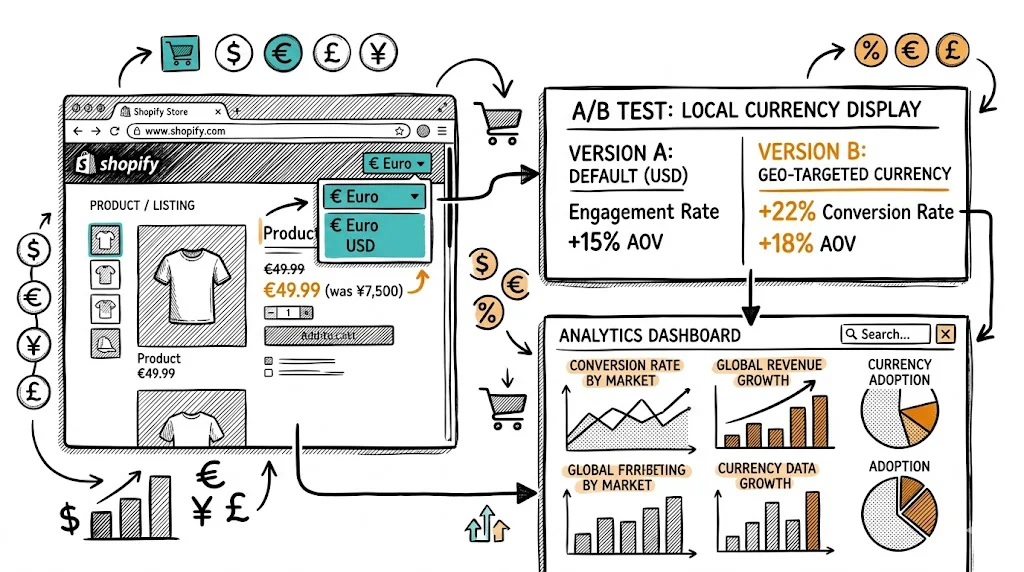
Showing prices in a shopper's local currency — USD for Americans, AED for UAE visitors, SGD for Singapore residents — reduces friction and signals that your brand is ready for international business. For Indian D2C brands that have built a following in NRI communities or see organic international traffic, multi-currency pricing is a conversion lever that most brands delay too long.
Not every Indian D2C brand needs this immediately. Prioritize multi-currency when:
Brands like Kapiva, Forest Essentials, and Kama Ayurveda have built international businesses partly by removing currency friction for NRI buyers in the US, UK, and UAE.
| Country | Currency | Key Indian D2C Segment |
|---|---|---|
| United States | USD | Indian diaspora, wellness shoppers |
| United Kingdom | GBP | Large NRI community |
| UAE | AED | Indian expat hub, high spending power |
| Singapore | SGD | Large Indian professional community |
| Australia | AUD | Growing Indian diaspora |
| Canada | CAD | Significant NRI population |
The UAE and UK NRI markets are particularly valuable for Ayurvedic, traditional food, and personal care brands — these shoppers have high purchasing power and strong cultural motivation to buy Indian-origin products.
Shopify Markets (available to Indian merchants) allows you to:
This is the most comprehensive option and is recommended for brands with genuine international scale.
If you use Shopify Payments (available in India as of 2024), you can enable automatic currency conversion. The price shown in USD/GBP/AED is calculated from your ₹ price at the current exchange rate, with a small conversion fee built in.
Limitation: You are still charging in INR — the currency display is cosmetic. For shoppers who want to pay in their local currency (settling charges in USD vs INR), this does not solve the currency risk problem.
BEST Currency Converter and Auto Currency Switcher show prices in the detected local currency without full Shopify Markets setup. Good for testing international interest before committing to full market setup.
Do not just convert ₹ to $ at current exchange rates and publish. Consider:
Purchasing power parity. A product that sells well at ₹499 in India targets a different income segment than $6 USD (the equivalent at current rates) targets in the US. Your Indian mass-market price might be a premium-segment price internationally, which is actually an opportunity.
Competitive benchmarking. If a similar US product costs $29, pricing yours at $6 USD is confusing to US shoppers who expect higher prices for Indian-origin premium products. Price at $18–$22 to signal value while remaining competitive.
Market-specific packaging. UK and US shoppers often prefer larger pack sizes at higher absolute prices. Consider market-specific product variants.
Currency rounding. ₹1,299 converts to $15.63 USD at current rates. Round to $15.99 (charm pricing) or $16.00 (clean pricing) rather than displaying the converted decimal.
Test these variables:
Auto-detect vs user-selected currency: Auto-detecting the currency based on location vs giving users a manual currency selector. Auto-detect reduces friction but can misfire for VPN users or shoppers who prefer INR for tax reasons.
Price display format: "USD 29.99" vs "$29.99" vs "29.99 USD." The $ symbol placement and ISO code format affects trust for different audiences.
Market-specific pricing vs exchange rate conversion: Test whether setting a specific USD price (e.g., $22) vs showing the converted ₹ equivalent lifts international checkout rates.
Use CustomFit.ai to run these tests across international traffic segments.
Not updating prices when exchange rates move significantly. If the ₹/USD rate moves 5–10%, your auto-converted prices drift out of alignment with your pricing strategy. Set rate floors and ceilings.
Showing INR price AND converted price together. This creates confusion — shoppers do not know which to trust. Show one currency per visitor, based on their location.
Charging in INR while displaying in USD. If a US shopper sees $22 but their credit card charges ₹1,829 (the INR equivalent), they see a currency mismatch on their statement. This triggers chargebacks and trust issues.
Forgetting tax display. UK VAT, UAE VAT, and Canadian GST/HST apply to international sales above certain thresholds. Display prices with applicable taxes included for each market.
Related reading: