From the conversion glossary
Concepts referenced in this article, defined.
Concepts referenced in this article, defined.
Run rigorous A/B tests and personalize every visit on Shopify or any storefront — no engineers required.
The price of your product is fixed — but how you display that price dramatically affects whether customers buy. Psychological pricing is not manipulation; it is understanding how human brains process price information and presenting your prices in the way that most accurately communicates value. The difference between ₹999 and ₹1,000 is ₹1. The difference in conversion rate can be 12%. Here are the psychological pricing strategies that work for Indian D2C brands, with guidance on how to test each.
Customers do not evaluate prices in a vacuum. They compare prices to:
Psychological pricing works by shaping each of these reference points to present your price as more attractive without changing the actual number.
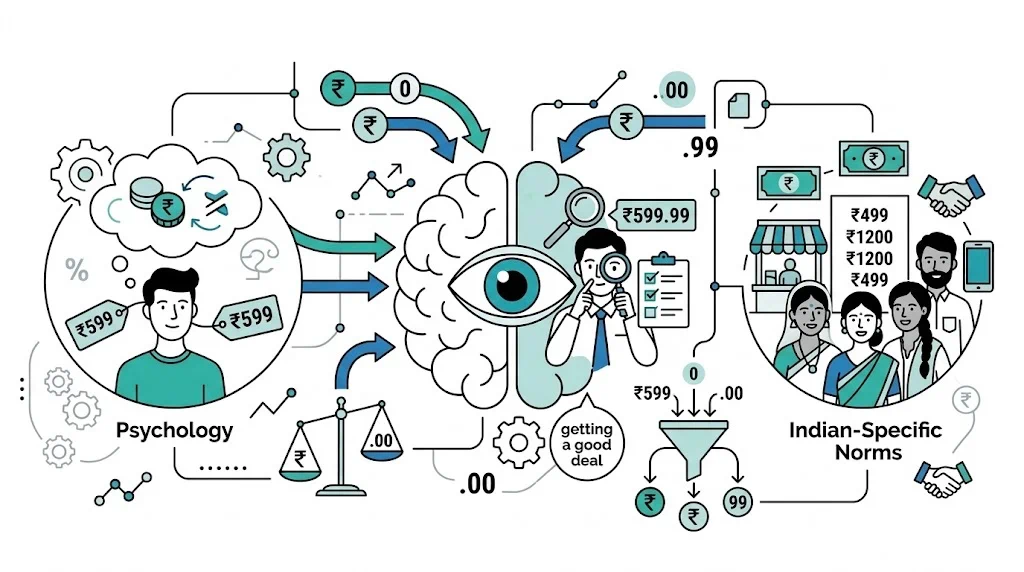
Charm pricing — ending prices in 9, 99, or 995 — is the most widely used psychological pricing technique because it exploits a specific cognitive bias: we read numbers left to right, so the leftmost digit anchors our impression.
₹999 feels closer to ₹900 than to ₹1,000. ₹499 feels dramatically less than ₹500. This "left-digit effect" is consistent across cultures and income levels.
For Indian D2C, effective charm price points:
When not to use charm pricing: For luxury-positioned brands, round numbers (₹1,000, ₹2,000, ₹5,000) actually signal premium quality. Luxury psychology differs from mass market. Charm pricing on a ₹15,000 watch feels tacky; a clean ₹15,000 feels appropriate.
How to test: Run an A/B test comparing your current price (say ₹500) with ₹499 on your product page. CustomFit.ai can serve the two versions to equal traffic segments and measure conversion rate difference.
Anchoring is the practice of showing a reference price alongside your selling price to make the selling price feel like a better deal.
In Indian ecommerce, this manifests as:
Critical rule: Anchors must be real. False MRP inflation is illegal under Indian consumer protection regulations and is increasingly detected by consumers. If your product's actual MRP is ₹599, do not show ₹999 as MRP.
For supplements and beauty: Per-day pricing is powerful. "Just ₹33/day for healthier skin" makes ₹999 feel trivial.
For Chargebee's B2B pricing, a similar principle applies: showing the cost in context of the value generated (a 40% AOV increase) makes the subscription fee feel modest. The same logic applies to D2C products — contextualize your price against the alternative cost or value delivered.
Bundles increase average order value while making individual product prices feel more attractive through comparison.
The three-option structure (Good/Better/Best) uses the decoy effect:
| Option | Contents | Price | Per Item |
|---|---|---|---|
| Starter | 1 product | ₹499 | ₹499 |
| Value Bundle | 3 products | ₹1,199 | ₹400 (20% off) |
| Complete Kit | 5 products | ₹1,799 | ₹360 (28% off) |
In this structure, the Value Bundle (middle option) is usually your target purchase. The Complete Kit makes it look like a steal. The Starter makes the Value Bundle feel like better value. This architecture — tested across thousands of D2C stores — consistently drives the most customers to the middle option.
How Kapiva uses bundles: Kapiva offers daily wellness bundles (Immunity Pack, Gut Health Pack, Weight Management Pack) that group 3 complementary products at 20% off individual prices. These bundles drive 30–40% higher AOV than individual product sales.
Bundle naming matters: "Starter Kit" implies beginning. "Complete Routine" implies comprehensiveness. "30-Day Challenge Bundle" implies a commitment with a benefit. Test your bundle names — the framing changes purchase behavior.
The free shipping threshold is a psychological pricing tool disguised as a logistics policy. When you set free shipping at ₹699 and a customer's cart is at ₹550, the "Add ₹149 for free shipping" prompt almost always results in an additional item added.
This is not manipulation — it is giving customers a clear value proposition: spend a bit more and get real monetary value (shipping savings of ₹60–100).
Threshold optimization:
Test different threshold amounts using A/B testing. A threshold that is too high feels unachievable; too low gives away shipping revenue without driving meaningful AOV lift.
See our full guide on free shipping threshold optimization for the complete methodology.
Buy Now Pay Later (BNPL) and EMI options function as psychological pricing tools by breaking large prices into palatable installments.
For Indian D2C:
The framing that converts:
For products in the ₹1,000–3,000 range, showing BNPL options increases conversion by 8–15% for price-sensitive segments, particularly for Tier 2 audiences and younger demographics.
Dynamic pricing — adjusting prices based on demand, time, or customer behavior — is advanced but increasingly accessible for D2C brands.
Practical applications:
Festive pricing with visible countdown: "Diwali Special — ₹799 (regular ₹1,099) — ends in 48 hours" with a real countdown timer. The time limit adds urgency to the price anchor.
First-order discount framing: "15% off your first order" vs. "₹150 off your first order" — test both. Dollar-amount discounts often outperform percentage discounts for lower-priced products; percentages outperform for higher-priced products.
Loyalty tier pricing: Showing loyalty members a different (better) price than non-members creates visible reward for loyal behavior and incentivizes program sign-up.
Exit-intent price offers: When a customer shows exit behavior, showing a time-limited offer ("Wait — here's 10% off valid for the next 15 minutes") captures some of the departing traffic. Use sparingly — overuse devalues your pricing.
Sometimes, pricing too low kills conversion. Customers use price as a proxy for quality, especially for categories with high quality uncertainty (skincare, supplements, personal care).
If you are converting poorly and your price is significantly below market, test a price increase. Counter-intuitive but documented: a serum priced at ₹399 sometimes converts worse than the same serum at ₹599 because customers suspect something is wrong with a "cheap" skincare product.
The price-quality balance for Indian D2C:
If you are repositioning a product upward in price, use anchoring and certification prominently to justify the new price point.
Test one variable at a time. When A/B testing pricing, change only the price display element — not the page layout simultaneously. Isolate the variable you are measuring.
Anchoring works only with credible anchors. False MRP inflation is increasingly detected by Indian consumers and creates distrust. Use honest anchors.
Bundle savings must feel meaningful. "Save ₹30 on a ₹1,499 bundle" is not compelling. "Save ₹450 (23% off)" is. The absolute saving must be significant relative to the bundle price.
Show price per day or per use for high-frequency products. "₹16/day for healthy skin" converts better than "₹499/month" for most skincare and supplement categories.
Test free shipping threshold quarterly. As your product mix and AOV evolve, the optimal threshold changes.
Track revenue per visitor, not just conversion rate. A pricing change that reduces conversion slightly but increases AOV significantly can be a net win.
Psychological pricing is not about tricking customers — it is about presenting genuine value in a way that human psychology processes as compelling. When honest, it is a win for both sides: customers feel they got value, and your conversion rate and average order value improve together.