From the conversion glossary
Concepts referenced in this article, defined.
Concepts referenced in this article, defined.
Run rigorous A/B tests and personalize every visit on Shopify or any storefront — no engineers required.
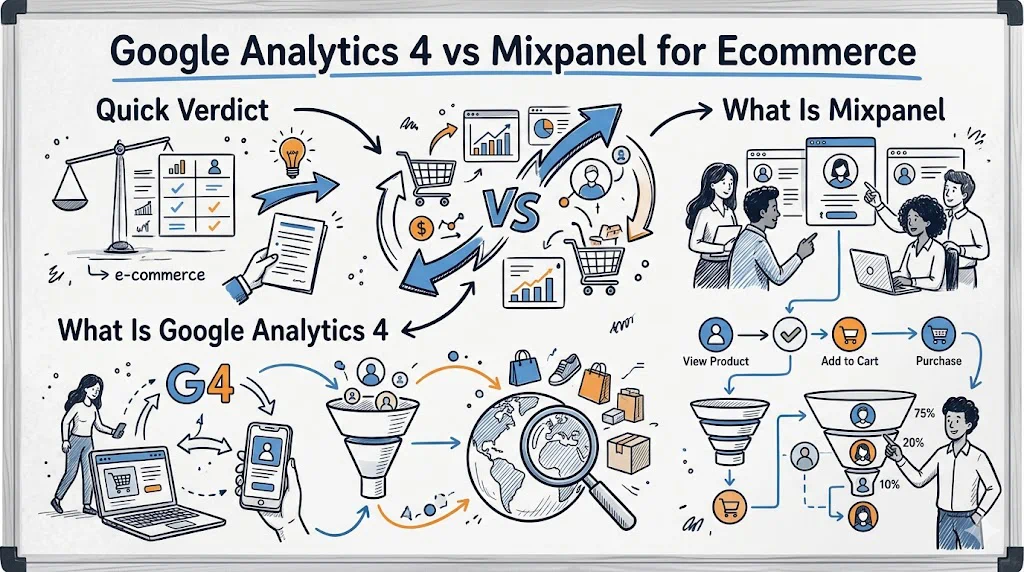
GA4 is the baseline — it's free, works out of the box with Google's ad ecosystem, and is sufficient for most ecommerce reporting needs. Mixpanel is a more powerful product analytics tool built around user-level event tracking, making it better suited to brands that need to understand cohort behaviour, retention, and complex conversion funnels. If your primary goal is tracking marketing attribution and standard ecommerce KPIs, GA4 is the obvious choice. If you're building a subscription product, a loyalty programme, or need deep funnel analysis by user segment, Mixpanel justifies its cost.
GA4 is Google's current web and app analytics platform, replacing Universal Analytics. It uses an event-based data model and is tightly integrated with Google Ads, Search Console, and BigQuery. GA4 is free for most ecommerce brands, with a paid tier (GA360) for enterprise users processing billions of events. Most Shopify and WooCommerce stores use GA4 as their primary analytics tool via native integrations or Google Tag Manager.
Mixpanel is a product analytics platform that focuses on user-level event tracking, funnel analysis, cohort retention, and A/B test results. It's primarily used by SaaS companies but has a growing ecommerce user base, particularly among subscription and DTC brands with complex purchase journeys. Pricing starts at a free tier (20M events/month), with Growth plans starting around $28/month and Enterprise plans on custom pricing.
| Feature | GA4 | Mixpanel |
|---|---|---|
| Ecommerce tracking | Native (GA4 Enhanced Ecommerce) | Custom events required |
| User-level reporting | Limited (user ID stitching) | Core feature |
| Funnel analysis | Yes (limited) | Advanced, multi-step |
| Cohort analysis | Basic | Advanced |
| Retention reports | Limited | Strong |
| Google Ads integration | Native | Third-party |
| Real-time reporting | Yes | Yes |
| BigQuery export | Free (daily) | Available (paid) |
| Session-based model | Yes | No (event-based) |
| Free tier | Always free | 20M events/month |
| Shopify integration | Native | Via third-party connectors |
| GDPR/privacy compliance | Yes | Yes |
GA4 is free for the vast majority of D2C brands — there is no paid tier until you're processing billions of hits per day (GA360 starts at roughly $50,000/year). This makes it an obvious default for Indian D2C brands at any stage, from a ₹10 lakh/month Shopify store to a ₹100 crore brand like Nykaa or Mamaearth.
Mixpanel's free tier covers up to 20 million events per month, which is substantial. A mid-size ecommerce store tracking page views, product views, add-to-cart, checkout steps, and purchase events might hit 5–10 million events/month with a moderate traffic volume. Growth plans at $28/month (around ₹2,300/month) unlock unlimited saved reports and team features. For most D2C brands, Mixpanel's free tier is sufficient to start.
The real cost difference emerges at scale, where GA4 remains free and Mixpanel's event-based pricing grows with traffic.
GA4 has purpose-built ecommerce tracking. If you install the GA4 Shopify app or configure Enhanced Ecommerce via GTM, you get product views, add-to-cart, checkout funnel steps, purchase events, and revenue reporting out of the box. The standard ecommerce reports in GA4 are good enough for most brands — you can see top products, checkout abandonment rates, and revenue by channel without custom development.
Mixpanel requires custom event implementation for ecommerce tracking. There's no out-of-the-box "purchase funnel" — you define the events yourself (viewed_product, added_to_cart, checkout_started, order_completed) and build funnels in the Mixpanel UI. This is more work upfront but gives you significantly more flexibility. You can build funnels that span multiple sessions, filter by user properties (like acquisition source or customer segment), and analyse which cohorts convert versus churn.
For subscription D2C brands — those selling supplement stacks, skincare routines, or pet food on a recurring model — Mixpanel's retention and cohort reports are genuinely more useful than GA4's. For standard one-time-purchase ecommerce, GA4's native reporting is faster to implement and sufficient.
GA4 integrates natively with every Google product: Google Ads, Search Ads 360, Display & Video 360, Google Merchant Center, Looker Studio, and BigQuery. If your paid acquisition runs through Google, this integration is valuable — you can see ad spend and revenue in the same platform.
Mixpanel integrates with Segment, Amplitude, Braze, and most modern data stacks. It works well in organisations with a CDP (Customer Data Platform) feeding standardised events into multiple tools. Shopify integration requires either a third-party connector (like Elevar or Triple Whale) or a custom Segment integration.
For Indian D2C brands using Razorpay, PayU, or other local payment processors, GA4's ecommerce events can capture payment method data if configured correctly. Mixpanel can do the same but requires more custom work.
GA4 and Mixpanel both excel at telling you what users do. GA4 shows you which pages have high exit rates; Mixpanel shows you where users drop out of your checkout funnel. But neither tool is built to run controlled experiments that fix those problems.
Understanding that 68% of users abandon your checkout at the payment step is a starting point. The next step — testing a simplified checkout layout, adding UPI as a featured payment option, or changing the CTA copy — requires an A/B testing tool that can show two versions of a page to different user segments and measure which converts better.
If you're evaluating GA4 or Mixpanel for your D2C analytics stack, you'll also want an A/B testing tool alongside it. CustomFit.ai integrates with Shopify and works alongside your analytics setup — you can run no-code experiments on your store and send results back to GA4 or Mixpanel as custom events for unified reporting. Start a 14-day free trial and turn your analytics insights into measurable revenue lifts.
Can I use GA4 and Mixpanel together? Yes. Many teams use GA4 for marketing attribution and standard reporting, and Mixpanel for product analytics and retention analysis. Segment makes this dual-tracking straightforward.
Which is better for Shopify stores? GA4 has a native Shopify integration and is easier to set up for standard ecommerce reporting. Mixpanel requires more configuration but offers more analytical depth.
Does Mixpanel replace GA4? No. They have different strengths. GA4 is better for marketing attribution and Google ecosystem integration. Mixpanel is better for user behaviour analysis and retention.
Is GA4 harder to use than Universal Analytics? Yes, for many users. GA4's event-based model and interface are less intuitive than UA for standard reporting, but its data model is more powerful for custom analysis.
What is the GA4 free data limit? GA4 is free with no official hit limits for standard use. The enterprise tier (GA360) is for companies needing higher SLA guarantees and processing billions of events daily.