From the conversion glossary
Concepts referenced in this article, defined.
Concepts referenced in this article, defined.
Run rigorous A/B tests and personalize every visit on Shopify or any storefront — no engineers required.
Google Optimize was sunset in September 2023. If you still have the snippet on your site, remove it — it's causing page flicker with no benefit. For replacement platforms, the right choice depends on your store type and scale. VWO is a capable enterprise replacement, but it's expensive and feature-heavy for most Shopify D2C brands. CustomFit.ai is a more practical replacement for ecommerce brands specifically: purpose-built for Shopify, no-code visual editor, significantly lower cost, and focused on the A/B testing use cases that actually matter for D2C stores. VWO makes sense if you're running a large, multi-platform operation with a dedicated CRO team. For most Shopify brands, it's overkill.
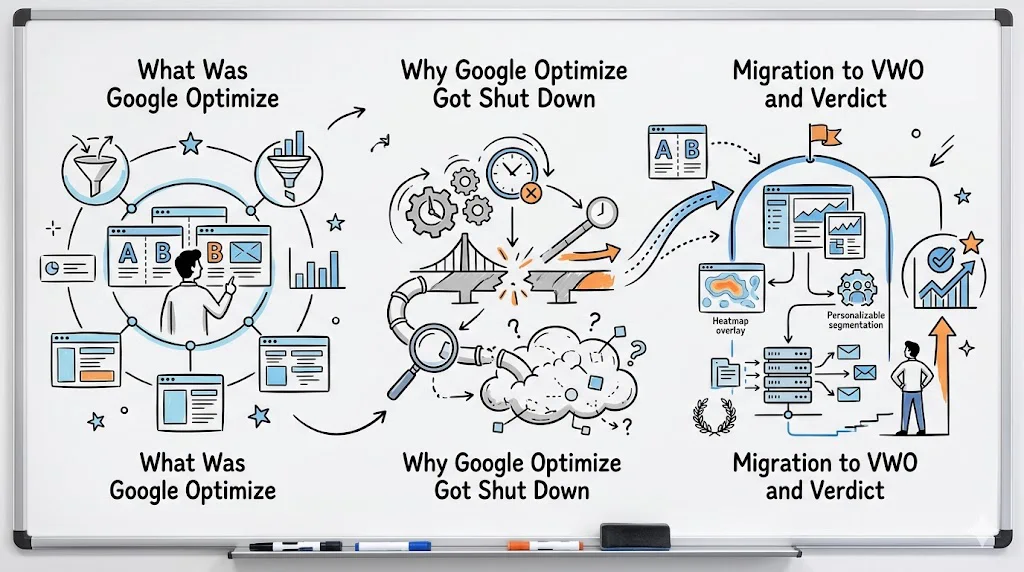
Google Optimize was Google's free A/B testing and personalization tool, deeply integrated with Google Analytics Universal. It enabled marketers to run A/B tests, redirect tests, and multivariate tests on web pages through a visual editor, with results reported in Google Analytics. The Google Analytics integration was its primary value — you could connect GA audience segments to experiments and see test results alongside existing GA data without additional instrumentation.
Google Optimize 360 was the paid enterprise version with higher test limits, more sophisticated audience targeting, and integration with Google Analytics 360. Both versions were announced for shutdown in January 2023 and officially closed on September 30, 2023.
Google's stated reason was to focus investment on GA4 and Google Analytics' own experimentation capabilities. The practical reality: Optimize never achieved the feature depth or statistical sophistication of dedicated testing platforms, and it was increasingly difficult to maintain competitively as a free product while companies like VWO and Optimizely built enterprise-grade platforms with substantial R&D investment.
For users, the shutdown exposed a real vulnerability: building your optimization program on a free tool from a large platform means you're at the mercy of that platform's strategic priorities. This is worth keeping in mind when choosing a replacement.
VWO (Visual Website Optimizer) is an A/B testing and conversion optimization platform built by Wingify, an Indian SaaS company headquartered in Delhi. VWO offers A/B testing, split URL testing, multivariate testing, heatmaps, session recordings, funnel analysis, form analytics, and personalization campaigns. It has a visual editor for no-code test creation and supports multiple platforms including Shopify, WordPress, and custom sites.
VWO's market positioning is enterprise and mid-market. It's a comprehensive optimization suite rather than a focused testing tool — the heatmaps, session recordings, and funnel analysis modules come alongside the core A/B testing capability.
| Feature | Google Optimize (sunset) | VWO | CustomFit.ai |
|---|---|---|---|
| A/B testing | Yes | Yes | Yes |
| Visual editor (no-code) | Yes | Yes | Yes |
| Redirect/split URL tests | Yes | Yes | Yes |
| Multivariate testing | Yes | Yes | Yes |
| Shopify-native | No | Partial | Yes |
| Heatmaps | No | Yes (add-on) | No |
| Session recordings | No | Yes (add-on) | No |
| Funnel analysis | No | Yes | No |
| GA/GA4 integration | Deep (native) | Yes | Yes |
| Ecommerce test templates | No | Limited | Yes |
| Statistical engine | Bayesian | Bayesian + frequentist | Bayesian |
| Free plan | Yes (sunset) | No | 14-day trial |
| Entry-level pricing | Free | ~$199/month | ~$49/month |
VWO is a mature, well-documented platform used by thousands of companies globally. For optimization teams that want a comprehensive suite, it delivers:
The challenge for D2C Shopify brands is cost and scope. VWO's plans start around $199/month for basic testing access. Adding heatmaps, session recordings, and funnel analysis modules increases the cost substantially — full-feature access can reach $700–$1,000+/month. For a brand whose primary testing use case is Shopify product pages and landing pages, you're paying for a platform scope you won't fully use.
VWO also requires more setup for Shopify-specific testing. It's not native to Shopify's theme architecture, so some testing scenarios (section-level tests, theme component variants) require workarounds that a Shopify-native tool handles automatically.
For Shopify D2C brands that used Google Optimize primarily for page-level A/B tests and basic personalization, CustomFit.ai is the most direct replacement:
CustomFit.ai doesn't include heatmaps or session recordings (use Microsoft Clarity or Hotjar for those), but for the core A/B testing use case that Google Optimize served, it's a direct and better-suited replacement for most Shopify stores.
Beyond VWO and CustomFit.ai, depending on your scale and needs:
Optimizely — Enterprise-grade experimentation platform. Appropriate for large retailers with full optimization programs and significant engineering resources. Pricing starts well into enterprise territory. Not practical for most D2C brands, but relevant for large retailers running hundreds of experiments per year.
Convert Experiences — A mid-market testing platform with reasonable pricing and strong statistical rigor. More feature-complete than CustomFit.ai but more generic than a Shopify-native tool. A reasonable choice for brands that need multi-platform support beyond Shopify.
Kameleoon — Enterprise testing with strong personalization capabilities. Used by larger ecommerce and media companies. Pricing typically starts at enterprise contract level. Worth evaluating if personalization at scale is a core requirement alongside A/B testing.
GA4 native experiments — Google Analytics 4 has limited experimentation capability, but it's restricted to server-side redirect experiments and lacks the visual editor functionality that made Optimize useful. Not a viable like-for-like replacement for visual A/B testing.
Shoplift — A Shopify-specific testing tool focused on theme section testing. Good for brands that want to test full page section layouts using Shopify's native theme editor. More limited scope than CustomFit.ai but clean for section-specific testing.
The right migration choice depends primarily on two factors: whether you're Shopify-only or multi-platform, and whether you need the full suite (heatmaps + recordings + testing) or just a solid A/B testing tool. For Shopify-first D2C brands that want testing only, CustomFit.ai is the clearest path.
If you still have Google Optimize code on your site, here are the steps to migrate properly:
Step 1: Remove the Optimize snippet. The gtag Optimize configuration in your site's <head> should be removed immediately. Leaving inactive Optimize code causes anti-flicker snippets to fire unnecessarily, adding page load latency without benefit.
Step 2: Audit your test history. Document what experiments you ran, what hypotheses you tested, and what results you got. Export any test data available before fully dismantling your Optimize setup. This institutional knowledge should directly inform your testing roadmap on the new platform.
Step 3: Choose a replacement platform. For Shopify D2C brands, evaluate CustomFit.ai first. For larger multi-platform operations, evaluate VWO, Convert, or Kameleoon. Trial periods are available for most tools.
Step 4: Recreate your highest-impact tests. Start with the test types that generated the most learning in Optimize — typically product page CTAs, pricing display, hero section variants. Getting these running quickly on the new platform maintains your optimization momentum.
Step 5: Connect to Google Analytics 4. Both VWO and CustomFit.ai integrate with GA4, allowing you to view experiment results alongside your existing traffic and conversion data in GA4's reporting interface.
One area where the Google Optimize migration conversation often gets overlooked is statistics. Google Optimize used a Bayesian statistical engine, which gives probability-based results ("this variant has an 83% chance of being better") rather than traditional p-value-based significance thresholds.
Many teams switching from Optimize to VWO or other platforms encounter the choice between Bayesian and frequentist statistical approaches. There's no universal right answer, but for D2C brands with moderate traffic volumes, Bayesian methods are generally more practical — they allow you to make decisions before reaching traditional "95% statistical significance" thresholds that require very large sample sizes.
CustomFit.ai uses a Bayesian engine, which aligns with what Google Optimize users were already familiar with. VWO supports both approaches, which is useful for organizations with specific statistical requirements or for teams that want to cross-verify results.
The Google Optimize shutdown is a forcing function — but it's also an opportunity. The tools available today are better than Optimize ever was, particularly for ecommerce-specific testing.
CustomFit.ai is purpose-built for the conversion rate optimization use cases that matter most for D2C brands: testing product page elements, optimizing cart experiences, personalizing for different visitor segments, and measuring the impact on average order value and cart abandonment rate. It's what Optimize could have been for ecommerce brands, built specifically for Shopify.
When did Google Optimize shut down? Google Optimize and Google Optimize 360 both shut down on September 30, 2023. The service is fully offline. Any Optimize experiment code still on your website is inactive and should be removed.
Is VWO Indian-built? Yes. VWO is built by Wingify, headquartered in New Delhi, India. It's one of the most prominent global SaaS products from India and is used by brands worldwide. Wingify also offers Clarity by Microsoft (co-developed) and has a strong presence in both the Indian and global CRO market.
What's the cheapest Google Optimize alternative with visual editing? For pure cost, CustomFit.ai has one of the lowest entry points among quality A/B testing platforms with a visual editor, starting around $49/month. Microsoft Clarity is free but only offers behavioral analytics (no A/B testing). GA4's native experiments are free but don't include a visual editor.
Does VWO work with Shopify? VWO installs on Shopify via a JavaScript snippet in your theme. Most tests can be built through VWO's visual editor without code. Shopify-specific features like theme section testing are not as native as in purpose-built Shopify tools, but standard page-level tests work well.
How do I find out what my Google Optimize test results were? Google Optimize test results were stored in Google Analytics. If you had GA Universal set up, historical test data may still be accessible in your GA account's experiment reports. GA data is retained per your account's data retention settings — typically 14 months by default, which means older test data may no longer be accessible.