From the conversion glossary
Concepts referenced in this article, defined.
Concepts referenced in this article, defined.
Run rigorous A/B tests and personalize every visit on Shopify or any storefront — no engineers required.
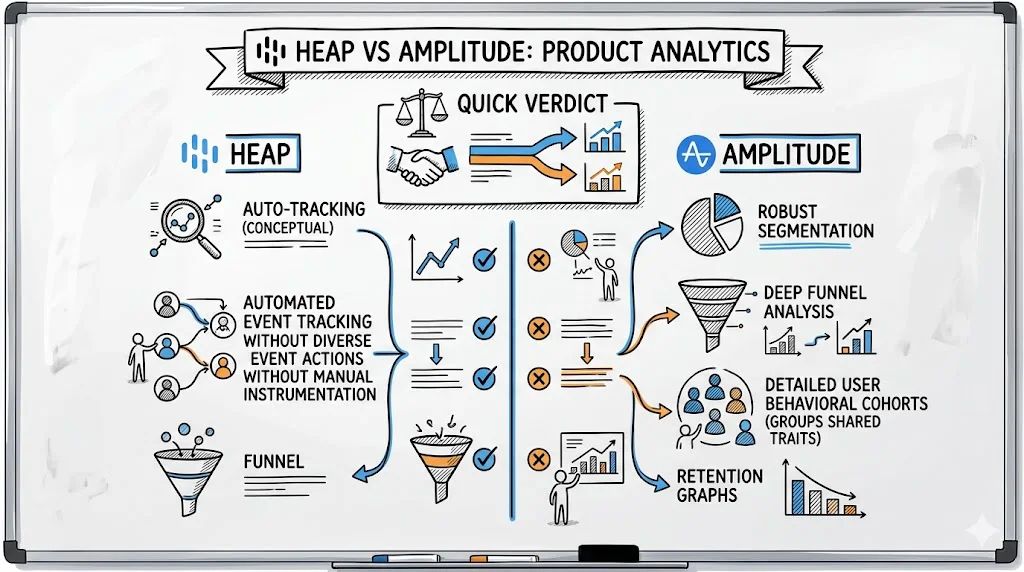
Amplitude is the stronger choice for most D2C brands that want product analytics as a core competency. Its funnel analysis, retention cohorts, and behavioral segmentation are best-in-class, and its free tier is genuinely useful for getting started. Heap's key differentiator — autocapture of all user interactions without pre-defined event tracking — makes it faster to get data flowing and useful for retroactive analysis. If you want to answer analytical questions you haven't thought of yet, Heap's autocapture is powerful. If you want a polished analytics platform with strong visualization and a clear product roadmap, Amplitude wins. For most D2C brands, Amplitude is the better starting point.
Heap is a product analytics platform that automatically captures every user interaction on your website or app — every click, pageview, form submission, and scroll — without requiring engineers to manually instrument events. This "autocapture" approach means you can go back and analyze user behavior retroactively, even for events you didn't think to track when you first installed Heap. Heap also offers funnel analysis, retention reporting, and behavioral segmentation.
Amplitude is a product analytics platform used by thousands of ecommerce, SaaS, and consumer app companies. It requires explicit event tracking (you define which events to capture), but in return offers one of the most powerful analytics interfaces available: funnel visualization, retention cohort analysis, behavioral cohorting, revenue analysis, and a strong A/B testing integration layer. Amplitude is used by D2C brands to understand the customer journey from first visit to repeat purchase.
| Feature | Heap | Amplitude |
|---|---|---|
| Autocapture (no event tagging needed) | Yes (core feature) | No (manual instrumentation) |
| Funnel analysis | Yes | Yes (stronger UI) |
| Retention cohort analysis | Yes | Yes (best-in-class) |
| Behavioral segmentation | Yes | Yes |
| A/B test integration | Limited | Yes (Amplitude Experiment) |
| Session replay | Yes (add-on) | Yes (Amplitude Session Replay) |
| Data warehouse sync | Yes | Yes |
| Shopify integration | Yes (via Segment or direct) | Yes (via Segment or direct) |
| Free plan | Yes (limited) | Yes (generous — 10M events/month) |
| Ease of setup | High (autocapture) | Moderate (event planning needed) |
| Best for | Retroactive analysis, fast setup | Ongoing product analytics program |
This is the core philosophical difference between the two tools, and it matters practically.
Heap's autocapture means you install the snippet and Heap immediately starts recording all interactions. You can later define events by pointing and clicking on elements in Heap's interface — no engineering needed for basic event creation. The benefit: you don't miss data because you forgot to track something. The downside: without structured event naming conventions, Heap data can get messy at scale, requiring retroactive cleanup.
Amplitude requires you to decide upfront which events to track and instrument them deliberately — typically with help from a developer. The benefit: clean, intentional data. The downside: if you didn't track something at install time, you can't go back and analyze it. For D2C brands just getting started, this means you need to think through your event taxonomy before going live.
Both tools offer funnel analysis (measuring the drop-off between each step in a user journey, e.g., product page → add to cart → checkout → purchase). Amplitude's funnel visualization is more polished and flexible — you can add and remove steps dynamically, compare funnels by segment, and see exactly which path variants users take through non-linear funnels.
Amplitude's retention analysis is widely regarded as the best in the market. For D2C brands focused on building repeat purchase habits, being able to visualize which cohorts return to buy again — and at what cadence — is directly valuable for refining your retention marketing strategy.
Before installing either tool, it's worth planning your event schema — the specific user actions you'll track and how you'll name and structure them. For D2C ecommerce brands, a standard event schema typically includes:
Product Viewed (with product ID, name, category, price as properties)Product Added to Cart (with product and cart value properties)Checkout Started (with cart value, item count)Payment Info EnteredOrder Completed (with revenue, product list, order ID)User Identified (with email, customer ID, loyalty tier)Both Amplitude and Heap can work with this schema. Heap's advantage is that even if you forgot to instrument an event on day one, you can retroactively define it from click data later. Amplitude's advantage is that explicitly designed events produce cleaner data from the start, which makes analysis more reliable over time.
For a brand launching on Shopify for the first time, Heap's zero-regret autocapture is practical — you get behavioral data from day one without upfront event planning. For a brand that already has Shopify running and is adding analytics deliberately, Amplitude's structured approach produces better long-term data quality.
Neither Heap nor Amplitude has a direct native Shopify app in the same way that Shopify-specific tools do. Both are typically integrated via a JavaScript snippet or through a customer data platform like Segment. If you're already using Segment, adding either Heap or Amplitude as a destination is straightforward.
For D2C brands on Shopify, Amplitude is more commonly used in combination with Segment as the analytics destination of choice. Heap's autocapture is easier to get running on Shopify without Segment as middleware.
Amplitude's free Starter plan is generous — 10 million events per month, unlimited users, and core analytics features. For most D2C brands in early to mid growth stages, the free tier is sufficient. Paid plans (Plus at ~$61/month, Growth at custom pricing) add advanced features including behavioral cohorts, advanced funnel comparison, and governance tools.
Heap's free plan is more limited (5,000 sessions per month on the free tier). Paid plans scale with session volume and are custom-priced. Heap can be comparable to or more expensive than Amplitude depending on traffic volume.
Analytics platforms like Heap and Amplitude are essential for understanding the customer journey — identifying where visitors drop off in your funnel, which cohorts have the highest purchase frequency, and which channels bring high-LTV customers. But they're measurement tools, not experimentation tools.
To actually improve your conversion rate, you need to run controlled experiments — showing different page variants to different visitor segments and measuring which performs better. Amplitude Experiment offers a built-in experimentation layer, but it's more feature-rich for product teams than for ecommerce-specific A/B testing.
CustomFit.ai fills this role for Shopify D2C brands: it runs page-level A/B tests on product pages, landing pages, and cart experiences without requiring code changes. Analytics platforms (Amplitude or Heap) tell you where your funnel has friction; CustomFit.ai tests whether your proposed fixes actually work.
The recommended stack: Amplitude for product analytics and customer journey understanding → CustomFit.ai for on-site experimentation → your data warehouse for long-term analysis.
The most practical application of Amplitude or Heap for D2C brands is building a data-driven testing backlog. Here's how analytics insights translate into experiment priorities:
Funnel drop-off → Identify the highest drop-off step in your purchase funnel (often add-to-cart to checkout, or checkout to payment). Hypothesize what's causing it (price shock? trust concerns? form friction?). Build A/B tests targeting that step.
Cohort differences → If customers from email traffic convert at 4.2% but customers from paid social convert at 1.8%, the page experience may be optimized for email-familiar customers but not for cold traffic. Test different product page variants for paid traffic specifically.
Retention drop-off → If 60% of first-time buyers don't purchase a second time within 90 days, analyze what the 40% who do return have in common. Use those behavioral signals to inform your retention email program and loyalty program design.
Behavioral sequences → If customers who view your "About" or "Our Story" page before viewing a product page convert at higher rates, promote that content more prominently in the browse experience and A/B test its placement.
Both Amplitude and Heap surface these patterns. The experimentation to act on those patterns is where CustomFit.ai enters the workflow.
Does Amplitude work with Shopify? Yes. Amplitude integrates with Shopify via a JavaScript snippet or through Segment. You'll want to track key ecommerce events: product viewed, add to cart, checkout started, purchase completed, and user identified. Amplitude has documentation specifically for ecommerce event schemas.
What is autocapture in Heap? Heap's autocapture automatically records every click, scroll, page view, and form interaction on your website without requiring manual event tagging. You can later define named events by clicking on elements in Heap's interface. This means you can analyze user behavior retroactively, even for interactions you didn't plan to track.
Is Amplitude free for small stores? Yes. Amplitude's Starter plan supports up to 10 million events per month at no cost. For a D2C store with moderate traffic, this is typically sufficient for a full product analytics setup including funnel analysis and retention cohorts.
Can I use Heap with a Shopify store without a developer? Yes for basic setup — install the Heap snippet via your Shopify theme's head section. No-code event definition via Heap's visual labeler also works without engineering. For more advanced configurations (server-side event tracking, custom user properties), developer involvement is recommended.
How do Heap and Amplitude differ from Google Analytics? Google Analytics is a web analytics tool focused on traffic and acquisition metrics. Heap and Amplitude are product analytics platforms focused on user behavior, funnel completion, and retention. They're complementary: GA for traffic analysis, Amplitude/Heap for understanding what users do after they arrive.