From the conversion glossary
Concepts referenced in this article, defined.
Concepts referenced in this article, defined.
Run rigorous A/B tests and personalize every visit on Shopify or any storefront — no engineers required.
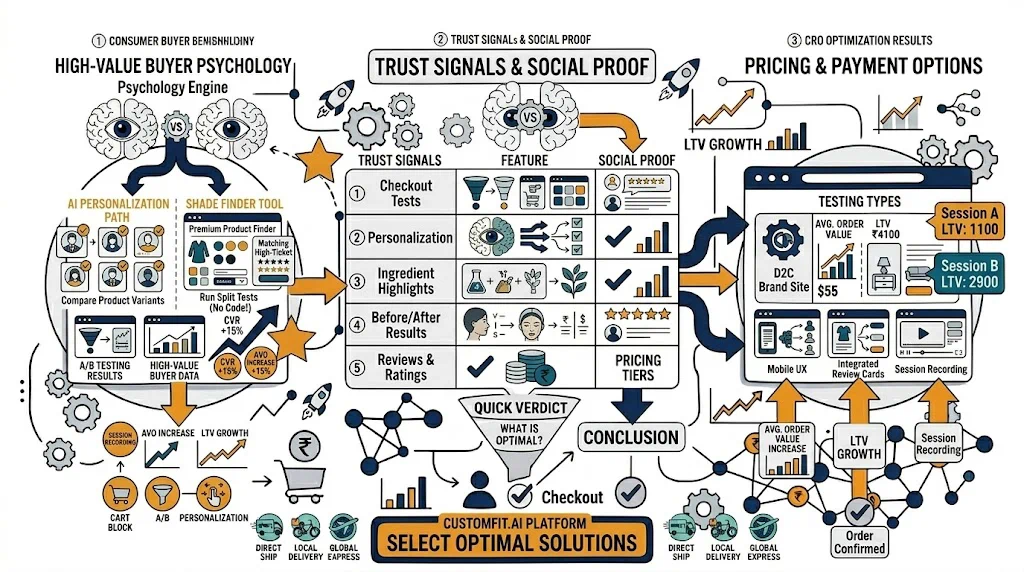
CRO for high-ticket products requires a fundamentally different approach than standard ecommerce optimization. When a buyer is considering spending ₹3,000–₹15,000 or more on a D2C product, the purchase psychology shifts from impulse to considered decision — and optimization strategies must shift accordingly. High-ticket CRO focuses on trust, confidence, and decision-support rather than urgency and friction reduction alone. Brands like Dyson India, premium Ayurveda brands, and high-end skincare lines achieve significant CVR gains by treating high-ticket buyers as deliberate decision-makers, not impulse buyers.
Understanding the psychology is essential before deploying any optimization tactic:
Considered purchase: High-ticket buyers take days or weeks to decide. They research, compare, read reviews, and return to the product page multiple times. Single-session optimization is less relevant than multi-session experience.
Loss aversion dominates: At ₹5,000+, the fear of making a wrong purchase decision is stronger than the desire to get a good deal. Your CRO must address this fear directly — through guarantees, return policies, and social proof from people the buyer identifies with.
Credibility signals matter more than persuasion techniques: Artificial scarcity ("Only 2 left!") and countdown timers that feel manufactured can backfire with high-ticket buyers who are more skeptical and deliberate. Evidence-based trust signals (certifications, clinical data, verified reviews, media coverage) work better.
The research phase is the purchase phase. For high-ticket products, most of the conversion work happens during research — before the buyer adds to cart. Product page content, comparison pages, and FAQ quality determine conversion more than checkout flow optimization.
Generic claims ("premium quality," "best in class") are invisible to high-ticket buyers. Specific, verifiable claims perform significantly better:
Test: Replace generic trust claims with specific, verifiable equivalents. Expect 8–15% lift in add-to-cart rate.
For high-ticket products, star ratings are insufficient. Buyers read reviews looking for specific use-case evidence:
Test: Adding review filtering by concern vs. standard review display → 10–18% lift in purchase rate from product page.
High-ticket buyers need the return policy to be prominent and specific:
Test: Moving return policy from footer to above-the-fold product page position → 12–20% lift in conversion for high-ticket products.
For wellness, health, and beauty high-ticket products:
India has high EMI adoption for purchases above ₹2,000. Testing EMI display on product pages consistently improves high-ticket CVR:
Brands report 15–25% add-to-cart rate improvements from prominent no-cost EMI display for products above ₹2,000.
High-ticket buyers are not immune to price anchoring — but the anchor must be credible:
For high-ticket products, payment method availability is a conversion factor:
Test: Add BNPL option at checkout for high-ticket SKUs → 8–12% CVR improvement in markets with strong BNPL adoption.
High-ticket buyers consume more product page content than impulse buyers. The challenge is organizing this content so both quick decision-makers and deep researchers are served:
Test: Sticky "Add to Cart" bar with key trust signal (30-day return guarantee) vs. standard product page without sticky bar → 10–15% add-to-cart lift.
For high-ticket products, buyers often compare multiple options before deciding. Make this comparison easy on your page:
Test: Adding a comparison table to the product page vs. no comparison → 15–25% lift in time on page and 8–12% lift in purchase rate for high-ticket categories.
High-ticket buyers rarely convert in a single session. Optimize the return experience:
Return visitor recognition:
Cart abandonment for high-ticket:
Retargeting for high-ticket:
Test the FAQ section. For high-ticket products, a well-designed FAQ that pre-empts purchase hesitations can improve conversion as much as any visual or CTA test. Test FAQ placement (below reviews vs. below product description) and content (generic vs. concern-specific questions).
Run qualitative research alongside tests. High-ticket buyer hesitations are diverse and specific. User surveys ("What almost stopped you from buying?") and post-purchase interviews reveal hypotheses your analytics data cannot surface.
Test price display format. "₹4,997" vs. "₹4,999" vs. "₹5,000" may seem trivial but can shift CVR 3–5% at high-ticket price points where buyers are highly price-aware.
Account for longer decision windows in your attribution. High-ticket attribution windows should be 14–30 days, not 7 days. Optimize your analytics setup accordingly so test results reflect the full decision period.
Related reading: