From the conversion glossary
Concepts referenced in this article, defined.
Concepts referenced in this article, defined.
Run rigorous A/B tests and personalize every visit on Shopify or any storefront — no engineers required.
The five-second test shows a participant your landing page for exactly five seconds, then removes it and asks what they remember. If they can't describe what you sell and who it's for, your landing page is losing conversions before a single word gets read. It's the fastest, cheapest clarity test available — and most D2C brands never run one.
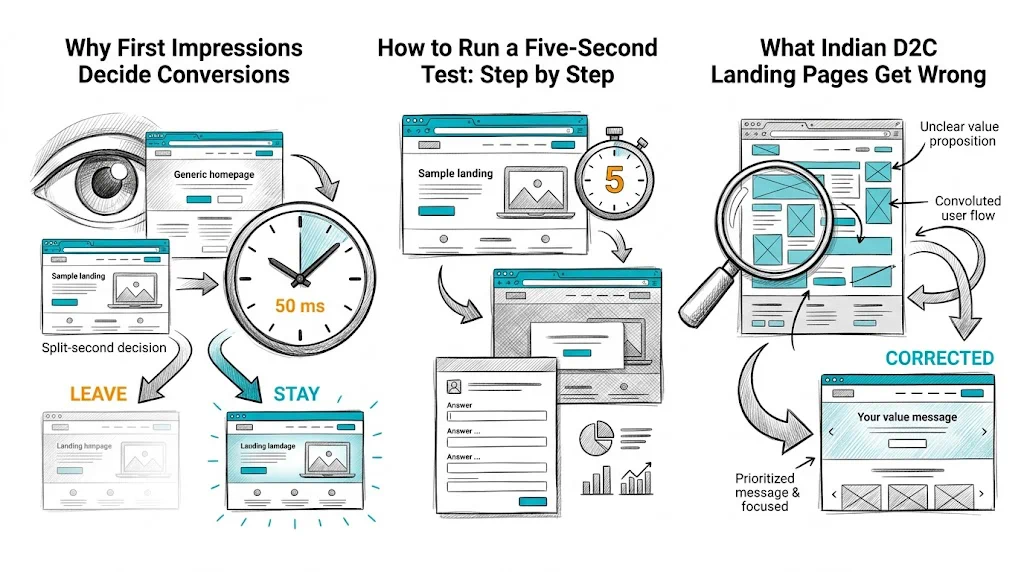
Visitors form an opinion of your landing page in 50 milliseconds — before they've read a word. Within five seconds, they've decided whether to stay or leave. All the copy, testimonials, and A/B test variants in the world don't help if your hero section fails this primal test.
Five-second tests specifically measure:
For Indian D2C brands running paid ads, landing page clarity is directly tied to ROAS. A confused visitor bounces. A clear, instantly comprehensible hero section keeps them reading — and buying.
Bellavita, Kapiva, and other high-performing D2C brands consistently invest in landing page clarity because they know: ad spend gets visitors to the door, but the hero section gets them through it.
Five-second tests work best on:
Take a full-page screenshot or use a tool that can display a live URL. Crop to show only the above-the-fold area for maximum signal clarity.
After the five-second exposure, ask participants:
Don't ask more than 5 questions. The value is in the open-text answers — they reveal the exact mental model visitors form in five seconds.
Target people who match your actual audience, not your team or close colleagues. Options:
Aim for 15-20 participants minimum. Fewer than 10 risks skewing results from one or two outliers.
Look for patterns across responses:
Positive signals:
Red flags:
Five-second test failures typically map to specific page elements:
| Problem | Likely Cause | Fix |
|---|---|---|
| Wrong product description | Headline too vague or clever | Lead with function, not brand voice |
| Wrong audience | Generic lifestyle imagery | Use audience-specific photography |
| No CTA recall | CTA has low visual contrast | Increase button color contrast, make text action-specific |
| No headline recall | Too many competing text elements | Reduce above-fold text density |
| Negative trust response | Design looks outdated or generic | Visual refresh, add trust signals above fold |
See also: Landing Page glossary | Conversion Rate Optimization glossary | Bounce Rate glossary
Headline clarity: Indian D2C brands often lead with brand taglines that mean nothing to a new visitor. "Pure. Honest. Effective." tells a visitor nothing about what you sell. "Ayurvedic hair oil that stops breakage in 30 days" is a five-second test winner.
Image-CTA alignment: The hero image shows a happy model. The CTA says "Shop Now." The product is never visible. Five-second test participants describe it as a "lifestyle brand" — and don't know what to buy.
Trust signals missing above fold: Indian shoppers are highly skeptical of D2C brands they've never heard of. Five-second tests regularly show that a "4.8★ from 12,000+ customers" line in the hero section dramatically increases trust recall.
COD/UPI visibility: Participants from Tier-2 cities consistently respond better to hero sections that mention "Cash on Delivery available" or show payment icons. Burying payment options at checkout loses trust early.
Mobile hero section breakdown: On mobile, desktop hero sections often break — text overlaps imagery, CTAs move below the fold, or font sizes are unreadable. Always run five-second tests on mobile screenshots too.
Lyssna (formerly UsabilityHub): Free tier allows unlimited tests with your own participants. Upload a screenshot, set 5 seconds, add questions, share link.
Maze: Free plan includes five-second tests. Integrates with Figma if you're testing prototypes.
Manual method: Show a screenshot on a laptop to 5 colleagues or customers. Close it after 5 seconds. Ask your questions. Record answers. This costs nothing and takes 30 minutes.
Google Forms + Timer: Share a screenshot in a Google Form, ask participants to view it for exactly 5 seconds on their own, then complete the form questions. Imperfect but free.
See also: User Experience glossary | Click Map glossary | Heatmap glossary
Five-second test findings should feed directly into your CRO backlog:
If headline clarity fails: A/B test benefit-led headlines vs. your current tagline. Example: Test "Clinically proven Ashwagandha — stress down in 14 days" vs. your current hero text.
If CTA recall fails: A/B test button colors, sizes, and copy. "Get My Free Sample" vs. "Shop Now" vs. "Try It Free."
If trust recall fails: A/B test adding social proof (star rating + review count) in the hero section vs. keeping it lower on the page.
If audience misidentification: A/B test different hero images — stock lifestyle vs. real customer photos vs. founder story imagery.
Run these tests with CustomFit.ai on Shopify without developer involvement.