From the conversion glossary
Concepts referenced in this article, defined.
Concepts referenced in this article, defined.
Run rigorous A/B tests and personalize every visit on Shopify or any storefront — no engineers required.
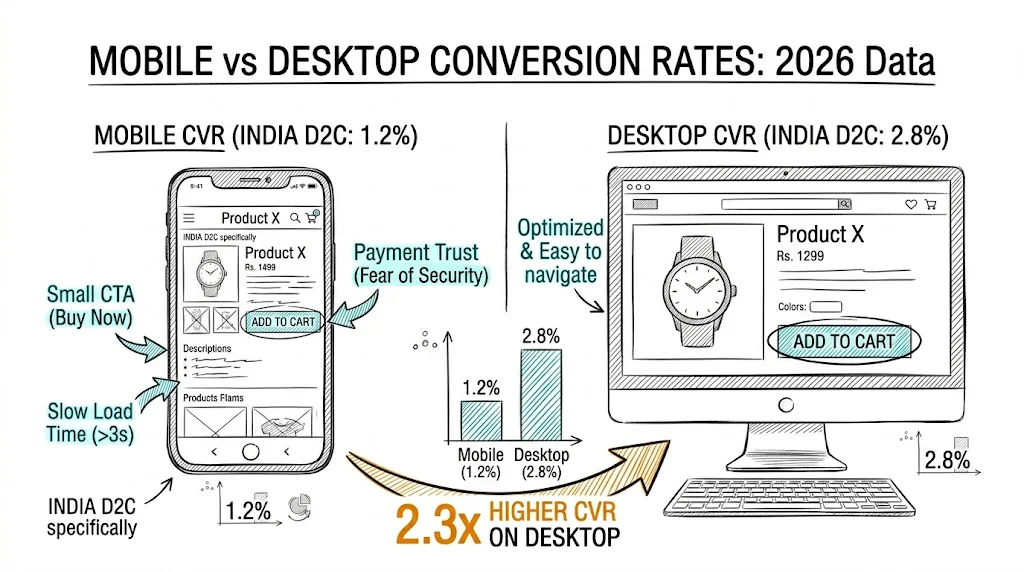
Mobile drives the majority of ecommerce traffic — but converts at a fraction of desktop rates. In India, where mobile accounts for 70-80% of D2C traffic, this gap represents the single largest CRO opportunity for most brands. Understanding why the gap exists — and how to close it — is more valuable than any other optimization you'll run this year.
Global benchmarks for ecommerce conversion rates:
The desktop-to-mobile CVR gap globally is roughly 2-3x. Mobile traffic has grown dramatically but mobile conversion rates have improved more slowly — creating a massive optimization opportunity.
The mobile-desktop CVR gap in India has unique characteristics:
Traffic is more mobile-skewed. Indian D2C brands typically see 70-80% of traffic from mobile, versus 50-60% in Western markets. This means the aggregate impact of low mobile CVR is even more severe for Indian brands.
Payment complexity. The Indian payment ecosystem is rich — UPI, COD, EMI, wallet, debit/credit card — but this complexity can create friction on mobile if not implemented well. A checkout flow that accommodates all payment methods while remaining simple on a 5-inch screen requires deliberate design.
Device range is wider. Indian mobile users shop across a broader range of device types and screen sizes — from flagship iPhones to budget Android devices with 2GB RAM. A page that loads beautifully on a flagship may be unusable on a mid-range Android.
COD dependency. Cash on delivery is still significant in Indian D2C, especially in Tier-2/3 markets. Brands that make COD selection easy on mobile typically see higher mobile CVR from these segments.
4G connectivity variation. While 5G is expanding, large portions of Indian shoppers still experience 4G speeds — or slower in certain areas. Page load time optimization has more CVR impact in India than in markets with consistent high-speed connectivity.
See also: Conversion Rate Optimization glossary | Bounce Rate glossary | User Experience glossary
Mobile users are often in discovery mode — browsing Instagram, watching YouTube, checking WhatsApp. Desktop users are more often in deliberate buying mode. This isn't a UX problem; it's a behavioral one. But it means your mobile product page needs to work harder to move users from browsing to buying intent.
Filling out checkout forms on mobile is genuinely harder. Keyboard autocomplete errors, zip code input switching keyboard types, address fields that don't have proper mobile input types — these frictions add up. Each field is a potential abandonment point.
Mobile connections are slower and more variable than desktop. A product page that loads in 2 seconds on desktop may take 4-5 seconds on a budget Android on 4G. Every additional second of load time reduces conversion rate by 7-12%.
Small buttons, hard-to-tap links, CTA buttons that shift below the fold when the keyboard opens — all are more severe problems on mobile. "Add to Cart" buttons that are easily accessible on desktop can require zooming or scrolling on mobile.
Trust badges, review counts, and social proof elements that are immediately visible on a desktop product page may be below the fold on mobile — meaning users need to scroll before they encounter them. Many don't.
Multi-step checkout flows are harder to navigate on mobile. Progress indicators are often missing. Payment method icons may be tiny. UPI app deep-links may not work if the app isn't installed.
Run Google PageSpeed Insights on your mobile homepage and top product pages. Focus on:
A 1-second improvement in mobile load time typically lifts mobile CVR by 7-12%. This is the highest-ROI technical improvement most D2C stores can make.
Audit your product page on an actual mobile device (not a browser resize). What appears without scrolling? On most D2C product pages, the answer is: hero image and title. Trust signals are buried.
Test moving key trust elements above fold on mobile:
See also: Click Map glossary | Session Recording glossary | Heatmap glossary
The checkout stage is where mobile abandonment is highest. Steps to reduce friction:
Run your A/B tests segmented by device. A desktop-winning variant may not win on mobile — different user behavior, different screen real estate, different friction points.
CustomFit.ai allows device-segmented testing — run a mobile-specific test without affecting desktop experience, or vice versa. This is particularly important for Indian D2C brands where mobile traffic dominance means a mobile-specific improvement moves aggregate CVR more than any desktop improvement.
| Category | Typical Mobile CVR |
|---|---|
| Wellness/Supplements | 0.8–1.8% |
| Skincare/Beauty | 1.0–2.2% |
| Fashion/Apparel | 0.6–1.5% |
| Home/Kitchen | 0.5–1.2% |
| Food/Beverages | 1.2–2.5% |
These are directional benchmarks. Your baseline and improvement trajectory matters more than comparison to category averages.
To track mobile vs. desktop CVR in GA4:
Or create a custom exploration with Device Category as a segment — this lets you compare mobile and desktop across all key funnel metrics simultaneously.