From the conversion glossary
Concepts referenced in this article, defined.
Concepts referenced in this article, defined.
Run rigorous A/B tests and personalize every visit on Shopify or any storefront — no engineers required.
A referral program turns your happiest customers into your cheapest and best acquisition channel. Referred customers convert at 3–5x the rate of cold traffic, have 18–25% higher LTV, and are more likely to become referrers themselves. For D2C brands paying ₹400–₹800 per new customer on Meta and Google, even a partially effective referral program dramatically improves CAC blended across all channels. Here's how to build one.
D2C brands compete with established brands on trust. A new shopper sees your Instagram ad and wonders: is this real? Will the product actually work? What happens if it doesn't? Every barrier to that first purchase is a conversion leak.
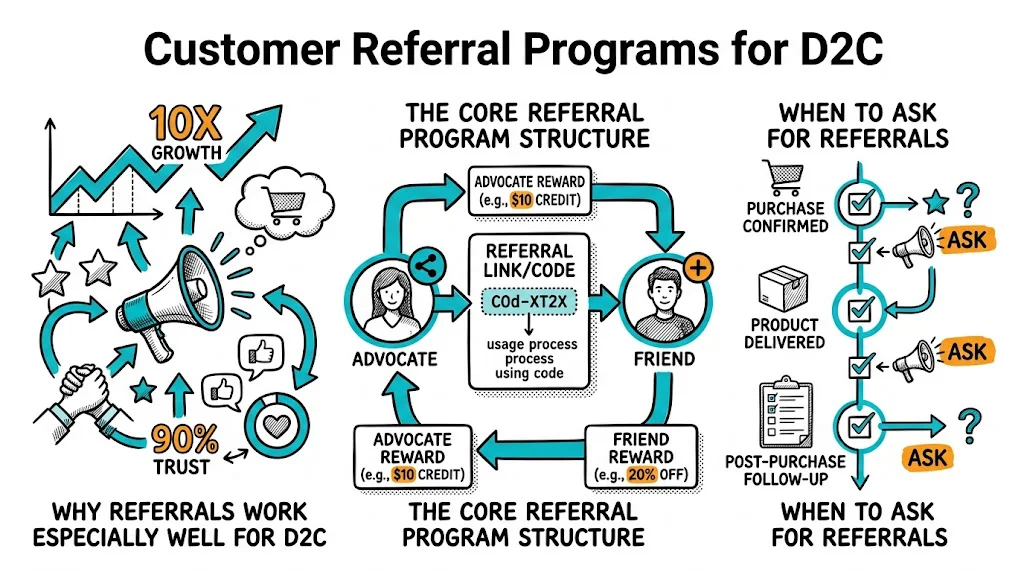
Referrals bypass this entire concern. When a friend says "I use this protein powder and it's genuinely good—here's 15% off," the trust is pre-established. The referred customer comes in with:
This is why referred customers convert at rates comparable to your best email segment, not your cold paid traffic.
Give something to both the referrer and the new customer:
The referrer reward motivates sharing. The new customer reward motivates converting. Without both, referral programs stall.
Example: "Give a friend ₹200 off their first order. Get ₹200 store credit when they buy."
This structure works because:
Some brands only reward the referrer, or only the new customer:
Referrer only: Motivates sharing but the new customer has no extra incentive to convert. Lower conversion rate on the referred click.
New customer only: Great entry-price incentive but doesn't motivate current customers to share proactively.
One-sided programs work as supplemental acquisition (offering a discount code to new customers) but not as true referral programs. If you want referral volume, use double-sided.
Timing is critical. Asking a customer who just received their order and is still uncertain about it to "refer a friend" is premature. The ideal moments:
After a positive signal:
In post-purchase email sequences: Add a referral ask in Email 4 or 5 of your post-purchase flow—after the review request, once the customer has had enough time to form a strong opinion.
In win-back campaigns: Customers who come back after lapsing and order again are in a high-satisfaction state. Reach them with a referral ask in the first post-win-back email.
How customers share the referral determines volume. Options:
Unique referral link: Most common. Each customer gets a unique URL (e.g., yourbrand.com/ref/[customer-code]). The link auto-applies the new customer discount. Easy to track.
Referral code: A short code (e.g., PRIYA15) that the new customer enters at checkout. Slightly higher friction than a link but works well for WhatsApp sharing (people copy-paste codes).
WhatsApp share button: An in-flow "Share via WhatsApp" button that pre-populates a message with the referral link. In India, WhatsApp is where referrals actually happen. A green "Share on WhatsApp" button on the referral program page dramatically outperforms an email share option.
SMS referral: Less common but effective for older demographic segments. Pre-written SMS with the referral code.
Popular referral tools for Shopify:
Most tools handle:
A referral program that nobody knows about generates zero referrals. Drive awareness:
Post-purchase email sequence: Add referral CTA starting from Email 3 or 4.
Loyalty program integration: Make sharing a points-earning action. "Earn 500 points when your friend makes their first purchase" adds referral into the habit loop.
Product packaging insert: A physical card in the box saying "Love [Brand Name]? Here's a gift for your friends" with a referral code is unexpectedly effective. Opening a beautifully packaged D2C product is a shareable moment—channel that.
Account dashboard: Make the referral link prominent in the customer account page. Customers who log in are high-engagement; they'll find it.
Festive campaigns: "Gift a friend for Diwali — they get ₹300 off, you get ₹300 credit" during October–November converts at higher rates. The gifting mindset aligns perfectly with referral behavior.
Thank-you page popup: Immediately after purchase, show a "Share and give your friend ₹200 off" offer. Purchase satisfaction is at its peak — this is one of the best conversion moments for referral signup.
When a referred customer clicks a referral link, their first experience on your site matters enormously. They come in with partial information (what their friend told them) and a discount code. The site needs to:
CustomFit.ai lets you build personalized landing experiences for referral traffic. When a visitor arrives via a referral link, you can show a tailored welcome message, highlight relevant products, and display the discount prominently—without any developer work. This referral-specific experience converts at meaningfully higher rates than sending all traffic to the generic homepage.
See how CustomFit.ai personalizes referral traffic landing pages →
Referral programs attract self-referrals and fraud if not protected. Common fraud patterns in D2C:
Basic protections:
Most referral platforms include basic fraud prevention. Review it and test it before launching.
Referrals sent per customer: How actively is your customer base sharing? Under 0.1 (1 in 10 customers sends a referral) is low. Target 0.3–0.5 for active referral programs.
Referral link click-through rate: Of referral links sent, what percentage get clicked? 15–30% is typical; below 10% suggests the referral message is weak or the incentive isn't compelling.
Referred-to-buyer conversion rate: Of clicked referral links, what percentage result in a purchase? Target 15–25%.
Referred customer LTV vs. non-referred: Over 6–12 months, do referred customers have higher LTV? They almost always do. Quantifying this justifies higher reward spend.
CAC for referred customers: (Reward cost × referral volume) / new customers acquired via referrals. Compare to your paid CAC. Typically, referral CAC is 40–70% lower than paid.