From the conversion glossary
Concepts referenced in this article, defined.
Concepts referenced in this article, defined.
Run rigorous A/B tests and personalize every visit on Shopify or any storefront — no engineers required.
Every email list has a segment of subscribers who were once active and have since gone quiet. They opened your welcome email, maybe bought once, and then stopped engaging. Re-engagement campaigns are the structured process of reaching this segment with a targeted message designed to either bring them back or confirm they have moved on — so you can focus your list on subscribers who actually want to hear from you.
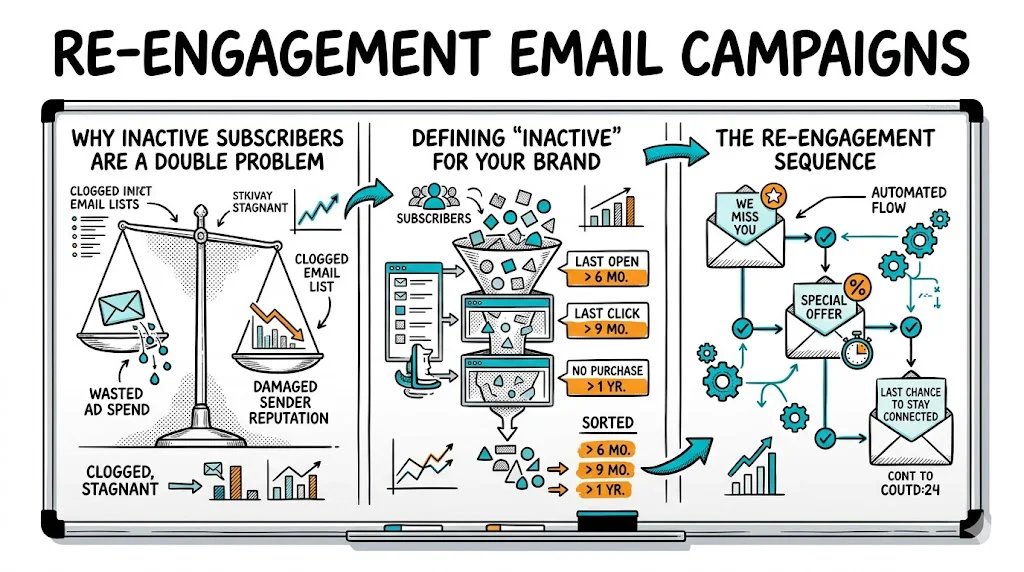
Inactive subscribers hurt you in two ways simultaneously:
Deliverability damage. Email service providers (Gmail, Outlook, Yahoo Mail) measure engagement rates — the percentage of your emails that are opened, clicked, or replied to. A large inactive segment pulls your engagement rate down. Low engagement rates cause providers to route your emails to spam or promotions folders, even for your active, engaged subscribers. Cleaning inactive subscribers protects deliverability for everyone else.
Distorted metrics. Open rate, click rate, and revenue per email all look worse when inactive subscribers are included in the denominator. This makes it harder to accurately measure improvements from testing.
The business case for re-engagement is clear: either re-activate subscribers who have value, or confirm they are gone and remove them to protect the active list.
The right inactivity threshold depends on how often you email:
For most Indian D2C brands sending 2–4 emails per week, 90 days of no opens or clicks is a reasonable definition of inactive.
Segmentation within inactive subscribers:
Do not lead with a discount. Lead with a question that piques curiosity and signals that this email is different from your regular promotional mail.
Subject line options:
Email body:
No discount yet. Email 1 is about re-establishing connection, not transacting.
Send only to subscribers who did not open or click email 1. Those who opened email 1 should receive a follow-up that builds on the reconnection rather than jumping immediately to an offer.
For the non-openers, now is the time for the incentive:
Subject line: "We'd love to have you back — here's 25% off"
Email body:
The offer should be more compelling than your standard promotional discounts. If you run 20% off sales regularly, a 20% re-engagement offer is not special. Use 25%, free product with purchase, or early access to a new launch.
Subject line: "This is our last email — unless you want to stay"
This email serves two purposes:
Body copy:
The final email is also a list hygiene tool. Subscribers who click "Remove me" give you useful signal and go unsubscribed. Subscribers who click "Stay on our list" are re-confirmed and can be moved back to the active segment.
The most effective re-engagement campaigns reference the subscriber's history:
Previous purchase reference: "We noticed you bought [Product Name] 6 months ago — our new [Related Product] pairs perfectly with it. Here's 25% off."
Category affinity: "You've always loved our skincare range — we've just launched a new Vitamin C serum that's already getting 4.9 stars."
Replenishment trigger: For consumable products (supplements, skincare, food), calculate the expected replenishment date: "Your [Chyawanprash 500g] from October should be running low by now — here's 20% off your next order."
Replenishment-triggered re-engagement sequences see 2–3x higher conversion rates than generic re-engagement emails because they time the message to match the customer's actual need.
After three re-engagement emails without any response, the subscriber is likely permanently disengaged. Continuing to mail them:
Sunset process:
WhatsApp re-engagement: For subscribers whose WhatsApp numbers you have (from order history), a WhatsApp message is often more effective than email for re-engagement. Open rates are significantly higher. Keep the WhatsApp message brief and add the exclusive offer as the reason to click.
Festive season window: Subscribers who have been inactive can be re-activated more easily during Diwali, Navratri, or New Year when shopping intent is universally higher. A targeted festive re-engagement campaign ("The Diwali offers your family will love — just for subscribers we haven't heard from lately") takes advantage of seasonal motivation.
Regional personalisation: For brands with subscribers across India, referencing the subscriber's city or state in a re-engagement email drives noticeably higher open rates. "Your exclusive offers for [City Name]" is specific enough to feel personal.
Track these metrics for each re-engagement sequence:
A good benchmark: 5–15% of lapsed subscribers will re-engage with a well-optimised 3-email sequence. Below 5% suggests the sequence or offer needs improvement. Above 15% suggests your definition of "inactive" is set too aggressively (you are mailing people who are not actually disengaged).
Do not re-engage the entire inactive segment at once. Run the sequence in batches of 1,000–2,000 per week. This limits deliverability damage if engagement rates are low and allows you to adjust the sequence before reaching the full segment.
A/B test the offer type. Percentage discount vs. flat ₹ off vs. free product with purchase. The winning offer type often varies by product category and subscriber demographic.
Maintain a preference centre. Give subscribers the option to reduce email frequency rather than fully unsubscribe. Some inactive subscribers are over-emailed, not disinterested. A "email me monthly only" option saves them from your active list.
For more on email strategy, see the Email & Retention pillar guide and the article on abandoned cart email sequences.