CustomFit.ai β€” Website personalization, A/B testing and CRO for Shopify and D2C
Product
Features
✱
Website Personalization
Adapt to each visitor's behavior & intent
β§–
A/B & Multivariate Testing
Rigorous experimentation
✨
AI CopilotNEW
Personalize with a prompt
πŸ€–
AI WingmanNEW
Auto-optimize toward winners
🎯
AI Conversion OptimizerNEW
GPT-grade test ideas
✎
No-Code Visual Editor
Drag-and-drop edit any element
β–¦
Product Recommendations
Personalized recs that lift AOV
βš‘
Feature Flags
Ship safely with kill-switches
β—§
Chrome Extension
Edit your store in the browser
⧉
Shopify, WooCommerce & more
All platform integrations
View all features β†’
Use Cases
$
Price A/B Testing
Test price points to maximize revenue
β–¦
Theme A/B Testing
Compare whole layouts & designs
πŸ—‚
Template A/B Testing
Test whole PDP/PLP templates
🏷
Discount A/B Testing
Find the offer that converts
🚚
Shipping A/B Testing
Thresholds, speed & copy
✍
Content A/B Testing
Copy, images & reviews
πŸ’³
Checkout Gateway A/B
Payments & one-click
βŒ–
Geo-Based Personalization
Per-location content & offers
⚑
Buyer-Intent Nudges
Exit-intent & retargeting
↔
Split-URL / Redirection
Full-page redirect tests
View all use cases β†’
Solutions & Guides
β€’
Conversion Rate Optimization
The complete CRO guide
β§–
A/B Testing Software
Buyer's guide for D2C
πŸ›’
Cart Abandonment Recovery
Win back lost carts
πŸ“°
Landing Page Optimization
Convert more paid traffic
S
Shopify A/B Testing
Test your store, no code
S
Shopify Personalization
Tailor the store per shopper
β—”
First-Time Visitor Offers
Convert new shoppers with trust & offers
β˜…
Repeat-Customer Experiences
Reward and re-engage loyal buyers
β—Ž
Campaign-Matched Pages
Match the landing page to the ad
βŒ–
Location-Based Experiences
Currency, language & regional offers
Explore CRO β†’
Customer stories
GIVA
+32%
conversion via personalized recs
GIVA
Mamaearth
+18%
revenue lift from PDP A/B tests
ME
The Sleep Company
+24%
AOV from product recommendations
TSC
Read customer stories β†’
Integrations
SWsfGA+15
✦
Not sure where to start?
Let AI Copilot pick your first tests

β€œWe wake up to evidence-backed tests ready to deploy β€” not a backlog of maybe ideas.”

AN
Anirudh S.
Growth Β· Chargebee
β˜…β˜…β˜…β˜…β˜…4.8on G2 Β· 2,400+ brands
Talk to our team β†’
Widgets
Integrations
Ecommerce & Checkout
Shopify
Shopline
Shoplazza
GoKwik
ShopFlo
Razorpay Magic Checkout
Breeze
Shiprocket
View all integrations β†’
Analytics & Behavior
Google Analytics 4
Microsoft Clarity
Hotjar
Mixpanel
Amplitude
Heap
Adobe Analytics
Segment (CDP)
View all integrations β†’
Engagement, CRM & More
Klaviyo
MoEngage
CleverTap
WebEngage
HubSpot
Salesforce
Slack
Meta Ads
View all integrations β†’
CustomersPricing
Resources
CRO
β–€
Playbooks
Proven strategies to boost conversions
πŸŽ™
Interviews
D2C leaders & marketing experts
β–Ά
Webinars
Live deep dives & product sessions
Learn
✎
Blog
Tips, experiments & best practices
πŸ“•
Free E-Books
Mastering personalization
πŸ“–
Conversion Glossary
Every CRO term, defined
✦AI CopilotNEWLog inBook a demo
Start free trial
Select your platform β€” Install in 2 minsWe'll tailor the setup
⚑ Risk-free 14-day trial · No credit card · Cancel anytime
S
Shopify
Install from Shopify App Store
β€Ί
W
WooCommerce
Install the WooCommerce plugin
β€Ί
B
BigCommerce
Install from BigCommerce App Marketplace
β€Ί
SL
Shopline
Install from Shopline App Store
β€Ί
M
Salesforce / Magento
Install from the marketplace
β€Ί
SZ
Shoplazza
Install from Shoplazza App Store
β€Ί
WP
WordPress / Webflow
Install plugin or paste the script
β€Ί
β—§
Others
Custom-built on React, Next.js, etc.
β€Ί
Tip: pick your platform β€” we handle the restBook a demo β†’
Product
Website PersonalizationA/B & Multivariate TestingAI CopilotAI WingmanAI Conversion OptimizerNo-Code Visual EditorProduct RecommendationsFeature FlagsView all features β†’
Use Cases
Price A/B TestingTheme A/B TestingTemplate A/B TestingDiscount A/B TestingShipping A/B TestingContent A/B TestingCheckout Gateway A/BGeo-Based PersonalizationBuyer-Intent NudgesSplit-URL / Redirection
Solutions & Guides
Conversion Rate OptimizationA/B Testing SoftwareCart Abandonment RecoveryLanding Page OptimizationShopify A/B TestingShopify Personalization
Explore
WidgetsIntegrationsCustomersPricing
Resources
BlogPlaybooksWebinarsInterviewsE-BooksConversion Glossary
Platforms
ShopifyShoplineShoplazzaChrome ExtensionAll integrations
Start free trialBook a demo
Homeβ€ΊBlogβ€ΊIs Your A/B Test Really a Winner? How to Double-Check Before Scaling

Is Your A/B Test Really a Winner? How to Double-Check Before Scaling

Learn how to validate A/B test results before scaling using the right metrics, segmentation, and CRO best practices with CustomFit.ai.

SJSapna JoharDecember 21, 202512 min read
On this page
  1. Why False Winners Are More Common Than You Think
  2. Step One: Confirm You Tested the Right Goal
  3. Step Two: Check Whether the Lift Is Consistent Over Time
  4. Step Three: Validate Statistical Confidence Without Obsessing Over It
  5. Step Four: Look for Segment-Specific Effects
  6. Step Five: Check Downstream Metrics for Hidden Damage
  7. Step Six: Re-Run or Extend the Test When the Stakes Are High
  8. Step Seven: Ask Whether the Result Makes Behavioral Sense
  9. Step Eight: Decide How to Scale Carefully
  10. Common Mistakes Teams Make When Declaring a Winner
  11. How CustomFit.ai Fits Into Responsible Scaling
  12. Turning A/B Testing Into a Long-Term Advantage
  13. Conclusion: A Real Winner Holds Up After Scrutiny
  14. FAQs: Is Your A/B Test Really a Winner?
  15. What does it mean for an A/B test to be a real winner?
  16. Why do some A/B test winners fail after rollout?
  17. How long should I run an A/B test before declaring a winner?
  18. Is statistical significance enough to scale an A/B test?
  19. How does segmentation help validate A/B tests?
  20. Can AB testing for SEO be affected by scaling too fast?
  21. What metrics should I check before scaling an A/B test?
  22. Should I rerun important A/B tests?
  23. How can an A/B Testing Platform help avoid false winners?
  24. How does CustomFit.ai support safe scaling of A/B tests?
0%
Is Your A/B Test Really a Winner? How to Double-Check Before Scaling

From the conversion glossary

Concepts referenced in this article, defined.

Definition
What Is Winner? Definition, Formula & Guide
Definition
What Is Variant? Definition, Formula & Guide
Definition
What Is Lift? Definition, Formula & Guide
Definition
What Is Segmentation? Definition & Guide
Definition
What Is Control? Definition, Formula & Guide
Try CustomFit.ai

Run A/B tests and personalize your store without code. 14-day free trial, no credit card.

Start free trial β†’
Share
XLinkedInEmail

Start lifting conversions today.

Run rigorous A/B tests and personalize every visit on Shopify or any storefront β€” no engineers required.

Start free trialBook a demo

Built for every D2C category

🧴
Skincare
πŸ’„
Beauty
🌿
Wellness
β˜•
F&B
πŸ‘Ÿ
Apparel
πŸ’
Jewelry
πŸ›‹οΈ
Home
🍼
Baby
Live Β· Right now
Mamaearth β€” free-shipping band +12.4% AOVGIVA β€” festive collection page +34% revenueBellavita β€” PDP CTA test +27.4% CVRKapiva β€” Quiz-driven recs +9.48% CTRThe Sleep Co β€” landing personalized 2Γ— capturesPlum β€” Returning shopper swap +18.2% CVRMamaearth β€” free-shipping band +12.4% AOVGIVA β€” festive collection page +34% revenueBellavita β€” PDP CTA test +27.4% CVRKapiva β€” Quiz-driven recs +9.48% CTRThe Sleep Co β€” landing personalized 2Γ— capturesPlum β€” Returning shopper swap +18.2% CVR
Get in touch

Tell us about your store.

We reply within an hour during business hours. No sales pitch, no spam β€” just answers from someone who's seen 2,400+ D2C stores.

βœ“ Reply within 1 hourβœ“ No spam, everβœ“ Free demo & setup help
βœ“ Thanks! We'll be in touch shortly.
CustomFit.ai

The all-in-one website personalization, A/B testing & CRO platform for high-growth D2C brands. Made by marketers, fueled by coffee.

inπ•β—Žβ–Άf
Product
  • Features
  • A/B Testing
  • Personalization
  • AI Copilot
  • AI Wingman
  • AI Conversion Optimizer
  • Feature Flags
  • Widgets
  • Integrations
  • ROI Calculator
Platforms
  • Shopify
  • Shopline
  • Shoplazza
  • Salesforce
  • Chrome Extension
  • All Integrations
Resources
  • Blog
  • Playbooks
  • Webinars
  • GrowthFit Interviews
  • Free E-Books
  • Conversion Glossary
  • Case Studies
Compare
  • vs VWO
  • vs Optimizely
  • vs Google Optimize
  • vs Mutiny
  • vs Intelligems
  • vs Shoplift
  • vs AB Tasty
  • vs Convert
  • vs Kameleoon
Company
  • About Us
  • Partners
  • CustomFit Awards
  • Recognition
  • Contact
  • Privacy Policy
  • Terms & Conditions
Β© 2026 CustomFit.ai Β· Valley Monks Pvt Ltd Β· Made by marketers, fueled by coffee, and obsessed with conversions.
SOC 2 Type II Β· GDPR Β· CCPA Β· ISO 27001

You finally see it in your dashboard.

Variant B is outperforming Variant A. The conversion rate is up. Revenue looks higher. Someone on the team says, β€œThis is a winner. Let’s roll it out everywhere.”

This moment feels good. After weeks of planning, building, and waiting, it feels like proof that the work paid off.

But here is the uncomfortable truth many ecommerce and D2C brands learn the hard way.

Not every A/B test winner is a real winner.

Some β€œwinning” tests quietly fail after rollout. Some perform well for a short window and then regress. Others lift one metric while hurting another that matters more. And some wins are simply statistical noise that looked convincing because traffic spiked or behavior shifted temporarily.

Before you scale any A/B test across your ecommerce store, especially during high-traffic periods or campaigns, you need to slow down and double-check what you are seeing.

This guide walks through how to validate whether your A/B test is truly a winner before scaling. We will cover behavioral signals, statistical checks, segmentation traps, and practical validation steps. We will also touch on how teams using an A/B Testing Platform like CustomFit.ai approach this process in a structured way without turning it into overanalysis.

This is not about doubting experimentation. It is about respecting it.
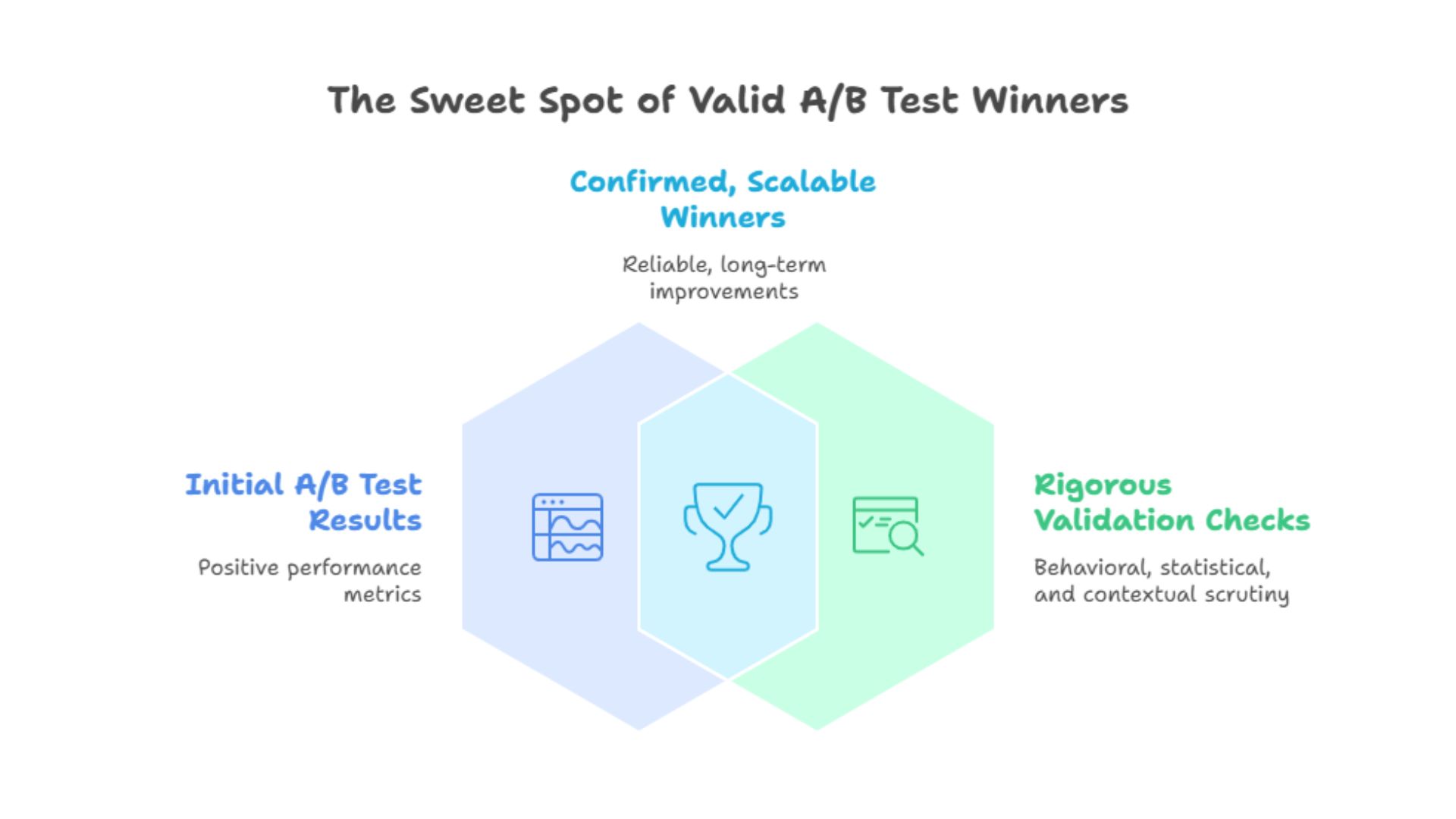
The Sweet Spot of Valid AB Test Winners

‍

Why False Winners Are More Common Than You Think

A/B Testing is powerful, but it is also easy to misinterpret.

Most ecommerce teams run tests under real-world conditions. Traffic is uneven. Campaigns start and stop. Discounts overlap. Behavior shifts by device, region, and time of day.

In this environment, it is surprisingly easy for a test to appear successful without being truly reliable.

Here are a few reasons false winners show up so often.

  • Short test durations that capture unusual traffic patterns
  • Results driven by a single segment rather than the whole audience
  • A focus on one metric while ignoring downstream effects
  • Seasonal or campaign-driven behavior skewing results
  • Changes that increase clicks but reduce purchase intent

When teams rush to scale without validating these factors, they often end up rolling out changes that do not actually increase conversion rate over time.

‍

Step One: Confirm You Tested the Right Goal

The first question to ask is deceptively simple.

What exactly did this test optimize for?

Many A/B tests are set up around convenient metrics instead of meaningful ones. For example:

  • Clicks on a button
  • Engagement with a banner
  • Scroll depth
  • Time on page

These metrics are not useless, but they are often proxies. During the holidays or high-intent periods, proxies can mislead.

Before scaling, ask:

Did this test improve the metric that actually drives revenue?

For an ecommerce store, the most reliable primary metrics usually include:

  • Add to cart rate
  • Checkout initiation
  • Completed purchases
  • Revenue per visitor

If your test β€œwon” on clicks but did not move add to cart or checkout completion, you need to pause. That does not automatically make it a bad test, but it does mean it is not ready to be scaled globally.

Teams using a structured A/B Testing Platform typically define a single primary metric upfront and treat other metrics as secondary signals. This clarity makes post-test validation much easier.

‍

Step Two: Check Whether the Lift Is Consistent Over Time

One of the most common traps in AB testing is early excitement.

You launch a test. After a few days, Variant B looks clearly ahead. The numbers feel convincing. But early results are often unstable.

Behavior changes throughout the week. Weekends behave differently than weekdays. Campaign launches can temporarily inflate intent.

Before calling a test a winner, review performance across time slices.

  • Did Variant B outperform consistently across multiple days?
  • Did it hold up during both high-traffic and low-traffic periods?
  • Did performance spike early and then flatten or reverse?

A true winner usually shows steady improvement rather than sharp peaks.

This is especially important for ecommerce brands running paid traffic. A short-term surge from ads can make a variant look stronger than it really is.

If you are using a platform like CustomFit.ai, reviewing performance trends over time rather than a single aggregate number helps avoid scaling on shaky ground.

‍

Step Three: Validate Statistical Confidence Without Obsessing Over It

Statistics matter, but they should guide decisions, not paralyze them.

Many teams either ignore statistical confidence entirely or get stuck chasing perfect significance that never arrives.

The practical approach sits in the middle.
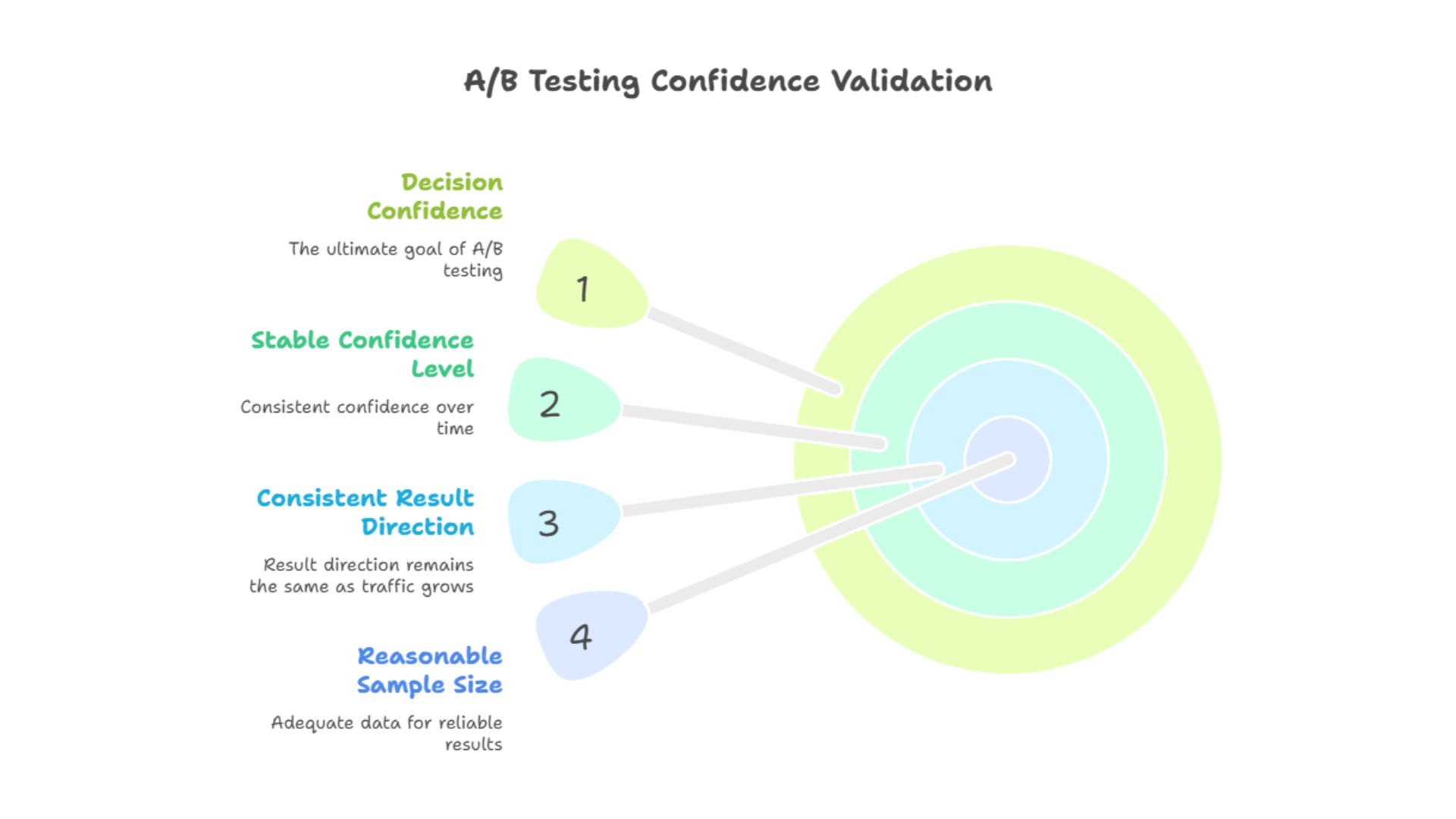
AB Testing Confidence Validation

‍

Before scaling, check:

  • Did the test reach a reasonable sample size for your traffic level?
  • Is the confidence level stable rather than fluctuating wildly?
  • Does the direction of the result remain the same as traffic grows?

If confidence jumps from 70 percent to 95 percent and back again, the test may not be stable. If it steadily improves as data accumulates, that is a healthier signal.

Modern A/B Testing Platforms simplify this by presenting confidence in a readable way rather than raw statistical jargon. The goal is not academic precision. The goal is decision confidence.

‍

Step Four: Look for Segment-Specific Effects

One of the biggest reasons tests fail after scaling is that they only worked for part of the audience.

This is extremely common in ecommerce.

For example:

  • A variant works well on desktop but hurts mobile
  • Paid traffic responds positively, organic traffic does not
  • New visitors convert better, returning customers convert worse
  • One region shows a strong lift, others show none

When you roll out globally without checking segmentation, you flatten these differences and lose the benefit.

Before scaling, break down results by:

  • Device type
  • Traffic source
  • New versus returning users
  • Geography if relevant

If Variant B is a clear winner for a specific segment but neutral or negative for others, the right move may not be full rollout. The smarter move may be personalization.

This is where tools like CustomFit.ai become especially useful, because they allow teams to turn a segment-specific win into a targeted experience instead of forcing it on everyone.

‍

Step Five: Check Downstream Metrics for Hidden Damage

A/B tests rarely affect only one part of the funnel.

A change that increases add to cart might reduce checkout completion. A design that feels urgent might increase purchases but also increase returns or cancellations.

Before scaling, review downstream metrics carefully.

Ask:

  • Did checkout completion remain stable or improve?
  • Did average order value change?
  • Did refund or cancellation rates shift?
  • Did page load or engagement metrics degrade?

These effects often show up quietly. If you scale too fast, you may only notice weeks later when revenue quality drops.

A responsible A/B Testing process treats conversion rate as part of a system, not an isolated number.

‍

Step Six: Re-Run or Extend the Test When the Stakes Are High

Some changes are low risk. Others are not.

If your test affects:

  • Pricing
  • Checkout flow
  • Subscription logic
  • Shipping visibility
  • Core navigation

It is worth validating twice.

This does not mean starting from scratch every time. Sometimes extending the test for another cycle or rerunning it during a different traffic mix is enough.
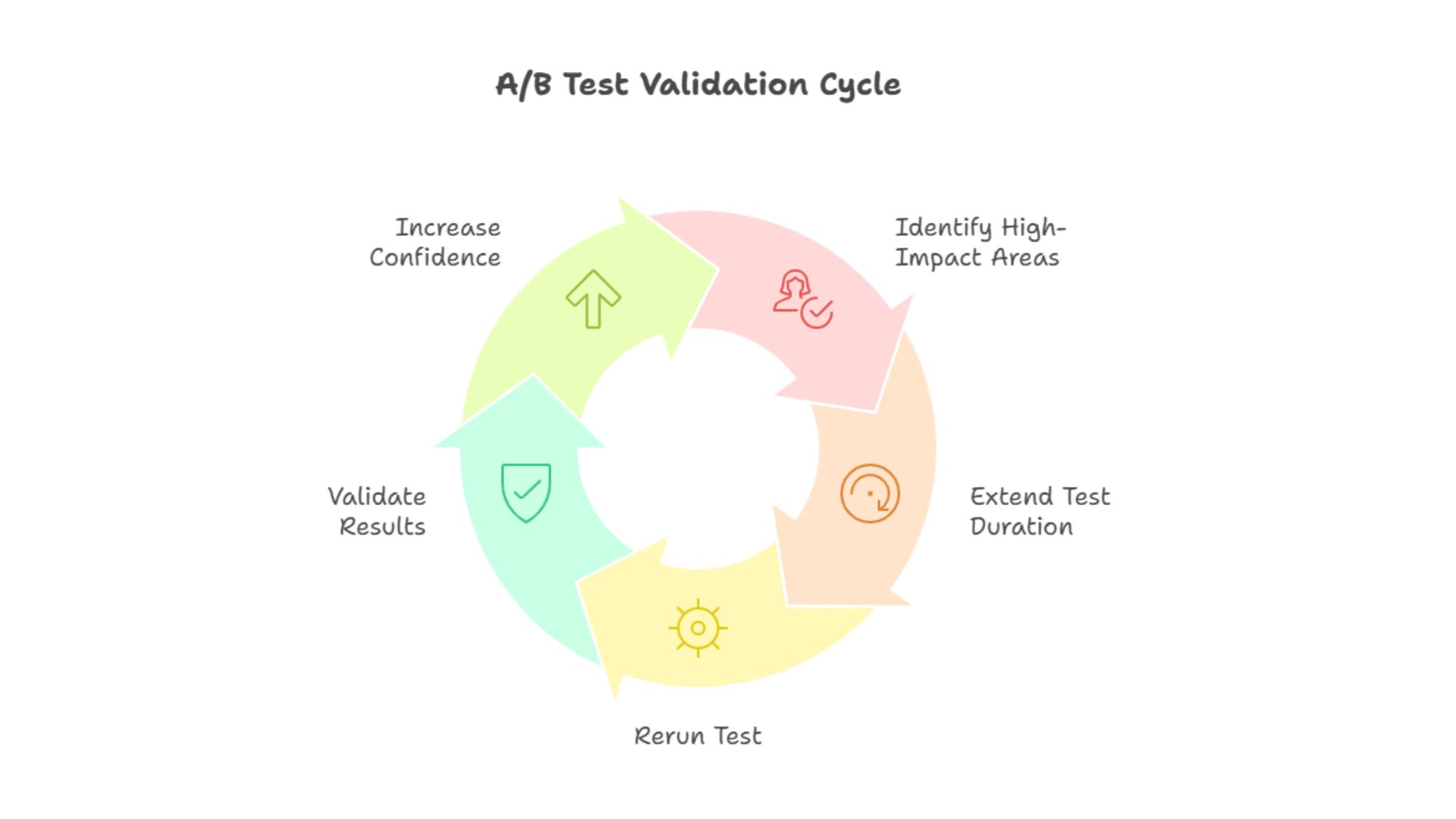
AB Test Validation Cycle

‍

For example:

  • Re-run the test during a non-sale period
  • Validate performance during a weekday-only window
  • Test the same change on a different high-traffic page

If the result repeats, confidence increases dramatically.

Conversion rate optimization companies often encourage this discipline because it prevents high-impact mistakes that are expensive to reverse.

‍

Step Seven: Ask Whether the Result Makes Behavioral Sense

Data is powerful, but logic still matters.

Before scaling, ask a simple question.

Does this result make sense given how users behave?

If a tiny copy change produced a massive lift, be cautious. If removing important information somehow increased conversion dramatically, dig deeper.

True winners usually align with behavioral intuition:

  • Reduced friction
  • Increased clarity
  • Improved trust
  • Better alignment with intent

If the result feels too good to be true, it often is.

This does not mean dismissing surprising wins. It means understanding them before acting.

Step Eight: Decide How to Scale Carefully

Scaling does not have to be all or nothing.

Instead of instantly rolling out to 100 percent of traffic, consider phased scaling.

  • Roll out to 50 percent and monitor
  • Apply only to high-performing segments first
  • Launch on a subset of pages
  • Keep monitoring key metrics post-rollout

A good A/B Testing Platform makes it easy to control exposure and rollback if needed.

This approach reduces risk while still capturing upside.

‍

Common Mistakes Teams Make When Declaring a Winner

Before moving on, it is worth calling out a few recurring mistakes.
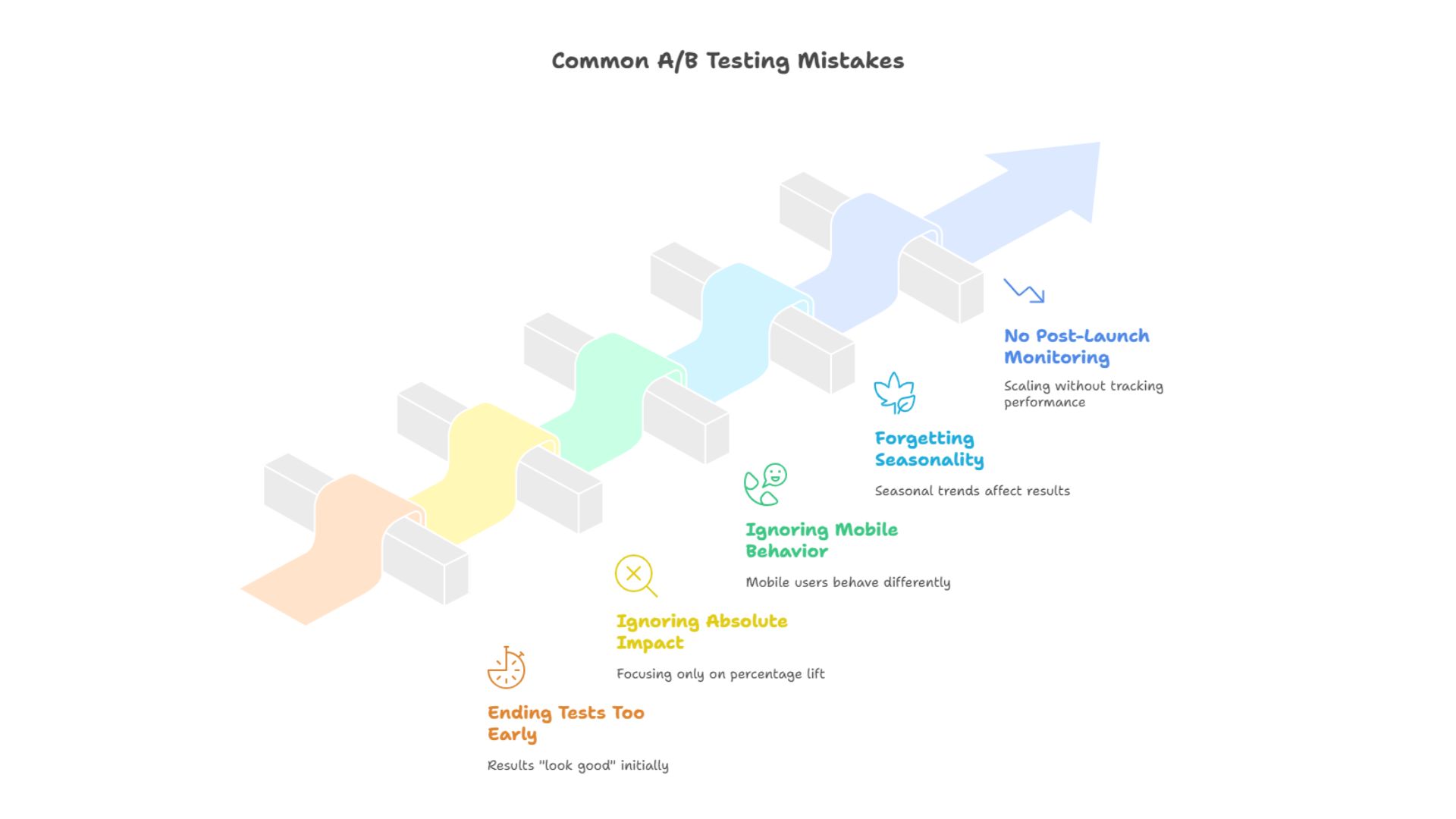
Common AB Testing Mistakes

  • Ending tests too early because results β€œlook good”
  • Focusing only on percentage lift without looking at absolute impact
  • Ignoring mobile behavior
  • Forgetting seasonality and campaign effects
  • Scaling without monitoring post-launch performance

Avoiding these mistakes does not require advanced math. It requires patience and structure.

‍

How CustomFit.ai Fits Into Responsible Scaling

CustomFit.ai is a conversion rate optimization company that helps ecommerce teams test, validate, and personalize website experiences without heavy development work.

While the platform simplifies running A/B tests, its real value shows up after the test ends.

Teams can:

  • Review segment-level performance easily
  • Turn segment-specific wins into personalized experiences
  • Control rollout exposure instead of forcing global changes
  • Monitor performance post-deployment

This makes scaling safer and more intentional, especially for D2C brands operating under high traffic pressure.

The tool does not decide for you. It gives you the clarity to decide well.

‍

Turning A/B Testing Into a Long-Term Advantage

The goal of A/B Testing is not to chase wins. It is to build confidence in decisions.

When teams validate properly before scaling, they:

  • Avoid reversals
  • Build trust in experimentation
  • Improve long-term conversion rate
  • Reduce internal debates
  • Create repeatable optimization habits

Over time, this discipline compounds. The ecommerce store becomes more stable, more predictable, and more resilient under pressure.

A test that survives validation is far more valuable than a test that simply β€œwon” once.

‍

Conclusion: A Real Winner Holds Up After Scrutiny

Seeing a positive A/B test result is exciting. Scaling it responsibly is where the real work begins.

Before you roll out any test widely, pause and ask:

  • Did it improve the right metric?
  • Did it perform consistently over time?
  • Does it hold across segments?
  • Did it avoid harming downstream behavior?
  • Does it make sense behaviorally?

If the answer is yes across these questions, you are likely looking at a true winner.

A/B Testing is not just about finding changes that work. It is about finding changes that keep working.

That is how you turn experiments into sustainable growth.

‍

FAQs: Is Your A/B Test Really a Winner?

What does it mean for an A/B test to be a real winner?

A real A/B test winner is one that consistently improves a meaningful business metric such as conversion rate or revenue, holds up across time and segments, and does not harm other parts of the funnel after scaling.

Why do some A/B test winners fail after rollout?

Many tests appear to win due to short-term behavior, campaign effects, or specific segments. When rolled out globally, those conditions disappear, and performance drops.

How long should I run an A/B test before declaring a winner?

There is no fixed duration, but tests should run long enough to capture different traffic patterns such as weekdays and weekends. Stability over time matters more than speed.

Is statistical significance enough to scale an A/B test?

Statistical confidence is important, but it is not enough on its own. Teams should also review segment performance, downstream metrics, and behavioral logic before scaling.

How does segmentation help validate A/B tests?

Segment analysis reveals whether a test worked broadly or only for certain users. This insight helps decide whether to roll out globally or use personalization instead.

Can AB testing for SEO be affected by scaling too fast?

Yes. Poorly validated changes can harm engagement metrics that indirectly affect SEO. Responsible AB Testing for SEO focuses on improving clarity and user experience, not just short-term clicks.

What metrics should I check before scaling an A/B test?

Focus on conversion rate, checkout completion, revenue per visitor, and any downstream signals such as refunds or cancellations.

Should I rerun important A/B tests?

For high-impact changes, rerunning or extending tests can confirm reliability and reduce risk. This is especially important for pricing, checkout, or navigation changes.

How can an A/B Testing Platform help avoid false winners?

A good A/B Testing Platform provides clear reporting, segment breakdowns, controlled rollouts, and post-launch monitoring so teams can validate results before scaling.

How does CustomFit.ai support safe scaling of A/B tests?

CustomFit.ai helps ecommerce teams analyze test performance deeply, personalize winning experiences for specific segments, and roll out changes gradually while monitoring impact. This reduces risk and improves long-term conversion rate outcomes.