From the conversion glossary
Concepts referenced in this article, defined.
Concepts referenced in this article, defined.
Run rigorous A/B tests and personalize every visit on Shopify or any storefront — no engineers required.
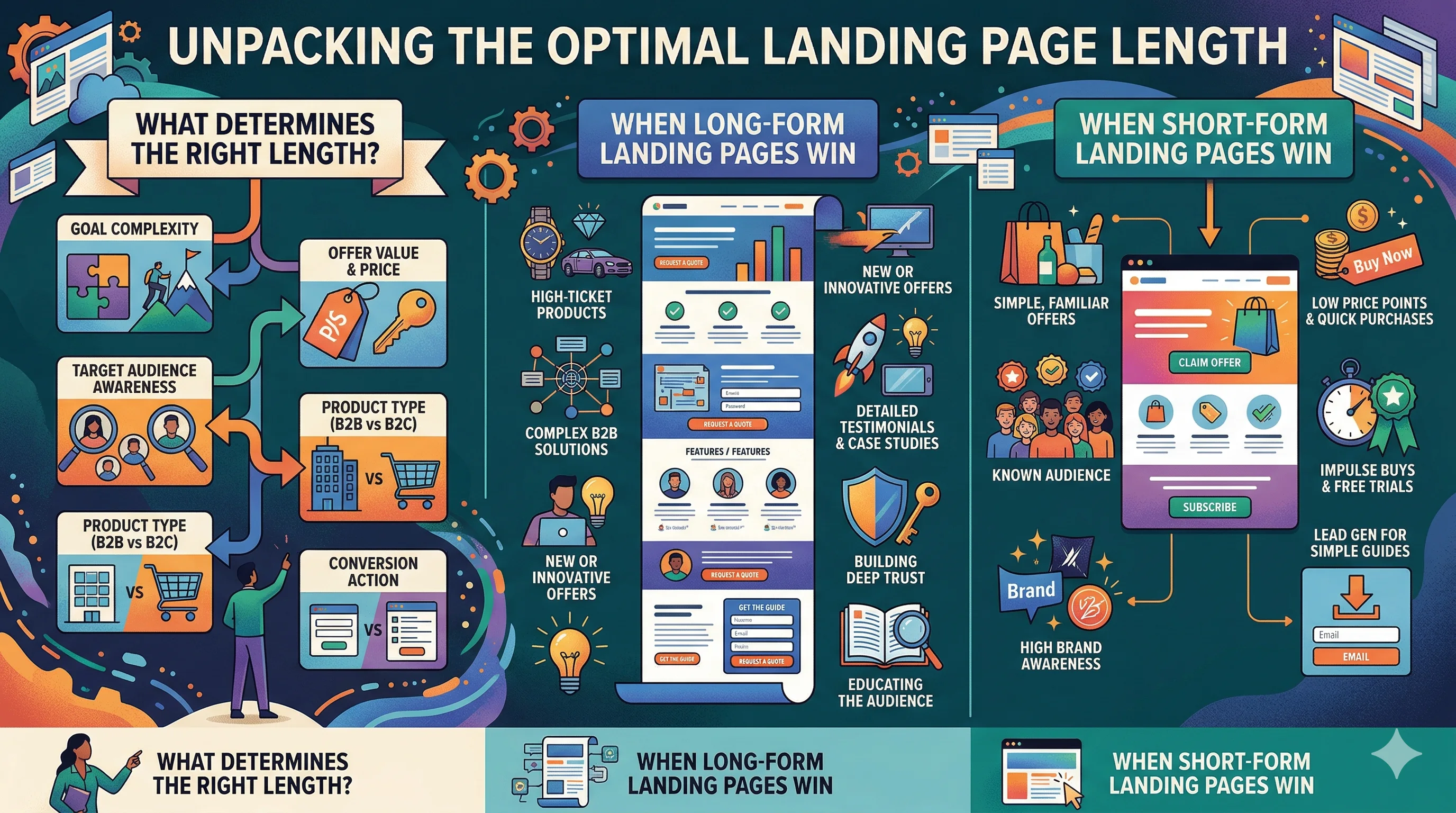
Long-form landing pages (1,500+ words, many sections, deep product explanations) and short-form pages (600–800 words, minimal scrolling, fast path to purchase) each have a place in D2C ecommerce. The mistake most brands make is choosing based on what they have seen others do rather than on what their specific traffic and product require. Here is the framework for making the right call — and then testing to confirm it.
Page length should be determined by one question: How much does my visitor need to know before they are comfortable buying?
This question is answered by two variables:
Cross these two variables:
| High Awareness (knows the category) | Low Awareness (discovering category) | |
|---|---|---|
| Low consideration (under ₹999) | Short-form wins | Short-form + education section |
| High consideration (₹1,500+) | Short-form with proof sections | Long-form essential |
New product categories. If you are selling something Indian consumers have not encountered widely — an adaptogen blend, a fascia massage tool, a postbiotic supplement — long-form is essential. You cannot skip the "why this matters" education.
Kapiva's Ayurvedic product pages for newer formulations include the science, the tradition, the ingredients, and the customer transformation stories — a format that would feel over-engineered for a commodity face wash but is necessary for a category-building product.
High-ticket products. Above ₹2,000, shoppers do more research. They read more, compare more, and want to see clinical evidence, detailed ingredient explanations, and extensive social proof before committing. Your page must satisfy this due diligence.
Cold Facebook/Instagram traffic. Cold audience visitors need more education because they arrived without intent. Long-form pages that walk them from "what is this" to "why I need it" to "proof it works" to "buy now" outperform short-form for unfamiliar products.
Products with complex objections. If there are common concerns ("Does this supplement interact with medications?" "Will this work on dark South Asian skin tones?") that your customer service team handles repeatedly, address them on the page. Each objection you resolve in the copy is a conversion you save from the customer who would have left to ask someone else.
High-intent search traffic. Visitors who typed "buy neem face wash Shopify" already know what they want. Give them a hero, a quick benefit list, price, and a buy button. Every additional section is a scroll they might not complete.
Retargeting campaigns. Visitors you are retargeting have already seen your product, possibly already visited your site. They do not need re-education — they need a reason to complete the purchase (urgency, a review they missed, a different price point). Short-form retargeting pages convert significantly better than long-form.
Known, repeat-purchase products. Your returning customers do not need to re-learn why your Vitamin C serum is good. They are here to reorder. A short, fast product page with their previous order pre-filled is what they need.
Impulse-priced products. Products under ₹499 are purchased impulsively. Long-form pages for low-priced items create a mismatch between the purchase commitment (low) and the research experience (high). It introduces doubt where none existed.
Short-form landing page structure:
Total: 600–800 words, 5 sections
Long-form landing page structure:
Total: 1,500–2,500 words, 9–10 sections
Many high-converting D2C pages use a hybrid: a short-form above-the-fold experience (hero, CTA, quick benefits) that converts impatient buyers immediately, followed by long-form content below the fold for shoppers who need more before deciding.
The sticky "Add to Cart" bar that follows scrollers down the page is the tactical implementation of this — it makes the short-form CTA available even while the visitor is reading long-form content.
Bellavita's product pages use this effectively: clean, fast hero with one CTA above fold, followed by deep ingredient stories, customer photo galleries, and FAQ sections below.
Test 1: Identical content, different order Same sections but short-form version puts social proof before product benefits vs long-form puts it after. This tests section ordering, not total length.
Test 2: Truncated vs full version Long-form version vs a version where all below-fold content is collapsed behind "Read more" expandable sections. Tracks whether the content matters or is invisible.
Test 3: Section removal Remove one section at a time from a long-form page and measure conversion impact. This identifies which sections are contributing to conversion vs adding length with no benefit.
Test 4: Entry point segmentation Show long-form to Facebook cold traffic (utm_medium=paid_social) and short-form to Google branded search traffic (utm_medium=cpc). Compare conversion rates within each segment.
Use CustomFit.ai to segment by traffic source and run length experiments without code.
Related reading: