From the conversion glossary
Concepts referenced in this article, defined.
Concepts referenced in this article, defined.
Run rigorous A/B tests and personalize every visit on Shopify or any storefront — no engineers required.
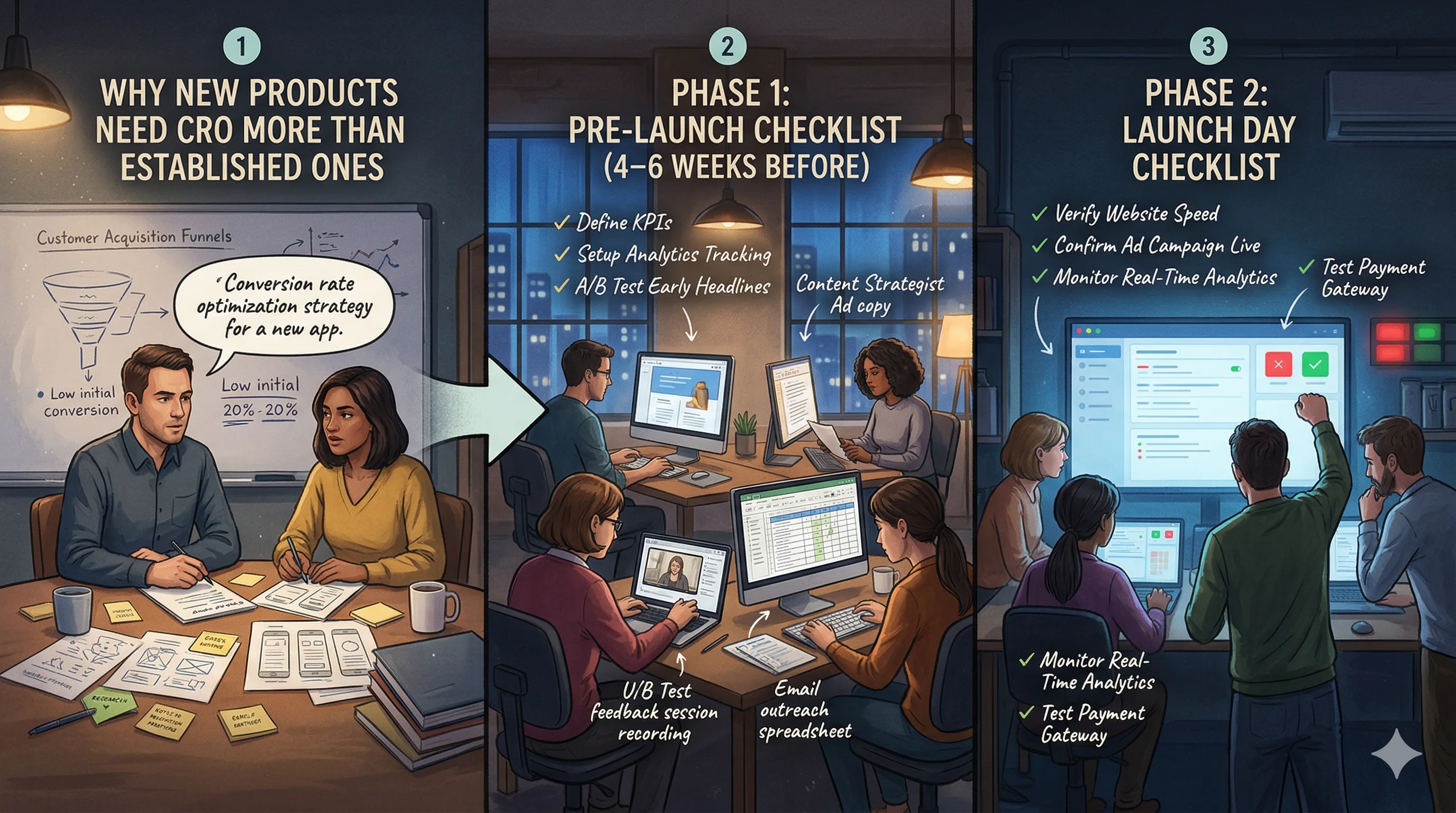
A new product launch is a high-stakes, one-shot event for most D2C brands — and most brands waste it by treating CRO as an afterthought. Building conversion rate optimization into the launch process from the start means you're not scrambling to fix a failing page after you've burned your launch traffic. This checklist covers every phase: pre-launch, launch day, first two weeks, and post-launch analysis.
Established products have something new ones don't: a track record. They have reviews, return visitor behavior data, heatmaps, session recordings, and A/B test results. A new product page is a blank slate — you're guessing at what messaging works, what objections buyers have, and what the conversion funnel should look like.
The brands that treat launch week as a CRO experiment — not just a marketing campaign — come out with data that compounds. Every test they run gives them insights that inform the next launch.
Bellavita, one of India's fastest-growing beauty D2C brands, achieved an 11% average conversion improvement using CustomFit.ai across their product portfolio — gains that came from exactly this kind of systematic CRO, applied from launch.
view_item, add_to_cart, begin_checkout, purchaseBuild a "Coming Soon" page 3–4 weeks before launch and drive early traffic to it via email list, social, and paid ads. Test:
This pre-launch data is gold. You're running A/B tests before your main traffic arrives, so by launch day you already know your winning headline.
On launch day, you have no reviews yet. Compensate with:
Don't make major changes in the first 48 hours — let traffic accumulate. At the 72-hour mark, review:
Bounce rate: If above 65% from paid sources, your landing page messaging doesn't match your ad. Fix the H1 or hero first.
Add-to-cart rate: Below 5% signals a product-price-trust problem. Check your reviews section (add beta testimonials if empty), pricing (is your launch price anchored against a higher "regular" price?), and delivery promise (is it visible?).
Checkout abandonment rate: Above 75% suggests friction in payment — check UPI flow, COD visibility, and mobile form usability.
Heatmap analysis: Where are people clicking that leads nowhere? Where are they stopping scrolling? These are your biggest CRO opportunities.
Test 1: Review substitute Control: Empty review section ("Be the first to review") Variant: Beta tester testimonials formatted as reviews, or a founder's note Expected lift: 8–15% in add-to-cart rate
Test 2: Urgency bar Control: No urgency element Variant: "Launch offer ends [date]" in a site-wide bar Expected lift: 10–20% in conversion rate during launch window
Test 3: Bundle upsell placement Control: Bundle shown below the fold Variant: Bundle shown in the hero section as the primary option Expected lift: 15–25% in average order value
By day 10, you should have preliminary data from your Week 1 tests. If a variant is winning clearly (even before 95% significance), consider increasing traffic to it while the test completes. Don't call it done — but don't ignore strong signals either.
Also in Week 2:
| Metric | Target | Actual | Notes |
|---|---|---|---|
| Launch-week CVR | >3% | — | Segment by channel |
| Add-to-cart rate | >8% | — | — |
| Cart abandonment rate | <70% | — | — |
| Average order value | >₹1,200 | — | Check bundle attach rate |
| Return rate | <8% | — | High returns = product-description mismatch |
| Review volume (2 weeks) | >20 | — | Accelerate with email nudges |
Learn more: Seasonal CRO Pillar | Valentine's Day CRO Playbook | CRO Pillar