From the conversion glossary
Concepts referenced in this article, defined.
Concepts referenced in this article, defined.
Run rigorous A/B tests and personalize every visit on Shopify or any storefront — no engineers required.
Your cart page (and cart drawer) is the last stop before checkout — and the last opportunity to increase what your customers spend before they complete their purchase. Most Shopify stores treat the cart as a passive summary of chosen items. Smart brands treat it as an active revenue lever. A/B testing cart elements — the free shipping bar, upsell recommendations, trust signals, and CTA copy — can lift AOV by 15–25% with no additional traffic. Here's how.
The average ecommerce store loses significant potential revenue at the cart stage in two ways:
Cart A/B testing addresses both. Tests that reduce abandonment and tests that increase order value often work simultaneously when done well.
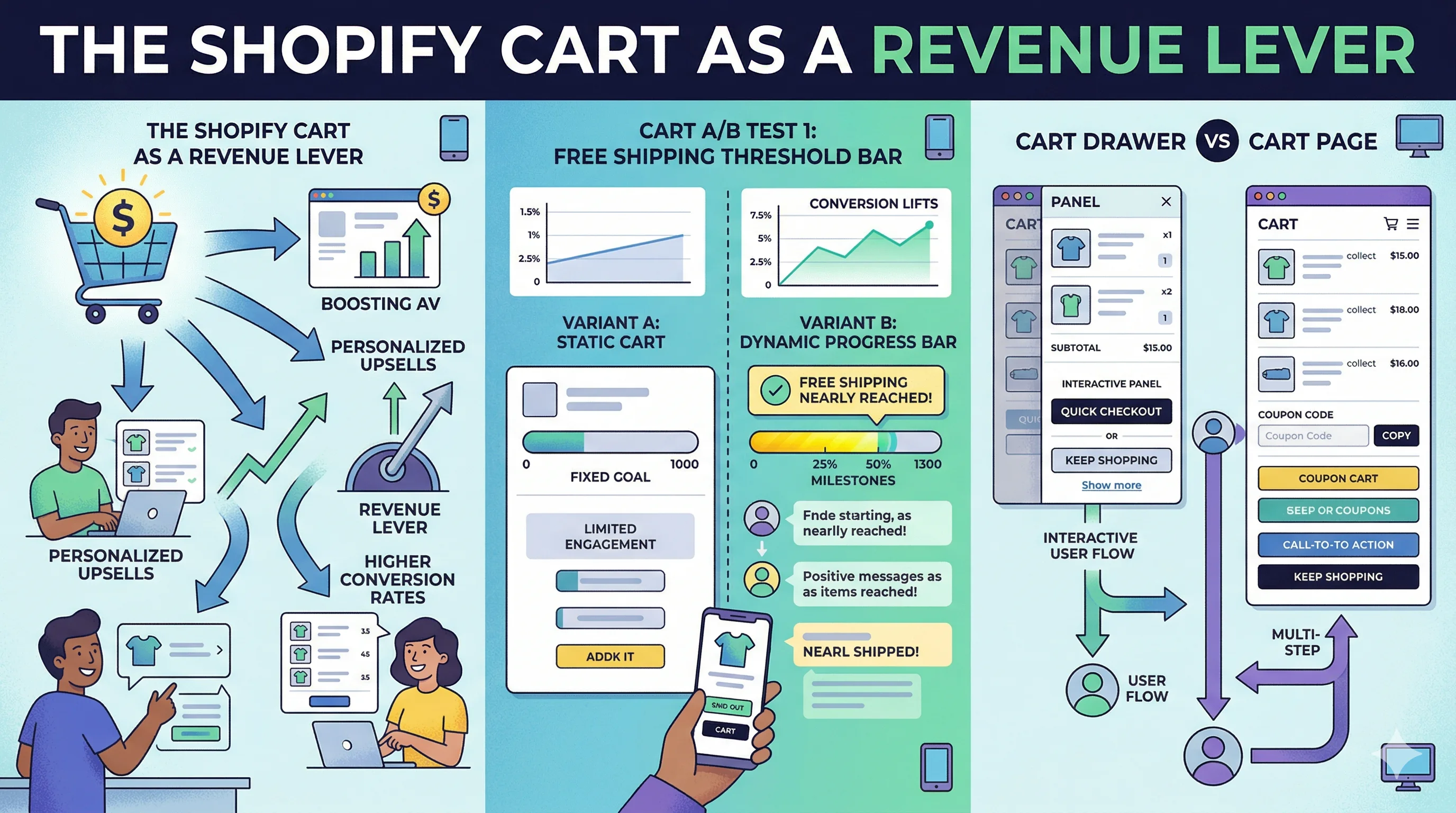
This is the single highest-impact cart test for most Shopify stores. A visual progress bar showing "Add ₹230 more to get free shipping" motivates incremental purchases.
Elements to test:
Expected impact: 8–20% lift in AOV for carts below the threshold; meaningful reduction in cart abandonment as buyers add items to qualify.
India note: Free shipping is an extremely powerful motivator for Indian D2C buyers. Even buyers who could afford the shipping cost will add items to avoid paying for delivery. Setting your threshold at 15–25% above your average cart value is typically optimal.
Showing relevant product recommendations in the cart ("Customers who bought this also added...") increases AOV when the recommendations are genuinely complementary.
Test variants:
Selection criteria for upsell products: Complementary (moisturizer → sunscreen), consumable add-ons (protein powder → shaker bottle), sample sizes (full-size buyer → trial size of adjacent product), or accessories (laptop → laptop bag).
Expected impact: 10–20% upsell attach rate, 12–18% AOV lift. Categories with natural pairings (skincare, supplements, electronics accessories) see larger lifts.
Cart abandonment often happens because buyers lose confidence in the last moment — "Is this site really safe? Will my COD order be delivered?" Cart-page trust signals address these doubts directly.
Elements to test:
Test placement: Just above the checkout button (high visibility) vs below cart items (natural reading flow) vs both.
Expected impact: 4–12% reduction in cart abandonment, particularly for new visitors and Tier 2/3 audiences who have higher COD preference and trust requirements.
The "Proceed to Checkout" button is one of the most-tested ecommerce elements for good reason — it's the most-clicked CTA on the cart page.
Copy to test:
Design to test:
Expected impact: 3–10% change in cart-to-checkout rate from button copy alone. Small changes compound significantly at volume.
How your cart summarizes the order affects buyer confidence and the perceived fairness of the total.
Test variants:
India-specific: Showing "Inclusive of all taxes" clearly reduces the "hidden fees" surprise that causes abandonment at the payment step.
For brands where gifting is significant (Diwali, birthdays, Raksha Bandhan), a gift note option in the cart can increase the perceived value of the order and reduce abandonment.
Test: Gift note field prominently in cart vs not offered vs offered at checkout
Expected impact: 8–15% uptake on gift notes during gifting seasons; buyers who add gift notes have 20–30% lower return rates.
Most modern Shopify themes use a cart drawer (slide-out panel) rather than a separate cart page. Both are testable. Key differences:
Test which is better for your audience: some brands find cart pages convert better because buyers have a dedicated, focused moment. Others find the cart drawer reduces abandonment by keeping buyers in the flow.
Related reading: Shopify Checkout A/B Testing | Shopify Free Shipping Bar | Shopify CRO Pillar