From the conversion glossary
Concepts referenced in this article, defined.
Concepts referenced in this article, defined.
Run rigorous A/B tests and personalize every visit on Shopify or any storefront — no engineers required.
Increasing your Shopify conversion rate means getting more of the visitors you already have to buy — without spending more on ads. For a Shopify store with ₹1 crore in monthly revenue, a 1 percentage point improvement in conversion rate is worth ₹12–15 lakhs in additional annual revenue. For most Indian D2C brands, conversion rate optimisation is the highest-ROI growth investment available. This guide covers every major tactic, from quick wins you can implement today to structural changes that compound over 12 months.
The average Shopify store converts at 1–3% of visitors. This means 97–99% of your paid and organic traffic leaves without buying. That gap is your opportunity.
Benchmarks by category:
Bellavita, one of India's top D2C beauty brands, achieved an 11% CVR lift through systematic A/B testing on CustomFit.ai — moving from a below-average to a top-decile performer in their category.
Conversion rate problems have four root causes:
Every tactic in this guide addresses one or more of these root causes. Identify which is your biggest problem before prioritising.
The product page is where the buying decision happens. It is the highest-priority conversion surface for most Shopify stores.
Aggregate star rating, review count, and one compelling testimonial should be visible before any scrolling. Shoppers who see validation before they read the pitch convert 15–25% better than those who find reviews buried below the fold.
"Add to Cart" is a default. Test benefit-oriented alternatives: "Get Free Shipping Today," "Try It — Easy Returns," or "Buy Now + Save ₹200." CTA copy changes regularly produce 5–15% lifts in add-to-cart rate.
On mobile, shoppers scroll through product details before deciding. A sticky bar at the bottom of the screen — always showing the product name, price, and add-to-cart button — keeps the purchase action accessible throughout the scroll. This single change produces some of the most consistent mobile CVR lifts in Shopify CRO.
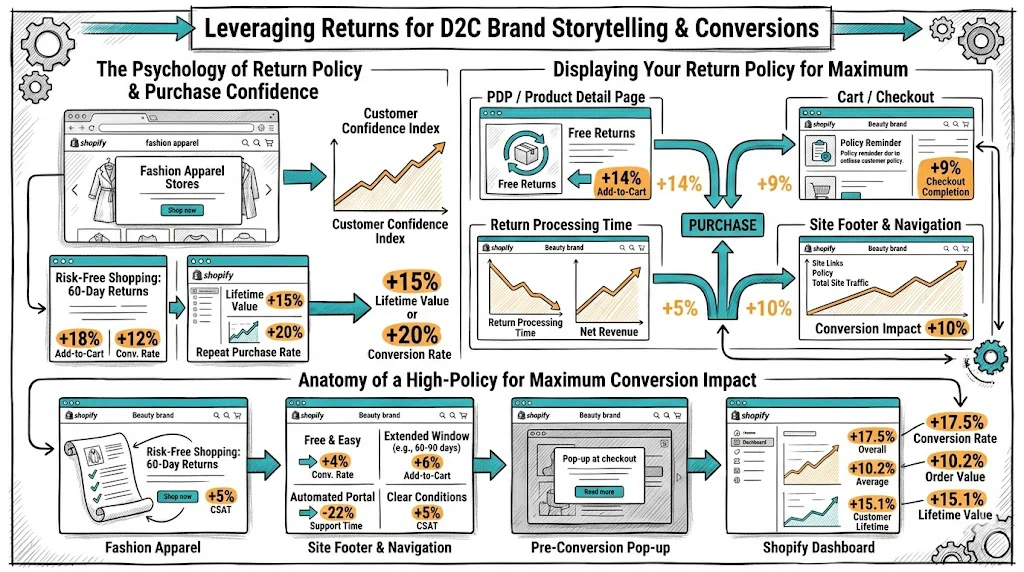
"14-day returns, no questions" shown prominently below the CTA eliminates purchase anxiety at the exact moment it's highest. Don't make visitors search your footer or a policy page for this.
5–8 questions that address the most common hesitations: "Is this for my skin type?", "What size should I get?", "How long until I see results?", "Can I return if it doesn't work?" FAQ sections on product pages regularly lift CVR by 8–15% for high-consideration purchases.
70–80% of Indian D2C Shopify traffic is mobile. Mobile conversion rates are typically 40–60% lower than desktop. Fixing mobile is the biggest leverage point for most stores.
Use a heatmap tool to see where mobile visitors stop scrolling. If 60% of mobile visitors never see your product description, the description is in the wrong place.
On mobile, what's visible in the first viewport is your entire first impression. This should include: product name, hero image, price, star rating, and an add-to-cart button. If any of these are missing, your mobile conversion rate is suffering.
Buttons and links that are too small for thumbs cause accidental taps and frustration. Every interactive element should be at least 44x44px. This includes add-to-cart, size selectors, image navigation, and quantity controls.
Desktop-style multi-level navigation menus create confusion on mobile. A hamburger menu with clear top-level categories and a persistent search bar covers most mobile navigation needs without overwhelming the interface.
Related reading: Shopify Mobile Optimization Guide
The cart abandonment rate on most Shopify stores is 70–80%. Checkout is where the majority of that loss happens.
Shopify's one-page checkout (available in Shopify 2.0 themes) reduces the multi-step friction that causes dropout. If your store is still on a multi-step checkout, switching is a high-priority upgrade.
A large percentage of Indian D2C shoppers — particularly new visitors and Tier 2/3 city shoppers — prefer COD. If UPI or card is shown first and COD is buried, these visitors will abandon the checkout. Use personalisation to surface COD first for new mobile visitors.
The checkout page is the highest-anxiety page on your store. Add SSL/security badges, return policy reminder, and a customer service contact. These signals reduce checkout drop-off for hesitant buyers.
Returning customers who have to re-enter their address and payment details are unnecessarily slowed. Shopify's native customer accounts handle this — encourage account creation with a post-purchase prompt.
Every additional second of page load time costs 7% in conversion rate on average. Indian mobile connections, even on 4G, are significantly slower than broadband in load tests.
Largest Contentful Paint (LCP) is the most conversion-relevant speed metric. If your Shopify store LCP is above 3 seconds on mobile, you're losing a measurable percentage of every traffic source.
Product images are the biggest performance bottleneck on most Shopify stores. Use WebP format, lazy-load below-the-fold images, and avoid hero images above 150KB.
Each Shopify app adds JavaScript. 20+ installed apps can add 2–5 seconds of load time. Audit your app list quarterly and remove anything that doesn't demonstrably improve revenue.
Related reading: Shopify Speed Optimization: Complete Guide
Showing every visitor the same homepage, the same product order, and the same CTA is a conversion rate ceiling. Personalisation breaks through that ceiling.
New visitors need brand education and first-purchase incentives. Returning visitors who haven't purchased need a nudge — a "you browsed this last week" prompt. Returning purchasers need loyalty signals and new arrival alerts.
Mumbai visitors in July should see monsoon skincare. Delhi visitors in October should see Diwali gift bundles. Bengaluru visitors from paid tech-focused ads should see productivity supplements. Location is one of the most powerful personalisation signals available.
Visitors from Instagram ads are in a different mindset than visitors from Google organic search. Match the landing page experience to the channel: ad visitors get a simplified, distraction-free page that matches the ad creative; organic visitors get a content-rich product page with SEO context.
CustomFit.ai's 1000+ targeting attributes make all of these personalisations buildable in minutes without developer involvement. See how it compares: CustomFit.ai vs VWO | CustomFit.ai vs Optimizely
A/B testing is the engine that drives sustained conversion rate improvement. Individual changes move the needle once. A structured testing programme moves it continuously.
Start with your testing roadmap:
With CustomFit.ai, you can launch your first Shopify A/B test in under 30 minutes — no developer, no IT ticket.
| Tactic | Traffic Required | Estimated Lift | Effort | Priority |
|---|---|---|---|---|
| Sticky mobile CTA bar | Any | 8–20% mobile CVR | Low | Start here |
| Social proof above fold | Any | 10–25% CVR | Low | Very high |
| CTA button copy test | 2,000+ visits/mo | 5–15% ATC | Low | Very high |
| Return policy on product page | Any | 5–10% CVR | Low | High |
| Product page FAQ | 1,000+ visits/mo | 8–15% CVR | Medium | High |
| Mobile checkout COD | Mobile heavy | 5–12% checkout CVR | Low | High |
| Site speed (LCP) | All | 7% per second saved | Medium–High | High |
| Geo personalisation | 5,000+ visits/mo | Varies | Medium | Medium |
Related reading: Shopify Speed Optimization | Shopify Mobile Optimization Guide | Shopify Product Page A/B Testing Ideas | Reduce Shopify Cart Abandonment: 12 Tactics | Shopify Upsell & Cross-Sell Strategies