From the conversion glossary
Concepts referenced in this article, defined.
Concepts referenced in this article, defined.
Run rigorous A/B tests and personalize every visit on Shopify or any storefront — no engineers required.
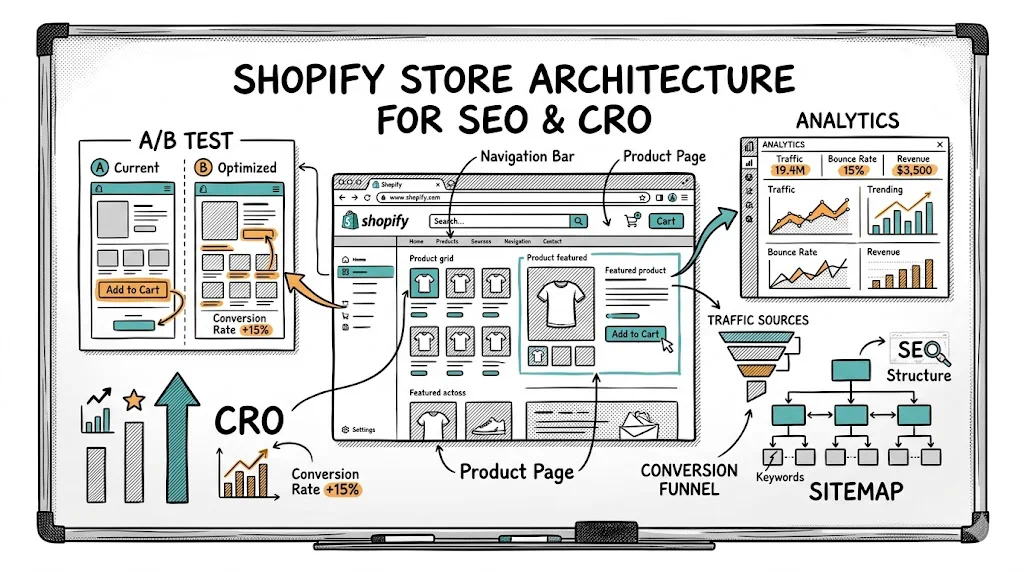
The way your Shopify store is organized — which collections exist, how they're named, how navigation is structured, and how internal links connect pages — directly affects both search engine rankings and visitor conversion rates. For Indian D2C brands with 50–200+ SKUs, poorly designed architecture is one of the most common causes of low organic traffic and high bounce rates. A store where visitors can't find what they're looking for within 2–3 taps will always have below-average conversion rates regardless of how well individual pages are optimized.
The logical organization of your products into categories and sub-categories. This exists conceptually before it's built in Shopify.
Good IA mirrors how your customers think about products:
Bad IA forces customers into your internal organizational logic:
For Indian D2C brands: Research how your customers describe your products. Use Google's "People also ask" for your category terms, analyze search queries in Google Search Console, and look at how category-leaders like Nykaa or Purplle label collections.
Shopify uses Collections as the primary organizing unit. Collections can be:
For SEO + CRO, automated collections (tag-based) are easier to maintain — a new product tagged "moisturiser + oily-skin" automatically appears in the right collections.
Recommended collection hierarchy for Indian D2C:
Top-level collections (in navigation):
/collections/skincare — Skincare/collections/haircare — Hair Care/collections/body-care — Body CareSub-collections (linked from collection pages, not necessarily in main nav):
/collections/face-moisturisers — Face Moisturisers/collections/face-serums — Face Serums/collections/face-cleansers — Face CleansersAttribute-based collections (filterable, SEO-targeted):
/collections/skincare-oily-skin — Skincare for Oily Skin/collections/vitamin-c-products — Vitamin C Products/collections/sulfate-free-shampoo — Sulfate-Free ShampoosThese attribute-based collections target specific long-tail keywords that buyers use — "vitamin c serum India," "sulfate-free shampoo for Indian hair" — and each is a standalone SEO landing page.
Internal links distribute "link equity" across your store and help both users and search engines discover pages. The optimal structure:
Homepage → Top-level collections: Navigation links, featured collection sections Top-level collections → Sub-collections: "Shop by concern" or "Shop by product type" sections on collection pages Sub-collections → Products: Standard product grid Products → Related products: "Frequently bought with," "Complete the routine" Products → Collections: Breadcrumb navigation ("Skincare > Moisturisers > this product") Blog posts → Products/Collections: 2–3 internal links per post to relevant products
This creates a web of connections that ensures no page is more than 3 clicks from the homepage.
Navigation is the primary tool visitors use to explore your store. Poor navigation structure is the most common cause of high bounce rates on Indian D2C stores.
Keep it simple. 5–7 top-level items maximum:
Indian D2C customers respond well to a prominent "Sale" or "Offers" navigation item — it reduces the anxiety of potentially missing a better deal elsewhere.
70–85% of Indian D2C traffic is mobile. Mobile navigation must:
A persistent search bar or prominent search icon in the header converts high-intent visitors efficiently. Customers who use search convert at 2–3x the rate of browsers — make search easy to find.
For brands with 50+ SKUs, search becomes the primary navigation method for returning customers who know what they want. See: Shopify Search & Filter Apps.
Shopify's URL structure is:
/products/product-slug/collections/collection-slug/blogs/blog-name/post-slug/pages/page-slugProduct URL best practices:
/products/vitamin-c-brightening-serum-30ml not /products/prod-001/products/vitamin-c-serum not /products/best-vitamin-c-serum-buy-onlineCollection URL best practices:
/collections/vitamin-c-serums targets "vitamin c serums" searchesWhat you can't change in Shopify URLs:
Shopify fixes the /products/, /collections/, and /blogs/ prefixes. You cannot use /shop/ or /category/ as the prefix.
Each collection page is a potential SEO landing page. For it to rank and convert:
Required elements:
Optional but high-converting:
Brands like Plum and mCaffeine have turned their collection pages into editorial experiences — this approach ranks better and converts better than a plain product grid.
Once your architecture is sound, layer in personalization.
CustomFit.ai enables showing different collection page content to different visitor types:
This architecture-level personalization is what separates brands achieving 11% CVR improvements (Bellavita, Kapiva) from those running static collection pages.
/collections/vitamin-c-serum-oily-skin collection with 5 products outranks individual product pages for that specific query.Related reading: Shopify SEO Checklist | Shopify Collection Page Optimization | Shopify Search & Filter Apps | Conversion Rate | Bounce Rate | A/B Testing