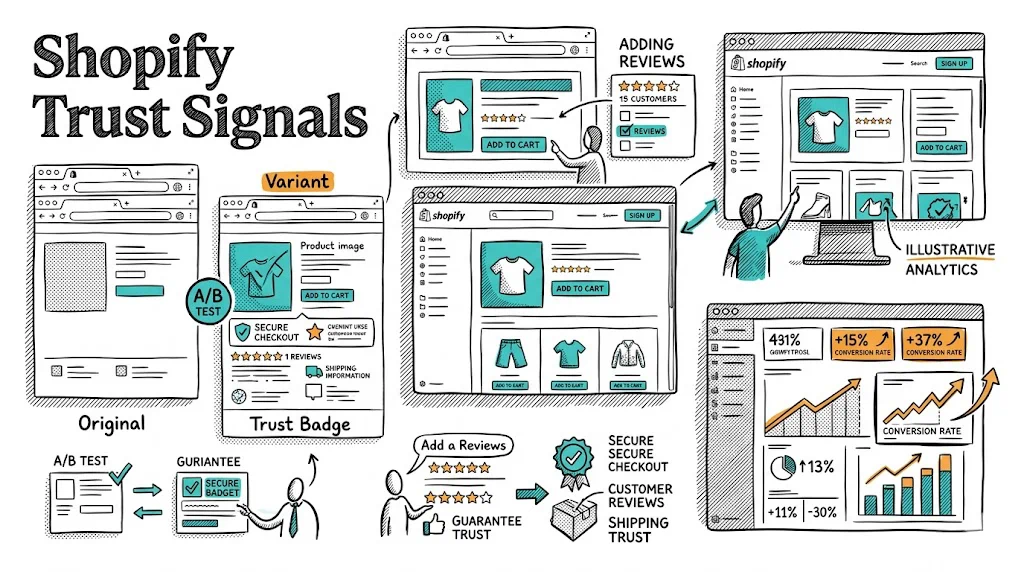
A first-time visitor to your Shopify store arrives with a fundamental doubt: "Should I trust this brand with my money?" Trust signals are every element on your site that answers "yes" to that question. Getting this right is not optional — it's the difference between a bounced visitor and a paying customer. For Indian D2C brands, where a significant percentage of buyers have never heard of you before clicking your Instagram ad, trust-building is the first CRO priority.
The Trust Gap for D2C Brands
Established brands (Nykaa, Mamaearth, boAt) don't need to work hard on trust signals — buyers already know them. Every new D2C brand faces a trust gap with first-time visitors. You know your products are high quality. Your customers know it. But the new visitor doesn't.
Trust signals bridge this gap without requiring personal interaction. The goal is to give first-time visitors enough confidence to make that first purchase — because once they experience your product, trust follows naturally.
Types of Trust Signals for Shopify Stores
1. Security and Payment Trust Signals
These address the fear of online fraud — particularly salient for first-time online shoppers and Tier 2/3 buyers.
- SSL certificate indicator — Most themes show a padlock in the browser, but adding an explicit "Secure Checkout" badge near your CTA reinforces this
- Payment gateway logos — Razorpay, PayU, Stripe logos communicate that a trusted third-party handles payment processing
- PCI DSS compliance mention — For buyers who know what it means
- COD badge — "Cash on Delivery Available" is a trust signal for first-time buyers who don't want to commit money before seeing the product
2. Social Proof
The most powerful category of trust signals. Other people's positive experience is the closest thing to a personal recommendation.
- Star ratings and review counts — "4.7 stars from 3,241 reviews" works; even better when shown with review snippets
- Photo reviews — Real customers with real photos of real products
- Video testimonials — Even 30-second customer clips
- Subscriber/customer count — "Join 80,000+ happy customers"
- UGC (User-Generated Content) — Instagram mentions, unboxing posts, organic content from customers
India-specific: Reviews with Indian names, cities, and product context ("Seema from Pune, bought for Diwali gifting") convert better than anonymous or generic reviews.
3. Certifications and Quality Signals
Relevant certifications dramatically reduce doubt about product quality and safety.
- FSSAI license number — For food and food supplement brands
- AYUSH certification — For Ayurveda brands
- BIS certification — For electronics
- ISO certification — For manufacturing quality
- Lab testing certificates — For supplements and wellness products ("Third-party tested for purity")
- Organic/natural certifications — USDA Organic, India Organic, EcoCert
Display these on product pages where they're most relevant. A FSSAI number displayed on a food product page removes a specific doubt; displayed site-wide it becomes background noise.
4. Money-Back and Return Guarantees
Risk reversal is one of the most effective trust signals. A clear, easy-to-understand guarantee removes the financial risk of trying a new brand.
- "30-day money-back guarantee" — Works across categories
- "Try for 15 days — full refund if not satisfied" — Effective for wellness and beauty
- "Easy 7-day returns — we collect from your door" — Addresses logistics fear for Indian buyers
- "No questions asked returns" — Maximum simplicity
Placement: Near the CTA on product pages and above the checkout button on cart pages. Buried in footer = invisible = no impact.
5. Brand Story and Founder Trust
A face and a story behind the brand builds a different kind of trust — the human connection that distinguishes D2C from anonymous marketplace sellers.
- Founder photo and brief bio on the About page and homepage
- "Why we started this brand" story
- Team photos
- Behind-the-scenes manufacturing or sourcing content
For Indian D2C brands with strong founder stories (ex-corporate turning to Ayurveda, home chef who turned a recipe into a brand), this is particularly powerful.
"As seen in" is a powerful trust accelerator for brands with press coverage.
- Economic Times, Inc42, YourStory mentions
- Shark Tank India appearance or mention
- Industry award badges
- Influencer feature (macro-influencers only — micro-influencer mentions don't carry the same recognition)
7. Delivery and Logistics Confidence
Indian buyers have been burned by bad delivery experiences. Delivery-specific trust signals address this:
- "Ships within 24 hours" / "Same-day shipping for orders before 2 PM"
- "Delivery in 2–5 business days to [City]" (geo-personalized)
- "Tracked delivery — receive updates on WhatsApp"
- Courier partner logos (BlueDart, Delhivery, Xpressbees)
- "Damage-free packaging guaranteed"
Where to Place Trust Signals
Placement matters as much as the trust signal itself. The principle: place trust signals closest to the point of doubt.
| Page | Highest-Doubt Moment | Optimal Trust Signal Placement |
|---|
| Homepage | "Can I trust this brand?" | Above fold — social proof, brand story, review count |
| Product page | "Is this product worth it?" | Near CTA, below price, below reviews section |
| Cart page | "Should I pay for this?" | Above checkout button |
| Checkout | "Is my payment safe?" | Near payment form, near the "Place Order" button |
A/B Testing Trust Signals
Not all trust signals are equal for your specific audience. Test:
- Trust signal type: Money-back guarantee vs free returns vs "COD available" — which reduces abandonment most?
- Placement: Above-fold vs below-fold on product page
- Specificity: "Easy returns" vs "30-day money-back guarantee, collected from your door within 48 hours"
- Visual treatment: Trust badge (icon + text) vs text only vs icon only
- Number of signals: 3 trust signals near CTA vs 1 vs 6 (diminishing returns at some point)
Use CustomFit.ai to create these variants and run clean A/B tests. Most trust signal tests produce results in 2–3 weeks at typical D2C traffic volumes.
Tips / Best Practices
- Don't bury trust signals in your footer — Footer trust badges are invisible to 70%+ of visitors. Place them near the points of decision.
- Make your return policy scannable — "Free returns within 30 days, we arrange pickup, no questions asked" converts better than a 500-word policy document.
- Use real reviews, not generic star ratings — If you display "4.9 stars" but have only 12 reviews, sophisticated buyers will notice and discount it.
- Test trust signal combinations — Sometimes two complementary signals (security badge + return guarantee) outperform either alone.
- Match trust signals to category anxiety — Food brands need FSSAI. Electronics need warranty. Luxury brands need authenticity. Identify the specific doubt for your category.
- Update your review count regularly — A store with "2,341 reviews" last year and "2,341 reviews" this year signals a stagnant brand. Keep review counts current.
- Test COD messaging for Indian audiences — For first-time buyers in India, "Pay when you receive your order" is one of the most powerful trust signals available.
Key Takeaways
- Trust signals address the first-time buyer's fundamental doubt: "Can I trust this brand?"
- The highest-impact trust signals for Indian D2C brands are COD availability, easy returns, photo reviews from Indian customers, and relevant certifications.
- Placement near the point of doubt (near CTA, above checkout button, near payment form) dramatically outperforms footer or below-fold placement.
- A/B testing trust signal type, placement, and specificity identifies which elements matter most for your specific audience.
- CustomFit.ai enables no-code trust signal placement testing without developer involvement.
Related reading: Shopify Free Shipping Bar: Setup & A/B Test | Shopify Product Recommendations | CRO Pillar