CustomFit.ai β€” Website personalization, A/B testing and CRO for Shopify and D2C
Product
Features
✱
Website Personalization
Adapt to each visitor's behavior & intent
β§–
A/B & Multivariate Testing
Rigorous experimentation
✨
AI CopilotNEW
Personalize with a prompt
πŸ€–
AI WingmanNEW
Auto-optimize toward winners
🎯
AI Conversion OptimizerNEW
GPT-grade test ideas
✎
No-Code Visual Editor
Drag-and-drop edit any element
β–¦
Product Recommendations
Personalized recs that lift AOV
βš‘
Feature Flags
Ship safely with kill-switches
β—§
Chrome Extension
Edit your store in the browser
⧉
Shopify, WooCommerce & more
All platform integrations
View all features β†’
Use Cases
$
Price A/B Testing
Test price points to maximize revenue
β–¦
Theme A/B Testing
Compare whole layouts & designs
πŸ—‚
Template A/B Testing
Test whole PDP/PLP templates
🏷
Discount A/B Testing
Find the offer that converts
🚚
Shipping A/B Testing
Thresholds, speed & copy
✍
Content A/B Testing
Copy, images & reviews
πŸ’³
Checkout Gateway A/B
Payments & one-click
βŒ–
Geo-Based Personalization
Per-location content & offers
⚑
Buyer-Intent Nudges
Exit-intent & retargeting
↔
Split-URL / Redirection
Full-page redirect tests
View all use cases β†’
Solutions & Guides
β€’
Conversion Rate Optimization
The complete CRO guide
β§–
A/B Testing Software
Buyer's guide for D2C
πŸ›’
Cart Abandonment Recovery
Win back lost carts
πŸ“°
Landing Page Optimization
Convert more paid traffic
S
Shopify A/B Testing
Test your store, no code
S
Shopify Personalization
Tailor the store per shopper
β—”
First-Time Visitor Offers
Convert new shoppers with trust & offers
β˜…
Repeat-Customer Experiences
Reward and re-engage loyal buyers
β—Ž
Campaign-Matched Pages
Match the landing page to the ad
βŒ–
Location-Based Experiences
Currency, language & regional offers
Explore CRO β†’
Customer stories
GIVA
+32%
conversion via personalized recs
GIVA
Mamaearth
+18%
revenue lift from PDP A/B tests
ME
The Sleep Company
+24%
AOV from product recommendations
TSC
Read customer stories β†’
Integrations
SWsfGA+15
✦
Not sure where to start?
Let AI Copilot pick your first tests

β€œWe wake up to evidence-backed tests ready to deploy β€” not a backlog of maybe ideas.”

AN
Anirudh S.
Growth Β· Chargebee
β˜…β˜…β˜…β˜…β˜…4.8on G2 Β· 2,400+ brands
Talk to our team β†’
Widgets
Integrations
Ecommerce & Checkout
Shopify
Shopline
Shoplazza
GoKwik
ShopFlo
Razorpay Magic Checkout
Breeze
Shiprocket
View all integrations β†’
Analytics & Behavior
Google Analytics 4
Microsoft Clarity
Hotjar
Mixpanel
Amplitude
Heap
Adobe Analytics
Segment (CDP)
View all integrations β†’
Engagement, CRM & More
Klaviyo
MoEngage
CleverTap
WebEngage
HubSpot
Salesforce
Slack
Meta Ads
View all integrations β†’
CustomersPricing
Resources
CRO
β–€
Playbooks
Proven strategies to boost conversions
πŸŽ™
Interviews
D2C leaders & marketing experts
β–Ά
Webinars
Live deep dives & product sessions
Learn
✎
Blog
Tips, experiments & best practices
πŸ“•
Free E-Books
Mastering personalization
πŸ“–
Conversion Glossary
Every CRO term, defined
✦AI CopilotNEWLog inBook a demo
Start free trial
Select your platform β€” Install in 2 minsWe'll tailor the setup
⚑ Risk-free 14-day trial · No credit card · Cancel anytime
S
Shopify
Install from Shopify App Store
β€Ί
W
WooCommerce
Install the WooCommerce plugin
β€Ί
B
BigCommerce
Install from BigCommerce App Marketplace
β€Ί
SL
Shopline
Install from Shopline App Store
β€Ί
M
Salesforce / Magento
Install from the marketplace
β€Ί
SZ
Shoplazza
Install from Shoplazza App Store
β€Ί
WP
WordPress / Webflow
Install plugin or paste the script
β€Ί
β—§
Others
Custom-built on React, Next.js, etc.
β€Ί
Tip: pick your platform β€” we handle the restBook a demo β†’
Product
Website PersonalizationA/B & Multivariate TestingAI CopilotAI WingmanAI Conversion OptimizerNo-Code Visual EditorProduct RecommendationsFeature FlagsView all features β†’
Use Cases
Price A/B TestingTheme A/B TestingTemplate A/B TestingDiscount A/B TestingShipping A/B TestingContent A/B TestingCheckout Gateway A/BGeo-Based PersonalizationBuyer-Intent NudgesSplit-URL / Redirection
Solutions & Guides
Conversion Rate OptimizationA/B Testing SoftwareCart Abandonment RecoveryLanding Page OptimizationShopify A/B TestingShopify Personalization
Explore
WidgetsIntegrationsCustomersPricing
Resources
BlogPlaybooksWebinarsInterviewsE-BooksConversion Glossary
Platforms
ShopifyShoplineShoplazzaChrome ExtensionAll integrations
Start free trialBook a demo
Homeβ€ΊBlogβ€Ίux designβ€ΊInfinite Scroll vs Pagination for Ecommerce

Infinite Scroll vs Pagination for Ecommerce

SJSapna JoharHead of Growth & CRO, CustomFit.aiJanuary 15, 20258 min read
On this page
  1. The Core Tension: Browsing vs. Shopping
  2. What the Data Shows
  3. Infinite Scroll: When It Works
  4. Pagination: When It Wins
  5. The Load-More Button: Often the Best Hybrid
  6. SEO Considerations
  7. Mobile-Specific Considerations
  8. How to Choose and Test
  9. Tips and Best Practices
  10. Key Takeaways
0%
Infinite Scroll vs Pagination for Ecommerce

From the conversion glossary

Concepts referenced in this article, defined.

Definition
What Is Infinite Scroll? Definition & Guide
Definition
What Is Pagination? Definition & Guide
Definition
What Is Category Page? Definition & Guide
Definition
What Is Scroll Depth? Definition, Formula & Guide
Definition
What Is Control? Definition, Formula & Guide
← Back to Ux Design guide
Try CustomFit.ai

Run A/B tests and personalize your store without code. 14-day free trial, no credit card.

Start free trial β†’
Share
XLinkedInEmail

Related articles

ux design

White Space in Design: Impact on Conversions

Sapna JoharΒ· 8 min read
ux design

UX Design for Ecommerce: Conversion-Focused Guide

Sapna JoharΒ· 17 min read
ux design

UX Audit Checklist for Ecommerce

Sapna JoharΒ· 9 min read

Start lifting conversions today.

Run rigorous A/B tests and personalize every visit on Shopify or any storefront β€” no engineers required.

Start free trialBook a demo

Built for every D2C category

🧴
Skincare
πŸ’„
Beauty
🌿
Wellness
β˜•
F&B
πŸ‘Ÿ
Apparel
πŸ’
Jewelry
πŸ›‹οΈ
Home
🍼
Baby
Live Β· Right now
Mamaearth β€” free-shipping band +12.4% AOVGIVA β€” festive collection page +34% revenueBellavita β€” PDP CTA test +27.4% CVRKapiva β€” Quiz-driven recs +9.48% CTRThe Sleep Co β€” landing personalized 2Γ— capturesPlum β€” Returning shopper swap +18.2% CVRMamaearth β€” free-shipping band +12.4% AOVGIVA β€” festive collection page +34% revenueBellavita β€” PDP CTA test +27.4% CVRKapiva β€” Quiz-driven recs +9.48% CTRThe Sleep Co β€” landing personalized 2Γ— capturesPlum β€” Returning shopper swap +18.2% CVR
Get in touch

Tell us about your store.

We reply within an hour during business hours. No sales pitch, no spam β€” just answers from someone who's seen 2,400+ D2C stores.

βœ“ Reply within 1 hourβœ“ No spam, everβœ“ Free demo & setup help
βœ“ Thanks! We'll be in touch shortly.
CustomFit.ai

The all-in-one website personalization, A/B testing & CRO platform for high-growth D2C brands. Made by marketers, fueled by coffee.

inπ•β—Žβ–Άf
Product
  • Features
  • A/B Testing
  • Personalization
  • AI Copilot
  • AI Wingman
  • AI Conversion Optimizer
  • Feature Flags
  • Widgets
  • Integrations
  • ROI Calculator
Platforms
  • Shopify
  • Shopline
  • Shoplazza
  • Salesforce
  • Chrome Extension
  • All Integrations
Resources
  • Blog
  • Playbooks
  • Webinars
  • GrowthFit Interviews
  • Free E-Books
  • Conversion Glossary
  • Case Studies
Compare
  • vs VWO
  • vs Optimizely
  • vs Google Optimize
  • vs Mutiny
  • vs Intelligems
  • vs Shoplift
  • vs AB Tasty
  • vs Convert
  • vs Kameleoon
Company
  • About Us
  • Partners
  • CustomFit Awards
  • Recognition
  • Contact
  • Privacy Policy
  • Terms & Conditions
Β© 2026 CustomFit.ai Β· Valley Monks Pvt Ltd Β· Made by marketers, fueled by coffee, and obsessed with conversions.
SOC 2 Type II Β· GDPR Β· CCPA Β· ISO 27001

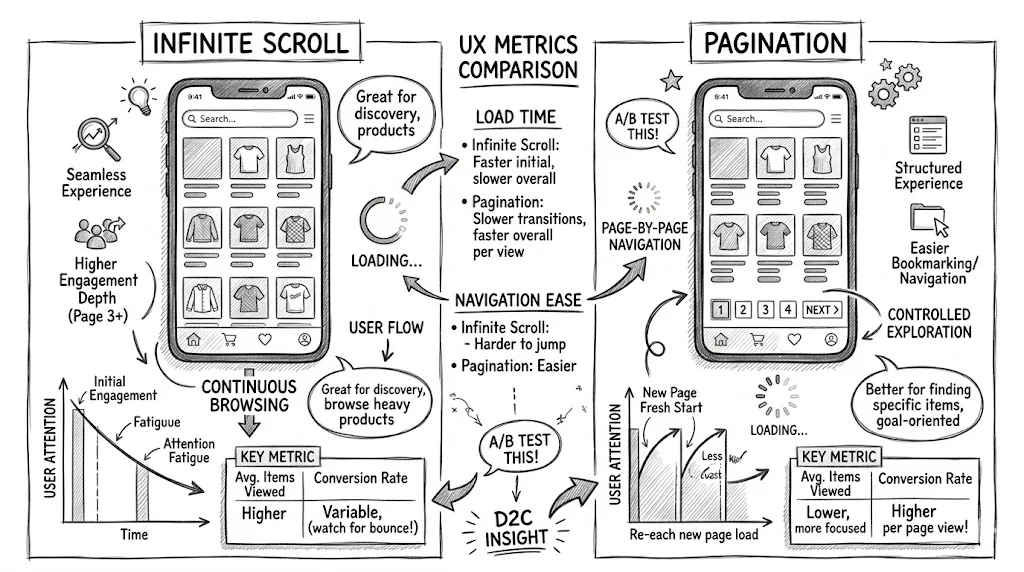
Infinite scroll feels modern and frictionless β€” no page turns, content just keeps appearing. Pagination feels structured and sometimes old-fashioned. But for ecommerce category pages, the data consistently points toward pagination (or a "Load More" button hybrid) outperforming infinite scroll for conversion rate, user satisfaction, and SEO. Here is the full comparison with the context Indian D2C brands need to make the right choice.

The Core Tension: Browsing vs. Shopping

Infinite scroll was designed for content discovery platforms where the user's goal is to browse indefinitely β€” social media feeds, news aggregators, content recommendation engines. The user has no specific destination in mind; more content is always welcome.

Shopping is different. Even when a customer is in discovery mode, they are managing a mental comparison list. They are looking at product A, thinking about product B they saw earlier, scanning for price anchors, and making relative comparisons. This cognitive work requires a sense of position and the ability to return to specific items.

Infinite scroll disrupts position. Pagination preserves it.

This is the central difference, and it explains most of what the data shows.

What the Data Shows

Multiple studies and merchant-side tests on ecommerce category pages show:

  • Pagination leads to higher conversion rates than infinite scroll for product category pages (the user's ability to navigate to a specific page and return to it correlates with purchase intent)
  • Infinite scroll leads to higher scroll depth and time on site β€” but time on site without conversion is engagement without revenue
  • Load-More buttons perform similarly to pagination for conversion rate but with slightly better scroll engagement

The most consistent finding: the back-button problem is the biggest measurable harm of infinite scroll. A user who scrolls through 80 products, taps one to view it, and returns to the category page lands at the top β€” not at product 72 where they were. On mobile, where every scroll costs time and thumb effort, this is a major frustration that causes users to abandon rather than re-scroll.

Infinite Scroll: When It Works

Infinite scroll is not universally bad for ecommerce. It has specific use cases where it outperforms:

New Arrivals and Trending feeds. When the user's intent is "show me what is new", infinite scroll matches the mental model. The products are implicitly ordered by recency, there is no "right" product to find, and position does not matter.

Visual discovery on mobile. For fashion, home dΓ©cor, and gift categories where the user is in pure browsing mode, infinite scroll can work β€” provided the back-button problem is handled (session state that returns the user to their last position).

Content sections adjacent to products. A blog feed, lookbook, or editorial content section on a landing page can use infinite scroll without the category page problems, since users are consuming content rather than comparing products.

Pagination: When It Wins

Traditional pagination β€” numbered pages (1, 2, 3, ... 10) or previous/next navigation β€” wins when:

Users are goal-oriented. A user searching for "Vitamin C serum under β‚Ή500" wants to scan efficiently and return to items they are comparing. Pagination gives them a framework.

Product count is high. A category with 200+ products across 20 pages is genuinely navigable with pagination. The user can jump to page 3 to find mid-range items (if products are sorted by price) or share a specific page with a friend.

SEO matters for category pages. Each paginated page has its own URL (/skincare?page=3), which can be indexed. Products on page 3 are discoverable from search engines. Infinite scroll products loaded after page 1 often are not indexed at all.

Return visits are common. A customer who researches products over multiple sessions needs to find their reference point again. "I saw it on page 2" is navigable. "I saw it somewhere in an infinite scroll about 80 products in" is not.

The Load-More Button: Often the Best Hybrid

The Load-More pattern combines advantages of both approaches:

  • Initial page shows 24–32 products (enough to form opinions, not overwhelming)
  • A "Load More Products" button below the grid loads the next 24–32 products, appending them below the existing ones
  • The URL updates to reflect the loaded state (for bookmarking and back-button behaviour)
  • The total product count is shown: "Showing 24 of 186 products"

This pattern:

  • Avoids the back-button problem (returning to the page shows all previously loaded products)
  • Gives users control over when they load more (unlike auto-loading infinite scroll)
  • Is more SEO-friendly than infinite scroll if properly implemented
  • Feels more modern than numbered pagination

Testing across Indian D2C stores shows Load-More performing within 5% of traditional pagination for conversion rate, while generating 15–20% more scroll engagement. For stores that care about both metrics, it is often the best starting point.

SEO Considerations

This is where the comparison is clearest: infinite scroll (without JavaScript rendering in Google's crawler) can result in a large share of your product catalogue being invisible to search engines.

Pagination SEO setup:

  • Each page has a unique URL: /running-shoes?page=2
  • Use rel="next" and rel="prev" HTML tags to help search engines understand the pagination chain
  • Avoid duplicate content by not showing page 1 content again on page 2 (obvious, but worth checking)

Infinite scroll SEO setup:

  • If infinite scroll is used, the initial page must contain the most important products (the ones you most want to rank for)
  • Use pushState to update the URL as new products load, creating addressable sections
  • Submit a Sitemap that includes individual product URLs β€” do not rely on crawlers discovering them via category page JavaScript

Load-More SEO setup:

  • Similar to pagination β€” each "state" should have an addressable URL or at minimum fall back to the paginated structure
  • Products visible in the initial (pre-click) state are the most SEO-accessible

For Indian D2C brands investing in organic search as a growth channel, pagination is the safest SEO choice. A category page that ranks for "[product type] buy online India" should show all its products to Google.

Mobile-Specific Considerations

On mobile, the tradeoffs shift slightly:

Infinite scroll feels more native on mobile. Social media has trained mobile users to expect endless scroll. The pattern matches their mental model for browsing content.

But the back-button problem is worse on mobile. Re-scrolling 80 products on a 5-inch screen is a significantly worse experience than re-scrolling on desktop. The frustration is higher, and the likelihood of abandoning rather than finding the product again is higher.

Load-More with session restoration is the optimal mobile solution. Show a reasonable initial set (12–16 products on mobile, since the grid is one column or two), then load more on tap, but preserve the loaded state so returning to the page shows the products the user had loaded.

How to Choose and Test

Start with Load-More. If you are currently using infinite scroll and want to test, a Load-More button is the lowest-disruption alternative. Measure:

  • Conversion rate from category pages
  • Back-button return rate (sessions that include category page β†’ product page β†’ category page)
  • Average products viewed per session

Run an A/B test. CustomFit.ai or your Shopify theme's built-in experimentation (if available) can split category page visitors between infinite scroll and Load-More. Track conversion rate as the primary metric over at least 2 weeks with 500+ visitors per variant.

Check analytics for the back-button problem. In Google Analytics (GA4), look at the flow from category pages to product pages and back to category pages. High back-navigation rates to the category page suggest users are trying to return to their position β€” and failing.

Tips and Best Practices

Always show total product count. "Showing 24 of 186 products" tells the user how much more exists and helps them decide whether to load more or refine their filters.

Add a sticky "Back to Top" button. If you use infinite scroll or Load-More and the user has scrolled far, a sticky back-to-top button reduces the effort of resetting.

Sort by most relevant by default. Whichever navigation pattern you use, the first 12–24 products visible are the most important. Sort by relevance, bestsellers, or new arrivals β€” not by internal database ID.

Test filter persistence with both patterns. If a user filters by "Price: Under β‚Ή999" and then loads more products, the filter must persist. Filters being lost on Load-More or back-navigation is a common bug worth auditing.

Key Takeaways

  • Pagination and Load-More buttons outperform infinite scroll for ecommerce conversion rate because they preserve user position and allow comparison shopping.
  • Infinite scroll has higher scroll depth and time-on-site metrics β€” but without conversion rate lift, these are vanity metrics.
  • The back-button problem is the most damaging practical issue with infinite scroll on mobile.
  • Pagination is the most SEO-safe option for large product catalogues.
  • Load-More buttons are often the best balance of engagement, conversion, and SEO.
  • Test your specific context β€” the right choice depends on your product density, user intent, and traffic source mix.

For more on ecommerce UX decisions, see the UX pillar guide and the UX audit checklist.