From the conversion glossary
Concepts referenced in this article, defined.
Concepts referenced in this article, defined.
Run rigorous A/B tests and personalize every visit on Shopify or any storefront — no engineers required.
The anchoring effect is one of the most reliable and well-documented pricing phenomena in ecommerce. When buyers see a ₹2,000 product marked down to ₹1,299, the ₹2,000 isn't just a number — it's a reference point that frames the entire value calculation. Without that anchor, ₹1,299 is just ₹1,299. With it, ₹1,299 feels like a deal. This guide explains how anchoring works, how to use it ethically and effectively, and how to test which anchoring tactics drive the most lift for your specific store.
The anchoring effect is a cognitive bias: when people encounter a number (the anchor), it disproportionately influences their subsequent judgments. In pricing, the first number a buyer sees shapes how they perceive every subsequent price.
Classic ecommerce anchors:
The anchor doesn't have to be a price you've sold at — it needs to be a credible reference point. Indian buyers are familiar with MRP (Maximum Retail Price) as the anchor, making the MRP vs. selling price anchor particularly natural and effective in Indian ecommerce.
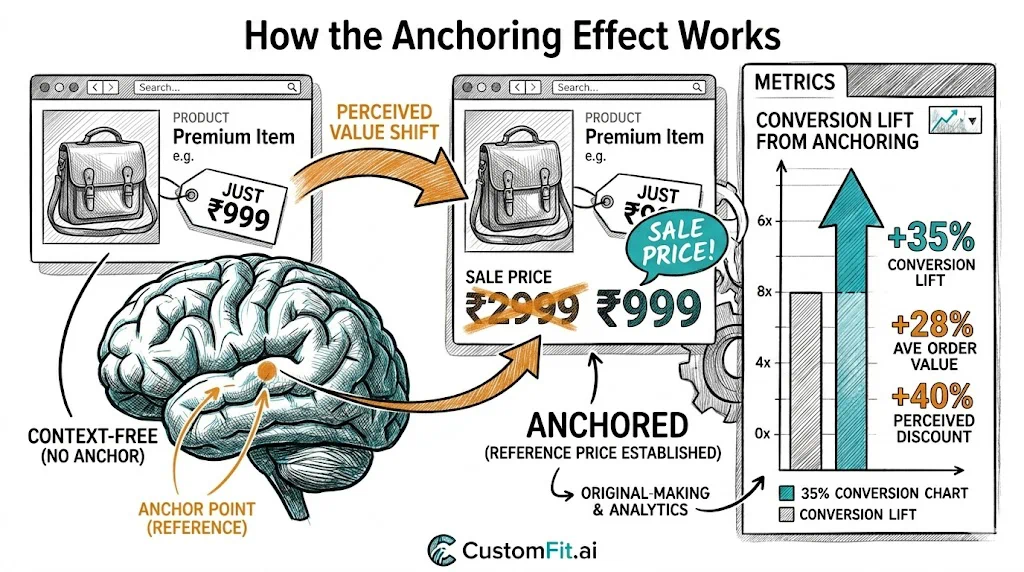
This is table stakes for Indian D2C. The MRP is a legal requirement on product packaging — use it as your anchor. Display the MRP prominently with a strikethrough, the selling price in a larger font, and the savings amount or percentage.
What to test: flat savings amount (₹700 off) vs. percentage (35% off) vs. both. For products under ₹2,000, flat amount tends to feel more concrete. For premium products above ₹5,000, percentage savings often resonates better.
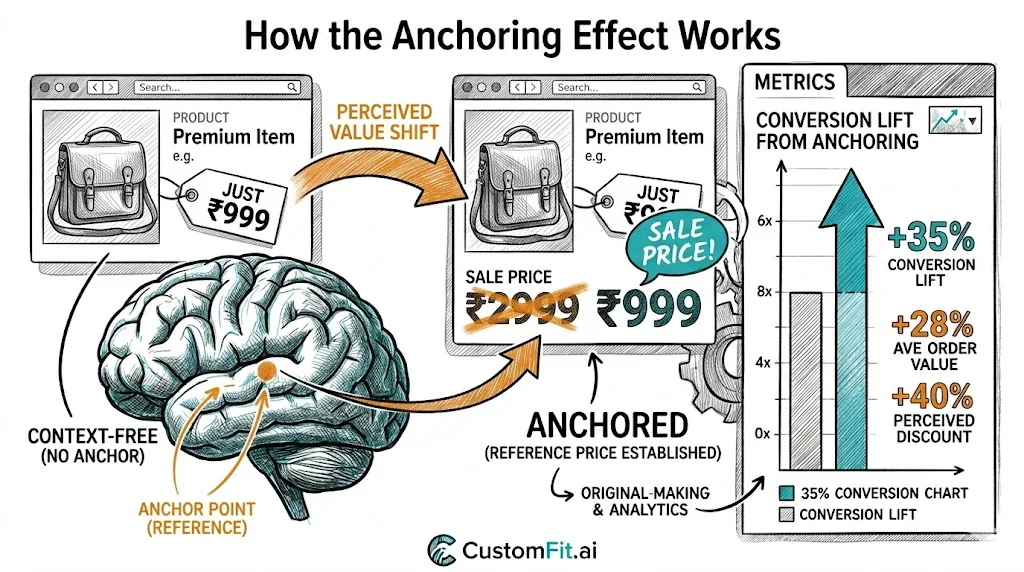
If you sell multiple pack sizes or subscription tiers, display the most expensive option first (left-most, top, or most visually prominent). This sets a high anchor. After seeing ₹4,999 for the annual plan, the ₹499/month plan feels modest. After seeing the 4kg protein tub at ₹3,999, the 2kg tub at ₹2,199 feels like a bargain.
This is the "decoy effect" working in tandem with anchoring — the premium option anchors perception of value, and the mid-tier option becomes the obvious choice.
Show what the buyer would pay for an alternative:
This tactic works because it gives buyers a real-world price reference that makes your product's value feel obvious. It's most effective when the comparison is genuine and the buyer already knows the comparator price.
Show what the products in a bundle would cost individually, then show the bundle price. "Individual value: ₹2,197. Bundle price: ₹1,499. You save ₹698."
The individual sum anchors the buyer to a higher number, making the bundle price feel like a significant saving. This tactic reliably lifts bundle add-to-cart rates and AOV simultaneously.
Breaking price down to the smallest meaningful unit is anchoring in reverse — you're showing that the price is tiny on a per-use basis:
This tactic reduces sticker shock for higher-priced items by reframing the reference from the total price to the per-use cost.
Product Detail Pages: The primary anchoring location. MRP strikethrough, savings badge, and tier comparison all belong here.
Collection and category pages: Show the anchor price (MRP + selling price) on product thumbnails. Buyers browsing collections form price expectations before clicking through to a PDP.
Cart page: Show total value of items before discount ("Cart value: ₹3,200 — You saved ₹701"). This reinforces the anchor at the moment of checkout decision.
Bundle builders: "Add 2 more items to complete the bundle and save ₹500" with a running total and anchor value displayed real-time.
Subscription toggle: "Monthly: ₹599 | Annual: ₹4,499 (save ₹1,689)" — the annual price displays the amount saved to anchor the perceived value of commitment.
Run A/B tests on every anchoring element — the effect size varies significantly by product category and audience:
Test 1: Savings display format
Test 2: Anchor placement
Test 3: Tier display order
Test 4: "Compare with" anchor
Test 5: Bundle value display
CustomFit.ai lets you set up and run all these tests without touching your codebase — build the variation visually, split your traffic, and read results from the dashboard.
MRP is a familiar and trusted anchor: Indian buyers are conditioned to the MRP system. A well-displayed MRP vs. selling price is the lowest-effort, highest-trust anchoring approach available to Indian D2C brands.
Festive season anchoring: During Diwali, Holi, and sale events, anchor with the "original price" and show the festive discount clearly. Buyers expect deals during festive seasons — but the anchored original price validates the size of the deal.
COD and EMI framing: For higher-priced items, showing the EMI amount ("₹833/month for 3 months") is an anchoring approach — you're reframing the reference from ₹2,499 to ₹833. Test whether EMI framing lifts add-to-cart on items above ₹2,000.
Never fabricate anchors: Consumer Protection Act 2019 and ASI guidelines prohibit false reference prices in India. Using a genuine MRP, a real competitor price, or an actual cost-per-use calculation is both ethical and effective. Fake "was" prices erode trust when buyers do their research.
Related reading: Pricing Strategy & Testing Pillar | D2C Brand Growth Pillar | A/B Testing | Average Order Value | Product Comparison Tables