From the conversion glossary
Concepts referenced in this article, defined.
Concepts referenced in this article, defined.
Run rigorous A/B tests and personalize every visit on Shopify or any storefront — no engineers required.
Average order value (AOV) is one of the highest-leverage metrics for D2C brands—increasing it improves unit economics without requiring more customers or lower prices. Bundle pricing is the most effective AOV optimization tactic available, because it creates genuine perceived value (the customer gets more) while also increasing revenue per transaction. This guide covers the bundle types that work, how to price them, and how to test and optimize.
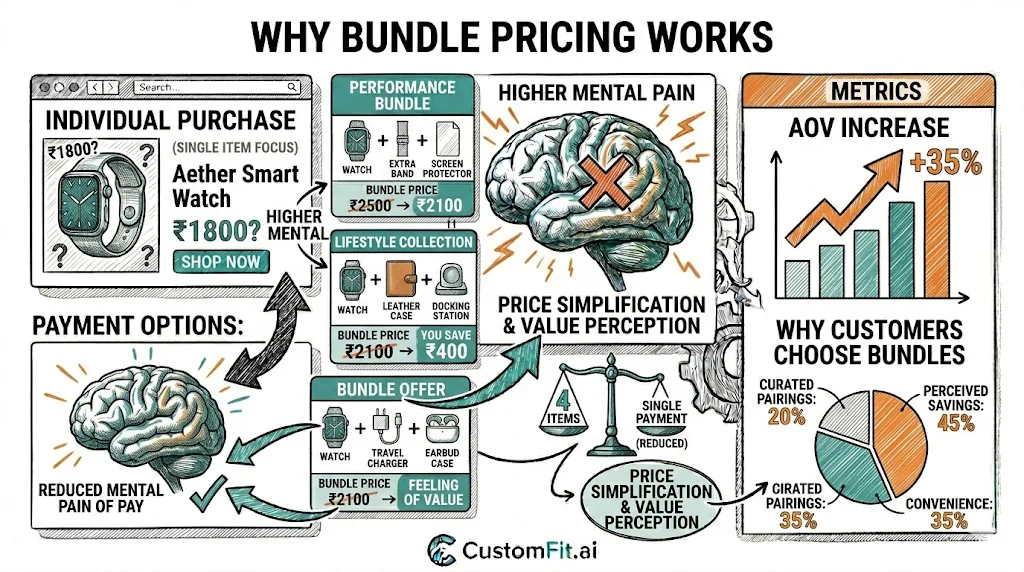
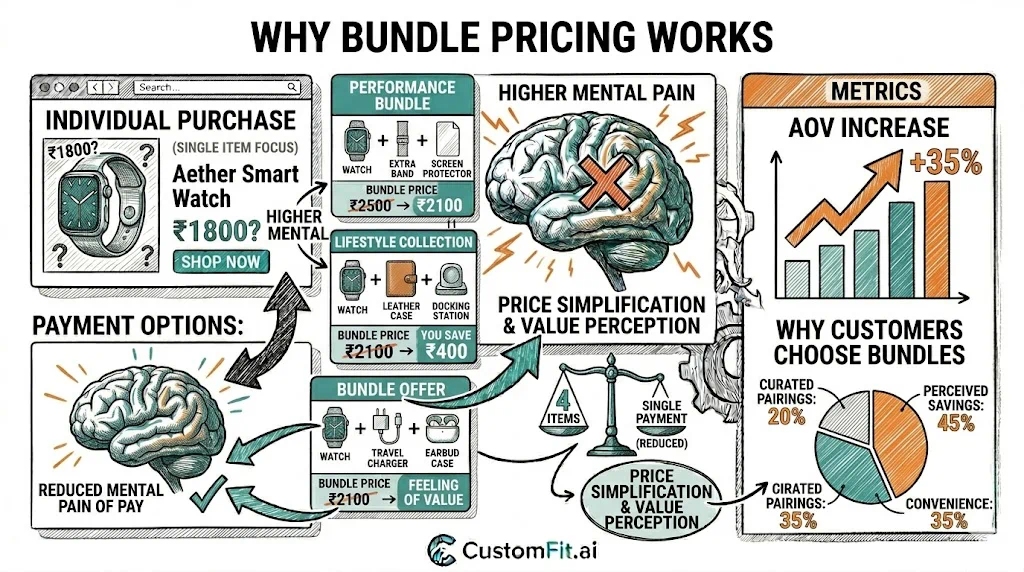
Customers make purchase decisions based on value perception, not just price. A ₹1,500 bundle that contains three items they want feels like a better deal than three separate ₹600 purchases totaling ₹1,800—even though the bundle is more expensive than any single item.
Bundle pricing works because:
Reduced decision fatigue: A well-curated bundle removes the need to separately consider and add multiple items. "This is everything you need for a complete skincare morning routine" resolves the decision—the customer doesn't have to figure out what pairs well with what.
Perceived savings: Even if the bundle discount is modest (10–15%), the perception of savings versus buying separately drives add-to-cart. Clear "you save ₹X" callouts make this tangible.
Discovery of new products: Bundles introduce customers to products they wouldn't have sought out independently. A hair care bundle that includes a new scalp oil the customer has never tried can create a new repurchase category.
CAC efficiency: The same acquisition cost generates more revenue per conversion. If your CAC is ₹500 and AOV rises from ₹900 to ₹1,400, the effective cost of acquisition as a percentage of revenue drops from 55% to 36%.
1. Complete-the-Set Bundles
Products that naturally form a complete use case. Skincare: cleanser + toner + moisturizer. Hair care: shampoo + conditioner + hair mask. Fitness: protein + creatine + pre-workout.
These bundles work because the need for all components is real—customers who buy one often need the others. Pre-packaging the complete set removes the multi-item shopping friction.
Pricing: 15–25% discount vs. purchasing individually. Show the math clearly: "Buy all 3 for ₹1,499. Individual price: ₹1,850."
2. Value/Starter Kits
For new customers or new product lines, a starter kit bundles entry-level products at a lower price point than individual items would suggest. The goal is trial—getting customers to experience multiple products at lower initial commitment.
Example: Mamaearth or mCaffeine offering a "Try Our Best Sellers" kit with travel-size versions of 4–5 products at ₹499. This drives trial, introduces multiple SKUs, and seeds repurchase for full-size versions.
Pricing: Often below the implied value because the goal is trial and LTV, not margin on the single transaction.
3. Gifting Bundles
Curated for gifting occasions—Diwali, birthday, anniversary, baby shower. These bundles command premium pricing because the gifting context shifts value perception. A ₹1,200 collection of three ₹400 products in a premium gift box can sell for ₹1,800 because the packaging, curation, and occasion add value.
Indian brands like Nykaa and Sugar Cosmetics build significant festive revenue through gifting bundles that are designed well in advance of peak seasons.
Pricing: Can exceed sum-of-parts pricing when the packaging and curation add tangible value. Test premium price points aggressively.
4. Volume Bundles (Multi-Pack)
"Buy 3, get 20% off" for consumables that customers repurchase regularly. Supplements, skincare serums, personal care products. The customer commits to more volume upfront; in exchange, they get savings and the brand gets improved LTV and reduced future CAC.
Pricing: Discount scales with volume. 3-pack at 15% off, 6-pack at 25% off. The margin trade-off is offset by the LTV gain (no re-acquisition cost for those future units).
5. Cross-Category Bundles
Products from different categories that serve a common context or customer. A fitness brand might bundle a water bottle with a protein supplement. A fashion brand might bundle a kurta with a matching stole. A skincare brand might bundle a face serum with a lip treatment.
These bundles require careful curation—random cross-category bundles feel forced and don't convert. Meaningful context bundles (same use occasion, same aesthetic, same customer type) work well.
The pricing structure of a bundle significantly affects both conversion and margin.
Framework:
The perception equation: "You save ₹351" is specific and credible. "15.6% off" is math that most customers won't compute. Always state savings in rupees, not just percentages.
Testing bundle discount levels: 10% discount vs. 20% discount affects both CVR and margin. A/B test to find the optimal point. Often 15% off performs nearly as well as 25% off—the lower discount preserves more margin.
Product page cross-sell: "Frequently Bought Together" placed on the product page, before add-to-cart. Shows two or three complementary items with a combined price and clear savings callout. This is the highest-converting bundle placement because it intercepts customers while they're already in purchase mode.
Dedicated bundle/kit pages: Some bundles warrant their own product page with full product imagery and description. Gifting sets and complete kits benefit from dedicated pages that can be driven by search traffic ("complete skincare routine kit") and ad campaigns.
Cart upsell: After a customer adds a single item to cart, suggest a complementary item to complete a bundle. "Add our Niacinamide Moisturizer for ₹350 (normally ₹450) and get free shipping." This cart-level bundle is effective but slightly lower converting than product-page presentation.
Post-purchase upsell: "Add this to your order before it ships." Shows a complementary item at a discount, available with one-click addition to an existing order. Works particularly well for consumable add-ons (a travel size of a complementary product).
Intuition-based bundles often underperform data-driven ones. Use your order data to find natural co-purchase patterns:
Shopify order analysis: Export 3–6 months of order data. Find the most common two-product and three-product order combinations. These are your natural bundles—customers are already buying these together, which proves demand.
Customer segment analysis: Different customer segments may have different natural bundle patterns. A customer in their 30s buying for themselves has different natural pairs than a customer buying as a gift.
Category page behavior: Which products are viewed together frequently? Session recordings and heatmaps can reveal browse-level affinity even without co-purchase data.
Review mining: Customer reviews often mention complementary products ("I use this with X for best results"). This is informal bundling signal.
Bundle optimization requires testing, not just launching. Key elements to test:
Bundle composition: Bundle A (cleanser + toner + moisturizer) vs. Bundle B (cleanser + serum + moisturizer). Which combination drives better AOV and conversion?
Bundle price point: ₹1,299 vs. ₹1,499 for the same bundle. Does the higher price significantly suppress CVR, or does it hold?
Bundle presentation: Product-page cross-sell vs. dedicated bundle page. Where does the bundle convert better for your audience?
Discount framing: "Save ₹300" vs. "15% off" vs. "Get 3 for the price of 2.5." Different framings resonate differently with different audiences.
CustomFit.ai enables bundle variant testing on Shopify—test different bundle presentations and pricing without engineering work, and measure AOV and RPV impact directly.
Indian festive and occasion calendar creates natural bundle demand:
Diwali: Gift hampers—curated sets in premium packaging. Plan 2–3 months ahead; festive bundle demand often peaks 2–3 weeks before Diwali itself.
Navratri/Durga Puja: Occasion-specific beauty and fashion bundles (festive makeup look kit, ethnic wear + accessories).
Holi: Color-specific or fun-themed beauty bundles; festive food gift hampers.
Wedding season (Oct–Feb, Apr–May): Bridal prep kits, bridesmaids gifting bundles, groomsmen kits.
Mother's Day / Women's Day: Gifting-focused bundles positioned as appreciation gifts.
Planning bundle collections for these occasions ahead of time, with dedicated landing pages and specific ad creative, captures the intent spike that each occasion creates.
Links: Average Order Value | Conversion Rate | Price Testing | Pricing Strategy Pillar | Dynamic Pricing Ecommerce | Post-Purchase Upsell Strategies