CustomFit.ai — Website personalization, A/B testing and CRO for Shopify and D2C
Product
Features
✱
Website Personalization
Adapt to each visitor's behavior & intent
⧖
A/B & Multivariate Testing
Rigorous experimentation
✨
AI CopilotNEW
Personalize with a prompt
🤖
AI WingmanNEW
Auto-optimize toward winners
🎯
AI Conversion OptimizerNEW
GPT-grade test ideas
✎
No-Code Visual Editor
Drag-and-drop edit any element
▦
Product Recommendations
Personalized recs that lift AOV
⚑
Feature Flags
Ship safely with kill-switches
◧
Chrome Extension
Edit your store in the browser
⧉
Shopify, WooCommerce & more
All platform integrations
View all features →
Use Cases
$
Price A/B Testing
Test price points to maximize revenue
▦
Theme A/B Testing
Compare whole layouts & designs
🗂
Template A/B Testing
Test whole PDP/PLP templates
🏷
Discount A/B Testing
Find the offer that converts
🚚
Shipping A/B Testing
Thresholds, speed & copy
✍
Content A/B Testing
Copy, images & reviews
💳
Checkout Gateway A/B
Payments & one-click
⌖
Geo-Based Personalization
Per-location content & offers
⚡
Buyer-Intent Nudges
Exit-intent & retargeting
↔
Split-URL / Redirection
Full-page redirect tests
View all use cases →
Solutions & Guides
⤢
Conversion Rate Optimization
The complete CRO guide
⧖
A/B Testing Software
Buyer's guide for D2C
🛒
Cart Abandonment Recovery
Win back lost carts
📰
Landing Page Optimization
Convert more paid traffic
S
Shopify A/B Testing
Test your store, no code
S
Shopify Personalization
Tailor the store per shopper
◔
First-Time Visitor Offers
Convert new shoppers with trust & offers
★
Repeat-Customer Experiences
Reward and re-engage loyal buyers
◎
Campaign-Matched Pages
Match the landing page to the ad
⌖
Location-Based Experiences
Currency, language & regional offers
Explore CRO →
Customer stories
GIVA
+32%
conversion via personalized recs
GIVA
Mamaearth
+18%
revenue lift from PDP A/B tests
ME
The Sleep Company
+24%
AOV from product recommendations
TSC
Read customer stories →
Integrations
SWsfGA+15
✦
Not sure where to start?
Let AI Copilot pick your first tests

“We wake up to evidence-backed tests ready to deploy — not a backlog of maybe ideas.”

AN
Anirudh S.
Growth · Chargebee
★★★★★4.8on G2 · 2,400+ brands
Talk to our team →
Widgets
Integrations
Ecommerce & Checkout
Shopify
Shopline
Shoplazza
GoKwik
ShopFlo
Razorpay Magic Checkout
Breeze
Shiprocket
View all integrations →
Analytics & Behavior
Google Analytics 4
Microsoft Clarity
Hotjar
Mixpanel
Amplitude
Heap
Adobe Analytics
Segment (CDP)
View all integrations →
Engagement, CRM & More
Klaviyo
MoEngage
CleverTap
WebEngage
HubSpot
Salesforce
Slack
Meta Ads
View all integrations →
CustomersPricing
Resources
CRO
▤
Playbooks
Proven strategies to boost conversions
🎙
Interviews
D2C leaders & marketing experts
▶
Webinars
Live deep dives & product sessions
Learn
✎
Blog
Tips, experiments & best practices
📕
Free E-Books
Mastering personalization
📖
Conversion Glossary
Every CRO term, defined
✦AI CopilotNEWLog inBook a demo
Start free trial
Select your platform — Install in 2 minsWe'll tailor the setup
⚡ Risk-free 14-day trial · No credit card · Cancel anytime
S
Shopify
Install from Shopify App Store
›
W
WooCommerce
Install the WooCommerce plugin
›
B
BigCommerce
Install from BigCommerce App Marketplace
›
SL
Shopline
Install from Shopline App Store
›
M
Salesforce / Magento
Install from the marketplace
›
SZ
Shoplazza
Install from Shoplazza App Store
›
WP
WordPress / Webflow
Install plugin or paste the script
›
◧
Others
Custom-built on React, Next.js, etc.
›
Tip: pick your platform — we handle the restBook a demo →
Product
Website PersonalizationA/B & Multivariate TestingAI CopilotAI WingmanAI Conversion OptimizerNo-Code Visual EditorProduct RecommendationsFeature FlagsView all features →
Use Cases
Price A/B TestingTheme A/B TestingTemplate A/B TestingDiscount A/B TestingShipping A/B TestingContent A/B TestingCheckout Gateway A/BGeo-Based PersonalizationBuyer-Intent NudgesSplit-URL / Redirection
Solutions & Guides
Conversion Rate OptimizationA/B Testing SoftwareCart Abandonment RecoveryLanding Page OptimizationShopify A/B TestingShopify Personalization
Explore
WidgetsIntegrationsCustomersPricing
Resources
BlogPlaybooksWebinarsInterviewsE-BooksConversion Glossary
Platforms
ShopifyShoplineShoplazzaChrome ExtensionAll integrations
Start free trialBook a demo
Home›Blog›checkout pricing›Dynamic Pricing for Ecommerce: How to Get Started

Dynamic Pricing for Ecommerce: How to Get Started

SJSapna JoharHead of Growth & CRO, CustomFit.aiJanuary 15, 20259 min read
On this page
  1. What Dynamic Pricing Means for D2C Brands
  2. Time-Based Dynamic Pricing: The Accessible Starting Point
  3. Demand and Inventory-Based Pricing
  4. Segment-Based Pricing
  5. A/B Price Testing: The Data-First Approach
  6. Psychological Pricing Principles
  7. Implementation Without Full Infrastructure
  8. Tips / Best Practices
  9. Key Takeaways
0%
Dynamic Pricing for Ecommerce: How to Get Started

From the conversion glossary

Concepts referenced in this article, defined.

Definition
What Is Dynamic Pricing? Definition & Guide
Definition
What Is Bundle? Definition & Guide
Definition
What Is Urgency? Definition & Guide
Definition
What Is Psychological Pricing? Definition & Guide
Definition
What Is Segmentation? Definition & Guide
← Back to Checkout Pricing guide
Try CustomFit.ai

Run A/B tests and personalize your store without code. 14-day free trial, no credit card.

Start free trial →
Share
XLinkedInEmail

Related articles

checkout pricing

Volume Discount Strategy for Ecommerce

Sapna Johar· 5 min read
checkout pricing

UPI & COD Optimization for Indian Ecommerce

Sapna Johar· 9 min read
checkout pricing

Tiered Pricing for D2C Products

Sapna Johar· 5 min read

Start lifting conversions today.

Run rigorous A/B tests and personalize every visit on Shopify or any storefront — no engineers required.

Start free trialBook a demo

Built for every D2C category

🧴
Skincare
💄
Beauty
🌿
Wellness
☕
F&B
👟
Apparel
💍
Jewelry
🛋️
Home
🍼
Baby
Live · Right now
Mamaearth — free-shipping band +12.4% AOVGIVA — festive collection page +34% revenueBellavita — PDP CTA test +27.4% CVRKapiva — Quiz-driven recs +9.48% CTRThe Sleep Co — landing personalized 2× capturesPlum — Returning shopper swap +18.2% CVRMamaearth — free-shipping band +12.4% AOVGIVA — festive collection page +34% revenueBellavita — PDP CTA test +27.4% CVRKapiva — Quiz-driven recs +9.48% CTRThe Sleep Co — landing personalized 2× capturesPlum — Returning shopper swap +18.2% CVR
Get in touch

Tell us about your store.

We reply within an hour during business hours. No sales pitch, no spam — just answers from someone who's seen 2,400+ D2C stores.

✓ Reply within 1 hour✓ No spam, ever✓ Free demo & setup help
✓ Thanks! We'll be in touch shortly.
CustomFit.ai

The all-in-one website personalization, A/B testing & CRO platform for high-growth D2C brands. Made by marketers, fueled by coffee.

in𝕏◎▶f
Product
  • Features
  • A/B Testing
  • Personalization
  • AI Copilot
  • AI Wingman
  • AI Conversion Optimizer
  • Feature Flags
  • Widgets
  • Integrations
  • ROI Calculator
Platforms
  • Shopify
  • Shopline
  • Shoplazza
  • Salesforce
  • Chrome Extension
  • All Integrations
Resources
  • Blog
  • Playbooks
  • Webinars
  • GrowthFit Interviews
  • Free E-Books
  • Conversion Glossary
  • Case Studies
Compare
  • vs VWO
  • vs Optimizely
  • vs Google Optimize
  • vs Mutiny
  • vs Intelligems
  • vs Shoplift
  • vs AB Tasty
  • vs Convert
  • vs Kameleoon
Company
  • About Us
  • Partners
  • CustomFit Awards
  • Recognition
  • Contact
  • Privacy Policy
  • Terms & Conditions
© 2026 CustomFit.ai · Valley Monks Pvt Ltd · Made by marketers, fueled by coffee, and obsessed with conversions.
SOC 2 Type II · GDPR · CCPA · ISO 27001

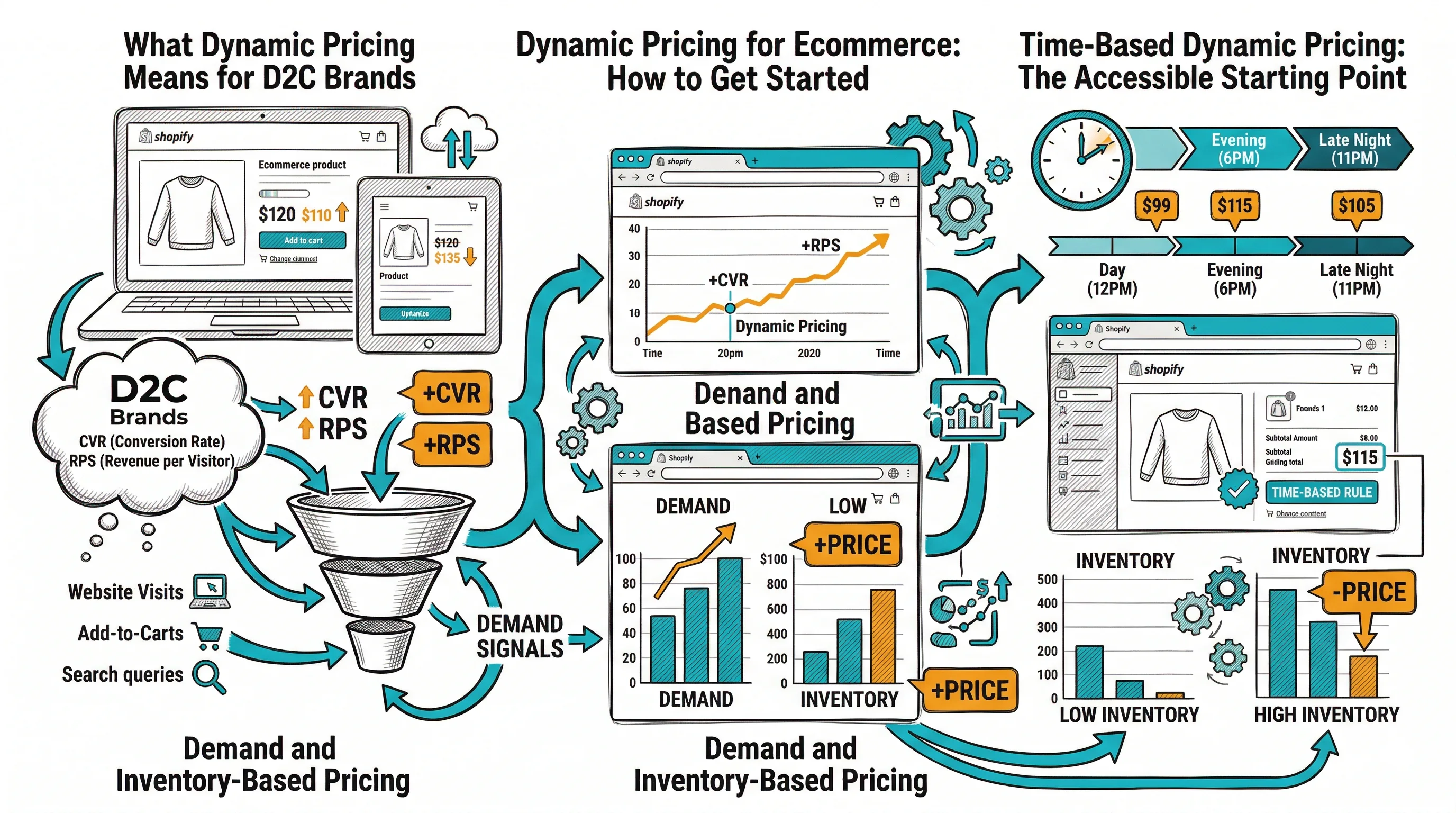
Dynamic pricing allows ecommerce brands to move beyond fixed prices and respond to demand, inventory, competition, and customer behavior in real time. Done well, it increases revenue per visitor and improves sell-through rates. Done poorly, it creates customer distrust and can undermine brand value. This guide walks through what dynamic pricing actually means for D2C brands, how to implement it at different levels of sophistication, and how A/B price testing gives you data before committing to any pricing change.

What Dynamic Pricing Means for D2C Brands

The term "dynamic pricing" gets applied to a wide range of tactics—from sophisticated algorithmic pricing (adjusting thousands of SKU prices in real time based on competitor data) to simple time-based discounting during festive season.

For most Indian D2C brands, the practical application falls into three categories:

1. Time-based dynamic pricing: Prices that change based on a calendar or countdown. Flash sales, early bird pricing, festive offers, clearance season. This is the most common and most accessible form.

2. Demand/inventory-based pricing: Prices that adjust based on stock levels or demand signals. As inventory runs low, prices may hold firm or increase slightly. As overstocked items need clearing, prices come down. This is mid-complexity and can be implemented via Shopify apps.

3. Segment-based pricing: Different prices for different customer groups. Loyalty member pricing, repeat customer discounts, referral-exclusive offers. This requires customer segmentation and a tool to serve different prices by segment.

Full algorithmic dynamic pricing (tracking competitor prices in real time and adjusting every 30 minutes) is primarily relevant for marketplace sellers and large catalog brands. For most D2C brands, the first two or three forms above generate meaningful revenue improvement with manageable complexity.

Time-Based Dynamic Pricing: The Accessible Starting Point

Festive season pricing is the most natural entry point for dynamic pricing in Indian ecommerce.

Diwali / Navratri / Holi pricing strategy:

During festive periods, consumer willingness-to-pay for gift-worthy products typically increases—buyers are in purchase mode and the emotional occasion justifies spending. This creates the opportunity to hold prices firm on premium products (rather than discounting them) while offering bundled value.

However, festive periods also bring intense competition. If competitors are discounting heavily, holding prices firm on identical or comparable products can hurt conversion. The right approach is category-specific:

  • Exclusive or differentiated products: Hold price or offer bundle value, not discount
  • Commodity-type products: Competitive pricing matters more; discount strategically
  • Gifting SKUs: Bundle + premium packaging at a price point that represents value but isn't a race to the bottom

Countdown urgency pricing:

"This price ends in 4 hours" is a time-based dynamic pricing element. When the countdown is real (the price genuinely reverts), it creates honest urgency. When it's fake (the countdown resets), it's manipulative and increasingly recognized as such by Indian consumers.

The Indian e-commerce market has grown sophisticated. Manufactured urgency that's been overused has a diminishing return—and risks trust damage when customers notice the "limited time" offer has been running for three months.

Early bird pricing:

For new product launches, pre-orders at a lower price point reward early commitment and generate revenue before the product is in hand. Effective for brands with engaged communities (email list, WhatsApp group) that can create real early-bird demand.

Demand and Inventory-Based Pricing

Adjusting prices based on demand and stock levels is the next layer of dynamic pricing sophistication.

Low-stock signaling: Showing "Only 5 left in stock" (when true) creates urgency without price change. This is the softest form of demand-based pricing psychology. The honesty requirement is critical—fake low-stock signals have been overused and create cynicism.

Clearance pricing: As inventory of a particular SKU or season ages, systematic markdown schedules prevent the buildup of dead stock. A markdown schedule might be: 10% off at 60 days unsold, 25% off at 90 days, 40% off at 120 days. Automated via Shopify apps.

Surge pricing (cautious application): During genuine peak demand—say, a product featured by a major influencer—holding prices firm while demand is high is a form of demand-based pricing. Actually increasing prices during demand spikes is risky for D2C brands because it can create viral negative sentiment ("they raised prices when they knew the product was popular").

Segment-Based Pricing

Showing different prices to different customer segments is powerful but requires careful implementation.

Loyalty/VIP pricing: Logged-in loyalty members see member pricing, which may be 5–15% below the listed price. This is widely accepted and builds retention—customers have a tangible reason to be in your loyalty program.

Repeat customer discounts: Using a Shopify tool or CustomFit.ai, you can identify returning customers and show them an exclusive offer. "Welcome back—here's 10% off your next order" is segment pricing that feels like a reward rather than discrimination.

New visitor vs. returning visitor: Showing a first-order incentive exclusively to new visitors (not returning customers who don't need the incentive to convert) is efficient spending—you're not discounting to customers who would have bought anyway.

What to avoid: Showing different prices for the same product to similar customers based on data like device type or geographic location (without clear rationale) can create trust issues when discovered and may face regulatory scrutiny under evolving Indian consumer protection rules.

A/B Price Testing: The Data-First Approach

Before committing to dynamic pricing infrastructure, A/B price testing helps you understand how price changes affect demand.

The basic price test:

Version A: Current price (₹999) Version B: Test price (₹899 or ₹1,099) Measure: Conversion rate AND revenue per visitor (not just CVR—a lower price may convert more but generate less revenue)

The goal isn't the highest conversion rate—it's the highest revenue per visitor (RPV). A 10% CVR increase that comes with a 15% price decrease results in lower total revenue.

Running price tests ethically:

Customers in a price A/B test see different prices for the same product. This is legal and standard practice. The test should run long enough for statistical significance (typically 2–4 weeks depending on traffic). Don't run price tests during anomalous periods (festivals, major promotions) that would contaminate results.

CustomFit.ai supports price testing on Shopify as part of its A/B testing functionality—no developer needed. Create variants with different price displays, split traffic, and analyze RPV and CVR together.

What price tests reveal:

  • Price elasticity: How sensitive your customers are to price changes. A 10% price increase that drops CVR by 3% means price is relatively inelastic in that range—you can likely raise price.
  • Psychological price points: ₹999 vs. ₹1,000 often converts differently despite a ₹1 gap. ₹1,499 vs. ₹1,500 can also show meaningful differences.
  • Segment differences: Mobile vs. desktop users may have different price sensitivities. New vs. returning customers often behave differently to price changes.

Psychological Pricing Principles

Dynamic pricing doesn't operate in a vacuum—it works alongside psychological pricing principles that affect how prices are perceived.

Charm pricing: Prices ending in 9 or 7 (₹499, ₹1,997) are perceived as lower than round numbers. This is still effective, though increasingly understood by consumers.

Price anchoring: Showing a higher original price alongside a sale price ("₹1,499 ₹999") creates the perception of value even if ₹999 has been the price for months. The FTC (US) and ASI (India) have guidelines on what constitutes deceptive pricing—anchoring against a genuine original price is fine; fabricating an MRP solely to create a "discount" is not.

Bundle pricing vs. per-unit pricing: A bundle of 3 items priced at ₹999 ("just ₹333 each") creates a different price perception than three items at ₹333 each. Bundle pricing often allows higher total prices while maintaining perceived value.

Free shipping thresholds: "Free shipping above ₹499" creates a dynamic where customers add items to reach the threshold. This is a form of demand-based price interaction that can be A/B tested with different thresholds.

Implementation Without Full Infrastructure

Most Indian D2C brands don't need enterprise dynamic pricing software. Here's a practical tiered approach:

Level 1 (Start here):

  • Manual festive pricing calendar (3–4 planned pricing events per year)
  • Markdown schedule for aging inventory (spreadsheet + manual Shopify price updates)
  • First-order discount code for new visitors (tracked via UTM or Shopify discount)

Level 2:

  • Shopify app for automated markdown schedules (e.g., Discounted by Hulk, Bold Discounts)
  • A/B price testing via CustomFit.ai for key SKUs
  • Loyalty member pricing via Shopify Loyalty apps

Level 3:

  • Competitor price monitoring tool (e.g., Prisync, Wiser)
  • Advanced segmentation with dynamic pricing by customer tier
  • Real-time demand signals driving clearance automation

Tips / Best Practices

  1. Start with time-based pricing before algorithmic pricing. Festive offers and markdowns are accessible, testable, and low-risk.
  2. Always measure revenue per visitor, not just CVR, when testing prices. A higher-converting lower price isn't always better.
  3. Make urgency signals honest. Real low stock, real countdowns. Fake urgency is increasingly detected and damages trust.
  4. Test price thresholds for psychological effects. ₹499 vs. ₹519 may show surprising CVR differences.
  5. Use loyalty pricing to reward retention, not acquisition. Member pricing is most defensible and builds LTV.
  6. Build a festive pricing calendar 2–3 months ahead. Reactive pricing decisions during festive peaks are usually suboptimal.
  7. Don't discount your hero products reflexively. Discount promotion trains customers to wait; bundle value maintains price integrity.
  8. Segment new vs. returning visitors for different offers. Don't give a first-order incentive to someone who was going to buy anyway.
  9. Monitor competitive pricing but don't react to every change. Brand positioning often matters more than price parity for D2C.
  10. Run price tests outside festive periods to get clean data that reflects normal buying behavior.

Key Takeaways

  • Dynamic pricing for D2C ecommerce covers a spectrum from simple time-based festive pricing to sophisticated algorithmic price adjustment—most brands should start simple.
  • A/B price testing is the data-first approach to pricing decisions: test before committing to a price change, and measure revenue per visitor, not just CVR.
  • Ethical dynamic pricing creates clear rationale for price variation (loyalty, timing, demand) and doesn't deceive customers with fabricated urgency or fake MRPs.
  • Segment-based pricing (loyalty member pricing, new visitor incentives) is the most impactful and least risky form of dynamic pricing for D2C brands.
  • Indian festive season creates a predictable pricing strategy opportunity—plan pricing calendars around Diwali, Navratri, and other occasions with 2–3 months of lead time.
  • CustomFit.ai supports A/B price testing on Shopify without developer resources—an accessible starting point for brands that want data-driven pricing decisions.

Links: Price Testing | A/B Testing | Conversion Rate | Pricing Strategy Pillar | Bundle Pricing Strategies | Shipping Rate A/B Testing