From the conversion glossary
Concepts referenced in this article, defined.
Concepts referenced in this article, defined.
Run rigorous A/B tests and personalize every visit on Shopify or any storefront — no engineers required.
Jewelry and accessories ecommerce has among the lowest conversion rates in D2C — typically 0.5–2% — because it's a high-consideration, high-trust, often high-value purchase category. Customers want to see how a piece looks from every angle, understand exactly what it's made of, know that the seller is legitimate, and feel confident that returns and exchanges are pain-free. CRO for jewelry isn't about aggressive tactics — it's about systematically removing the trust and information barriers that prevent a visitor who already likes a piece from completing the purchase.
This guide covers the specific CRO interventions that work for jewelry and accessories stores, with examples from the Indian market where gold purity standards, BIS hallmarking, and gifting culture create additional optimization opportunities.
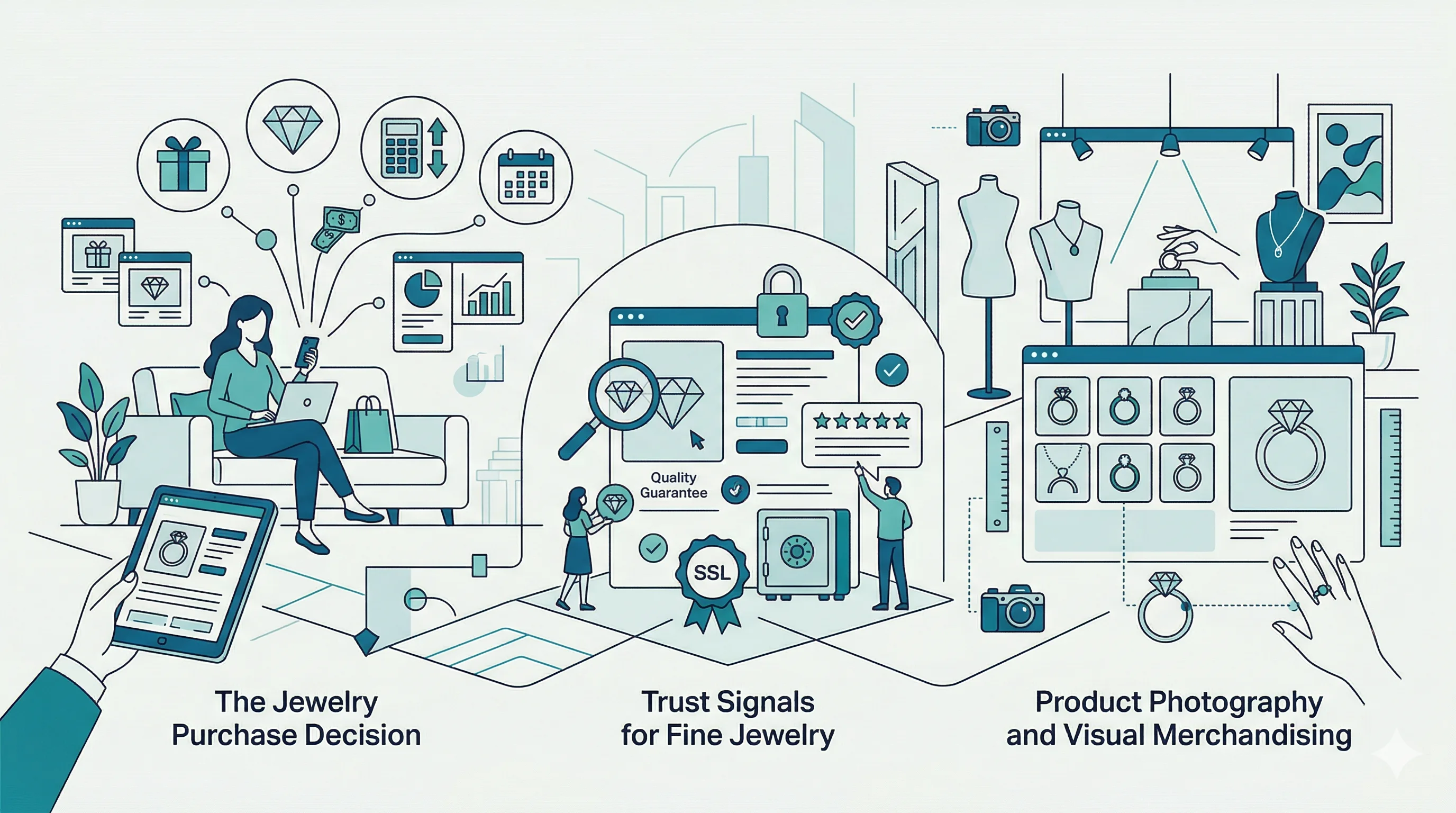
Before designing tests, understand what a jewelry buyer needs to feel before purchasing online:
Visual certainty: Does this piece look exactly like the photo? Multiple angles, video showing the piece in motion, and scale references (worn by a model with visible hand or neck) answer this.
Material confidence: Is this real gold? Real silver? What purity? BIS hallmarking, certification information, and karat/purity prominently displayed address this.
Sizing confidence: Will this fit? Ring size guides, bracelet length options, chain length options with neck visual references are essential for purchases where size determines whether the item can be worn.
Brand legitimacy: Is this seller real? For new-to-visitor brands, trust signals (years in business, verified reviews, social media following, return policy) matter disproportionately in jewelry because the purchase risk is higher.
Return and exchange safety: If it doesn't look right in person, can I return it? A strong, clearly communicated return policy reduces the perceived risk of online jewelry purchase.
Jewelry converts best when visitors can mentally confirm "this is exactly what I'll receive." Standard single product photography rarely achieves this.
What to test:
Multiple angles as the standard:
For Indian brands like Tanishq, Malabar Gold, or emerging D2C jewelry brands, showing a piece on a model's hand, neck, or ear provides the scale reference that flat product photos can't.
Video in the gallery: Test a 10–15 second video of the piece moving (rotating, light catching it) as the first or second gallery item. For intricate pieces (jhumkas, temple jewelry, layered chains), video converts significantly better than static images.
Before/after comparison for gifting: For gifting-focused products, show the piece in its gift box. "This is what the recipient will see when they open it" is a powerful selling image for Dhanteras, Valentine's Day, and anniversary purchases.
Jewelry purchases are higher-trust requirements than most D2C categories.
What to test:
BIS Hallmarking prominently displayed: For gold jewelry, BIS hallmarking certification is the Indian consumer's primary authenticity signal. Test showing the hallmark stamp image + certification number prominently near the price vs. only in the product description.
Certification display format:
Real gem certification: For diamond or gemstone jewelry, GIA or IGI certification displayed prominently — not just mentioned in the description — can significantly reduce hesitation for high-value purchases.
Lifetime warranty or polish guarantee: "Free polishing for life" or "Lifetime maintenance warranty" prominently displayed near the price. This is especially effective for fine jewelry brands targeting long-term wear.
Sizing is the #1 source of return in jewelry ecommerce. Reducing sizing errors through better on-page tools reduces returns and hesitation.
What to test:
Ring size finder integration: A print-and-measure guide or finger measurement tool directly on the product page vs. linking to a separate sizing guide. The on-page tool converts better because it keeps the user on the product page.
Chain/necklace length visualization: A visual guide showing how different chain lengths fall on the neck (14", 16", 18", 20", 22") vs. text description of lengths. Visual guides reduce return rates and increase confidence.
"How to measure your wrist" accordion: For bracelets, inline wrist measurement instructions vs. separate sizing page link. Keeping sizing information on the page reduces friction.
25–40% of jewelry purchases in India are gifts — Dhanteras, Valentine's Day, anniversaries, wedding gifts. The gifting purchase journey is different from personal purchase and requires specific optimization.
What to test:
Gift packaging display: Show the product in its gift packaging as a dedicated gallery image. "Arrives in a premium gift box" with an image of the actual box converts better than text-only mention.
Gift message option: An optional gift message field at checkout. Test showing this field prominently at checkout vs. as an optional "add gift message" toggle.
Delivery date guarantee for gifting: "Order by [date] — arrives before [festival]" with a specific date guarantee. This is particularly high-impact for time-sensitive gifts (Valentine's Day, Raksha Bandhan, Dhanteras).
"Gift this product" CTA: An alternate CTA ("Gift This" or "Send as a Gift") alongside "Add to Cart." Test whether this framing increases purchase rate from gifting-intent visitors.
Return anxiety is a major conversion barrier for online jewelry. Most ecommerce brands bury return policy in the footer.
What to test:
Return policy above the fold: "30-day free returns and exchanges" displayed near the price or CTA. Test this against the standard footer-only placement.
Risk reversal language:
COD for jewelry: For brands offering COD on jewelry, test prominent "Pay on delivery — no advance payment" near the add-to-cart button. This can significantly reduce purchase hesitation from first-time buyers.
Jewelry reviews with photos are particularly powerful because they provide the independent visual evidence of how the piece looks in reality.
What to test:
Worn product photos in reviews: Filter and feature reviews that include photos of the piece being worn. These are vastly more convincing than product-flat-lay review photos.
Review snippet above the fold: A single high-quality review ("This ring looks even better in person — exactly as shown. Excellent hallmarking. Delivered in 3 days. — Ananya, Delhi") near the product title.
Review display for gifting: "Gifted to my wife for our anniversary — she loved it" types of reviews are particularly relevant for gifting purchases. Feature these prominently for products with high gifting potential.
Indian jewelry consumers increasingly research and purchase on mobile. Mobile-specific jewelry CRO:
Image swipe gallery optimization: On mobile, product image swipes are the primary engagement. Ensure images load quickly (under 200KB each), swipe gesture is responsive, and the gallery indicator (dots showing 5 of 8 images) is visible.
Price display on mobile: On small screens, ensure price, discount, and total savings are visible without scrolling. EMI option ("₹1,499/month with 0% EMI for 6 months") should be visible near the price on mobile.
Sticky CTA on mobile: A sticky "Add to Cart" button that stays visible as visitors scroll through images and descriptions is consistently high-impact for jewelry and accessories product pages.
Show multiple model photos for wearable jewelry — ring on hand, necklace on neck, bracelet on wrist. Single product-on-background images aren't enough for online jewelry conversion.
Display BIS hallmark information prominently — for gold jewelry, this is India's primary authenticity signal. Don't bury it in the product description.
Test "Gift This" CTA alongside standard "Add to Cart" — for pieces with high gifting potential (rings, earrings, pendants), a separate gifting CTA can capture a different purchase intent.
Add delivery date guarantee before major Indian gifting festivals — Dhanteras, Valentine's, Raksha Bandhan. "Arrive before the festival" with a specific date is one of the highest-ROI seasonal optimization moves.
Feature photos-of-reviews prominently — jewelry UGC (photos of pieces being worn by real customers) is more conversion-effective than professional photography for many visitors.
Implement EMI display prominently for orders above ₹3,000 — jewelry is a high-consideration category where EMI availability can move the purchase decision for price-sensitive buyers.
Show ring/necklace sizing tool on the product page — don't link to a separate sizing page. On-page size tools reduce drop-off by keeping buyers in the purchase decision context.
Related reading: A/B Testing Social Proof | A/B Testing Images | Urgency and Scarcity Tactics | Conversion Rate Optimization | CRO Pillar Guide