From the conversion glossary
Concepts referenced in this article, defined.
Concepts referenced in this article, defined.
Run rigorous A/B tests and personalize every visit on Shopify or any storefront — no engineers required.
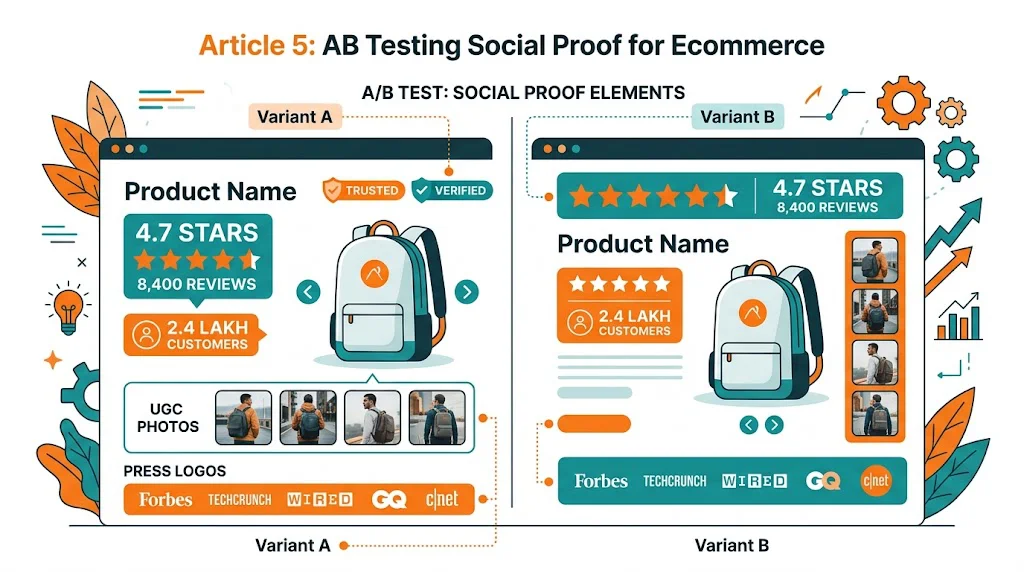
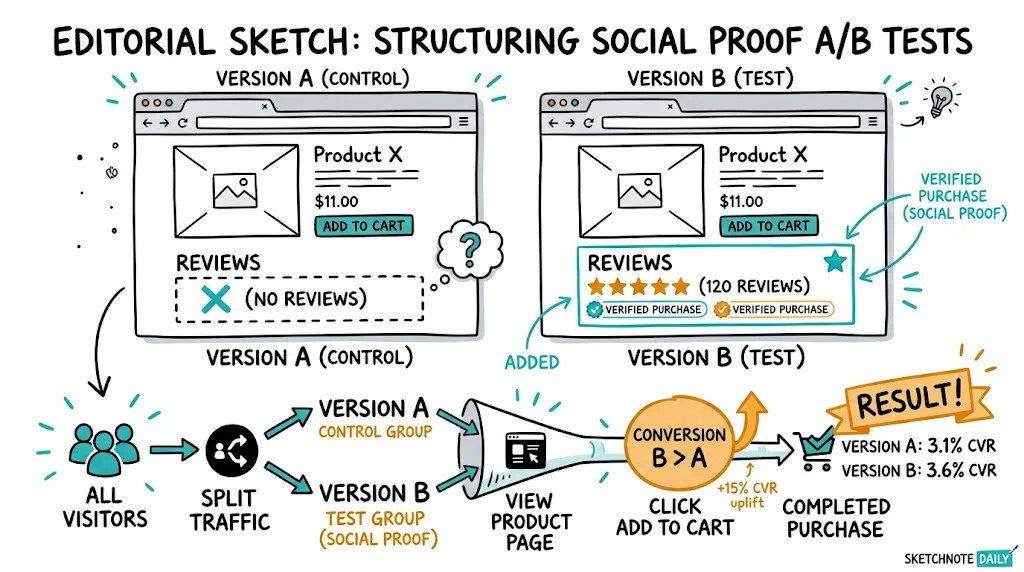
Social proof — reviews, ratings, UGC photos, testimonials, press mentions, and trust badges — can lift conversion rates by 10–30% when placed and presented correctly. The challenge is that "correctly" varies by product type, audience, and placement on the page. A/B testing social proof elements tells you which types of social proof matter most to your customers and exactly where on the page they need to appear to drive action.
Indian D2C shoppers are among the most review-reliant buyers globally — 82% read online reviews before purchasing, compared to 72% globally (Statista). This makes social proof testing particularly high-value for brands like Mamaearth, mCaffeine, Plum, and Pilgrim, where customer trust is built through community validation.
What to test:
Expected findings: Products showing review count alongside stars consistently outperform rating-only displays. "4.6 ★ (2,847 reviews)" signals scale and trust — the number proves the rating isn't fabricated.
Indian context: Indian consumers are particularly sensitive to review recency. Test displaying "last 30 days: 4.8 ★" alongside the all-time rating — this can increase trust for established products where reviews have accumulated over time.
Where reviews appear on the page significantly affects whether visitors read them before making a purchase decision.
What to test:
High-impact test: Moving even a single 5-star review snippet (3 sentences) to just above the add-to-cart button is consistently one of the highest-lift changes on product pages. Test this against your current placement.
Real customer photos create authenticity that professional photography can't replicate. A Kapiva customer showing their daily supplement routine is more persuasive than a studio image of the product.
What to test:
What to measure: Add-to-cart rate, time on page (UGC increases engagement), and image gallery interaction rate.
Written testimonials from specific customers or endorsements from known influencers.
What to test:
For Indian D2C: Testimonials from identifiably Indian customers (names, cities) outperform generic testimonials. "Priya Sharma, Bengaluru" is more credible than "Priya, India" — test the specificity level.
Badges communicating safety, authenticity, and purchase protection.
What to test:
High-impact for Indian ecommerce: "Secure Payment" and "COD Available" trust badges near the checkout button reduce purchase anxiety. Test badge placement (above vs. below CTA) and badge design (icon with text vs. text only).
Real-time or aggregated numbers that signal popularity.
What to test:
Important caveat: These signals only work when real. Fake scarcity ("Only 3 left" when you have 500 units) erodes trust when discovered. Only test genuine signals.
Step 1: Audit your current social proof Catalog every social proof element currently on your product page: where it appears, what format it uses, and whether you have data on interaction rates.
Step 2: Identify the biggest gaps Common gaps:
Step 3: Run the highest-impact test first If you currently have reviews only below the fold, your first test should be adding a review snippet above the fold. This consistently shows larger lifts than changing review sort order, badge design, or testimonial copy.
Step 4: Define your metrics
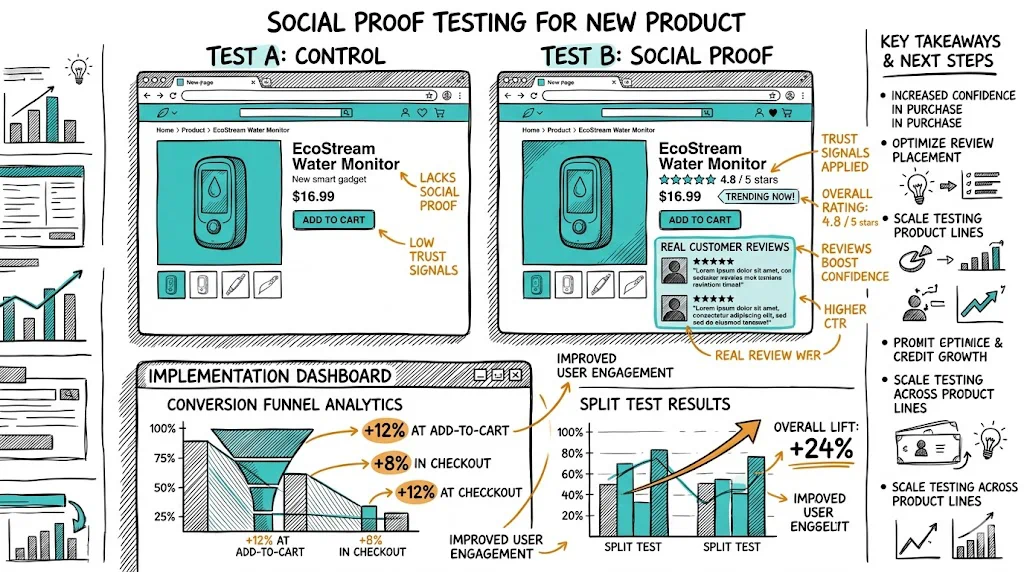
New products with no reviews present a challenge. Alternative social proof options:
Editor's choice / Founder's note: "Why we made this" from the founder, positioned as transparent storytelling rather than marketing. Test this against a generic product description.
Pre-order social proof: "Join 847 others who've already placed pre-orders" for launch products.
Related product social proof cross-reference: "From the same brand that made [popular product] with 10,000+ reviews" — borrows trust from established SKUs.
Media mentions: Even pre-launch media coverage can anchor trust. "Featured in Vogue India" near the product title is testable.
Direct metrics:
Indirect quality metrics:
Test review snippet placement above the fold before any other social proof test — it's the single highest-impact social proof experiment for most product pages.
Show review count with your star rating — "4.6 ★" alone is less persuasive than "4.6 ★ (3,204 reviews)". Test whether adding the count changes your CVR.
Test location-specific testimonials for Indian audiences — "Priya Mehta, Mumbai" outperforms "Customer, India" for trust and relevance.
Don't hide negative reviews — test showing them prominently — brands that show a balanced review distribution (including 3 and 4 star reviews) often outperform those that filter to only 5-star content. Authenticity outperforms polish.
Use UGC photos in your product gallery, not just the review section — test moving UGC photos up into the primary image gallery. For beauty and apparel, this can be one of the highest-lift image tests.
Test FSSAI, ISO, or category-specific certifications prominently — for food, supplement, and cosmetic brands, regulatory certifications are high-trust signals that are under-utilized in most Indian brand product pages.
Segment social proof tests by visitor type — new visitors need more social proof than returning customers. Test showing more extensive social proof (full review section, multiple trust badges) to new visitors while keeping a cleaner layout for returning visitors.
Related reading: A/B Testing Images | A/B Testing Headlines | Urgency and Scarcity Tactics | Conversion Rate Optimization | A/B Testing Pillar Guide