From the conversion glossary
Concepts referenced in this article, defined.
Concepts referenced in this article, defined.
Run rigorous A/B tests and personalize every visit on Shopify or any storefront — no engineers required.
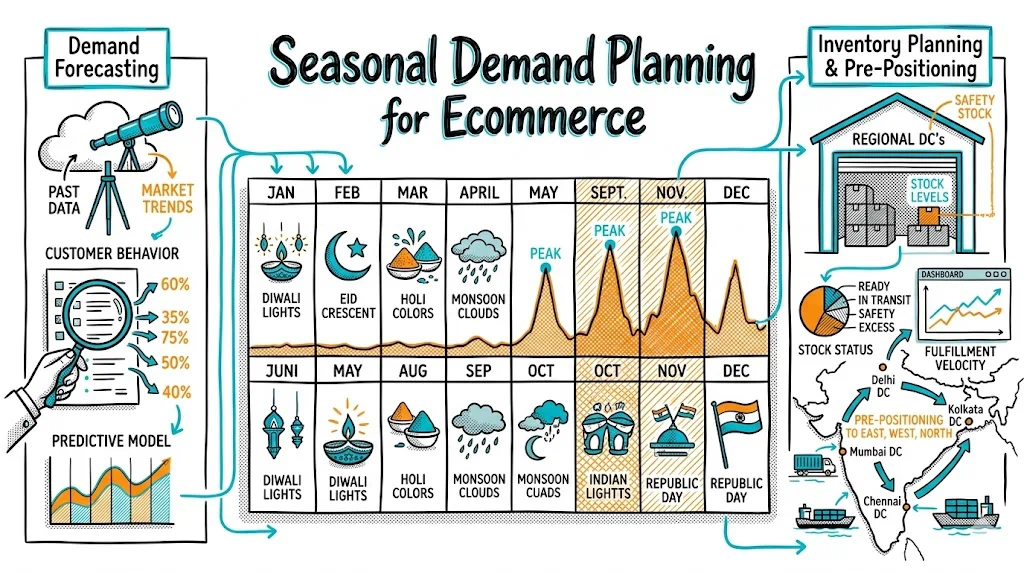
For Indian D2C brands, three to four weeks of the year—Diwali, Christmas/New Year, and the Big Billion Days/Great Indian Festival windows—can generate 30–40% of annual revenue. Brands that plan for these peaks execute them profitably; those that scramble run out of stock, make expensive last-minute ad buys, and disappoint customers. Seasonal demand planning is the difference between a festive season that funds your next year and one that creates financial stress.
Understanding the demand calendar helps you sequence preparation:
October–November (Navratri to Diwali): The biggest ecommerce window in India. Categories that spike: apparel, footwear, electronics, home decor, gifting, beauty, and dry fruits/sweets. Marketplace sale events (Big Billion Days, Great Indian Festival) fall in this window.
December–January (Christmas/New Year and Republic Day sales): Strong for electronics, fitness, fashion, and lifestyle. "New Year, new me" drives health and wellness.
February–March (Valentine's Day, Holi): Strong for gifting, personal care, and color cosmetics. Valentine's week creates a concentrated demand spike for beauty, fragrance, and accessories.
April–May (Summer prep): Skincare, sunscreen, cooling products, summer apparel.
June–July (Monsoon onset, mid-year sale): Amazon Prime Day and Flipkart's Big Savings Day typically fall here. Good for electronics, home, and kitchen.
Map your product catalog to this calendar and identify your top two or three demand windows—those are where planning investment pays off most.
Your own historical data (if available): Last year's daily/weekly order rate with a growth factor applied. If you grew 40% year-over-year, apply a 40–50% uplift to last year's peak.
Category benchmarks: Logistics partners and marketplace account managers share category-level demand multipliers. "Fashion grows 3.5x during Diwali" is a useful starting point if you have no history.
Google Trends: Trend your primary product keywords over 12 months to see the magnitude and timing of seasonal spikes in your category.
Notify-me and wishlist data: The size of your back-in-stock list and wishlist adds for specific products is a leading indicator of pent-up demand.
Create three scenarios:
Plan inventory for the target case, have supplier commitments in place for the stretch case, and define your "pause ads" trigger point if you approach stockout in base case.
Safety stock = (Peak daily demand forecast × Lead time days) + (Standard deviation of demand × Lead time factor)
For a simpler approach: if your peak daily demand estimate is 50 units and your supplier takes 12 days to replenish, keep at minimum 600 units on hand when the season starts, plus a 20% buffer (720 units).
Logistics speed matters during peak season when everyone's network is strained. If 40% of your orders go to Maharashtra and 30% to Delhi-NCR, pre-position inventory at fulfillment centers in Mumbai and Delhi before the sale window opens. This cuts delivery times by 1–2 days and reduces "expected delivery: 7–10 days" which hurts conversion.
Festive seasons bring higher return rates—customers buy impulsively and change their mind. Plan your reverse logistics capacity: returns processing, refund timelines, and inventory reinspection. Set customer expectations clearly on your returns page about festive season return timelines.
Update your website 1–2 weeks before the sale window:
CustomFit.ai lets you schedule these changes without code and A/B test which festive banners drive more add-to-cart.
For major sale events:
/festive-sale or /diwali-offers landing page (good for SEO and paid landing)/diwali-skincare-offers, /diwali-apparel-dealsTest your website's ability to handle 5–10x normal traffic before the sale starts. If you are on Shopify, check your theme's performance scores and reduce unoptimized image sizes. Talk to your Shopify plan provider about traffic expectations.
During peak seasons, even small checkout frictions multiply across high volume. Ensure:
Start email/WhatsApp warm-up 2–3 weeks before the sale:
Festive season CPMs on Meta and Google spike 40–100% as all brands advertise simultaneously. To compete efficiently:
Related reading: Conversion Rate Optimization | Average Order Value | Cart Abandonment | A/B Testing | Ecommerce Loyalty vs Acquisition
See also: D2C & Ecommerce Growth Pillar