From the conversion glossary
Concepts referenced in this article, defined.
Concepts referenced in this article, defined.
Run rigorous A/B tests and personalize every visit on Shopify or any storefront — no engineers required.
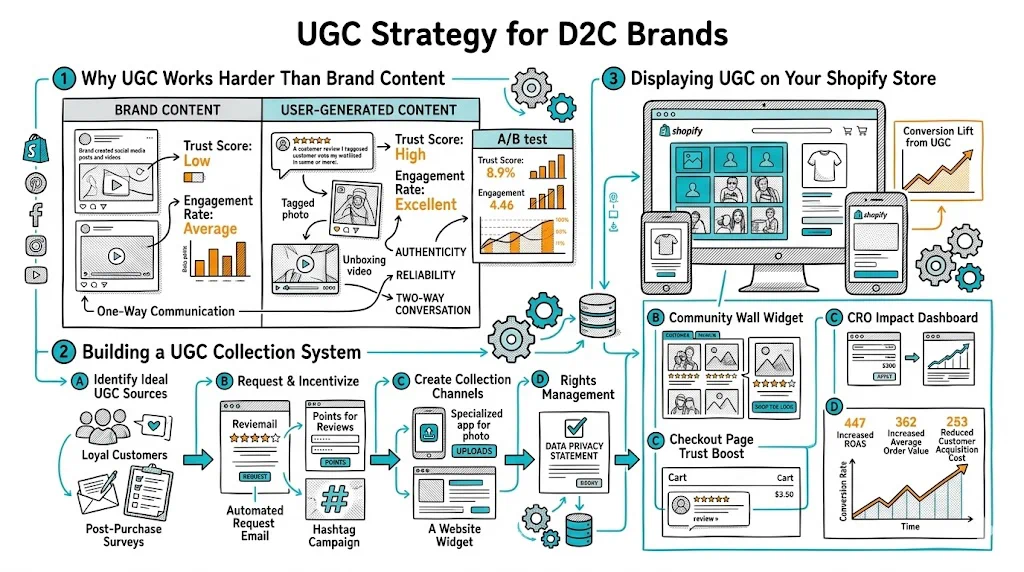
User-generated content (UGC) is the most credible content your D2C brand can put in front of a potential customer—because it didn't come from you. Customer photos, videos, and reviews are trusted by online shoppers at 6x the rate of brand-produced content, and for Indian D2C brands where first-time buyer hesitation is a major purchase barrier, a strong UGC strategy is one of the highest-ROI investments available. This guide covers how to systematically collect, curate, display, and use UGC to lift conversion rate and reduce paid acquisition costs.
The psychology of UGC is straightforward: when a potential buyer sees a real person who looks like them using your product and reporting a positive experience, the mental calculation shifts from "will this work?" to "this already worked for someone like me."
This shift reduces the single biggest barrier to D2C purchase: the uncertainty of buying from a brand you can't touch or physically evaluate before paying. In India, where return anxiety is high (especially for prepaid orders), seeing that real customers received the product, used it, and were satisfied dramatically increases purchase confidence.
UGC also solves the creative problem that plagues D2C paid advertising. Ad creative fatigue is the reason most brands' Meta and Google campaigns decay in performance over 2–4 weeks. UGC-based ad creative, which looks native and authentic rather than polished and promotional, consistently shows longer performance longevity and higher engagement rates—often at 2–3x the ROAS of studio-produced creative.
The best UGC request is specific, timed, and provides a clear value exchange.
Timing: Day 7–14 post-delivery is optimal for most consumable and beauty products—enough time for the customer to have tried the product and formed an opinion, not so long that the purchase enthusiasm has faded.
Specificity: "Share a photo of your experience" gets generic responses. "Share a photo of your [product name] in use and tell us one thing you noticed after your first week" gets testimonial-quality content.
Value exchange: ₹100–₹150 store credit for a review with photo, ₹300–₹500 for a video testimonial. These incentives should be mentioned in the collection request but never framed as "payment for positive review"—the content must be authentic.
WhatsApp: The highest-response UGC collection channel for Indian D2C. A WhatsApp message at day 10 post-delivery with a direct ask ("Can you share a photo of your experience with [product]?") gets 3–5x the response rate of email. Customers often reply with casual, authentic content that translates directly into compelling ad creative.
Packaging insert: A card with a QR code linking to your "Share your experience" form, placed in every order. Include the incentive clearly. This reaches every customer without a database requirement.
Thank-you page: A "Share your purchase on Instagram and tag #[brand]" prompt with a preview of what others have shared. Social proof of others sharing motivates new buyers to participate.
Review request email/WhatsApp sequence: Automated requests that include a link to a simple upload form. For apps like Loox and Judge.me on Shopify, this is built-in functionality.
Community posts: In your WhatsApp community or Instagram community, regular prompts like "This week's [Brand] spotlight—share your experience and we'll feature you" generate ongoing UGC from your most engaged customers.
Before using any customer content in ads or on your website, secure explicit permission:
For Instagram or WhatsApp DM content: Reply with "We'd love to share your post on our website and in our ads—is that OK?" and save the confirmation.
For form-collected content: Include a checkbox in your review collection form: "I give [Brand] permission to use this review and photos in marketing materials."
This is not optional. Content used without permission generates backlash disproportionate to the cost of asking.
The highest-impact UGC placement on a Shopify product page is a customer photo gallery immediately below the product images or below the description. Apps like Loox, Stamped.io, and Judge.me integrate directly with Shopify and auto-pull approved reviews with photos into a shoppable gallery.
What to display:
Placement matters: UGC social proof placed above the fold (visible without scrolling on mobile) shows 20–30% higher impact on add-to-cart rate than the same content placed below the fold. Test placement with CustomFit.ai to find the optimal position for your specific product pages.
A live Instagram feed or curated customer photo grid on the homepage builds brand community visibility and signals that real people are using and loving the product. Update this quarterly with fresh content to keep it current.
Your three most compelling UGC stories (with permission) should feature on the About page. Full name, photo, city, and a direct quote about the transformation. These are more persuasive than any brand-written copy because they come from real customers.
Indian D2C brands running Meta campaigns consistently find that UGC-based video ads (a customer talking to their phone camera about the product) outperform polished studio ads for two reasons:
Scroll-stopping authenticity: Phone-camera footage looks native to the feed; it doesn't immediately trigger the "this is an ad" response that studio footage does.
Social proof in the ad itself: When the ad is a customer testimonial, the credibility is built into the creative, not asserted by the brand. "I've been using this for 3 months and here's what changed" is more persuasive than "clinically proven to work in 3 months."
Systematically collect short-form video testimonials from your best customers (those with 5-star reviews, long tenure, high NPS scores). Ask for a 60–90 second video covering:
Even 5–10 genuine videos from real customers gives you a library of ad creative that can be tested across different audience segments.
Test UGC ads on three dimensions:
Encourage your most enthusiastic customers to share a WhatsApp Status about their experience. A screenshot of a Status featuring your product shared in your community creates chain-reaction sharing. This is an underexplored UGC channel that reaches a WhatsApp network that your Instagram presence may not.
Diwali, Navratri, and Holi are natural moments for themed UGC campaigns. "Share how [product] is part of your Diwali prep" generates contextually relevant content that resonates with buyers in the same festive mindset.
Hindi and regional language reviews and testimonials convert significantly better for non-metro audiences than English-only content. Actively collect reviews in Hindi and display them on product pages—a multilingual review section signals inclusivity and reach.
First-time COD buyers who complete their delivery and leave a review are your most valuable UGC generators because they represent the audience most others in their segment relate to. A personalised review request for COD completions ("You chose COD and loved it—tell others!") generates especially relatable content.
Review rate: Percentage of customers who leave a review. Target: 15–25% with photo, 5–8% with video.
UGC add-to-cart impact: A/B test product pages with and without UGC photo gallery. Measure add-to-cart rate for each. This is the most direct measure of UGC conversion impact.
Ad creative ROAS: Compare average ROAS for UGC-based ads vs. studio ads over 30-day periods. UGC typically shows 1.5–3x higher ROAS for Indian D2C audiences.
UGC freshness rate: What percentage of displayed customer photos were added in the last 90 days? Fresh UGC signals ongoing customer satisfaction; stale UGC (same photos for 18 months) signals stagnation.