From the conversion glossary
Concepts referenced in this article, defined.
Concepts referenced in this article, defined.
Run rigorous A/B tests and personalize every visit on Shopify or any storefront — no engineers required.
Your email campaign only works if it reaches the inbox. An email that lands in spam is not just unhelpful — it actively teaches email providers that your mail is unwanted, which makes future campaigns harder to deliver. Email deliverability is the infrastructure layer under your email marketing programme, and for most D2C brands, it is either ignored until something breaks or never properly configured. This guide covers everything needed to get emails into inboxes reliably.
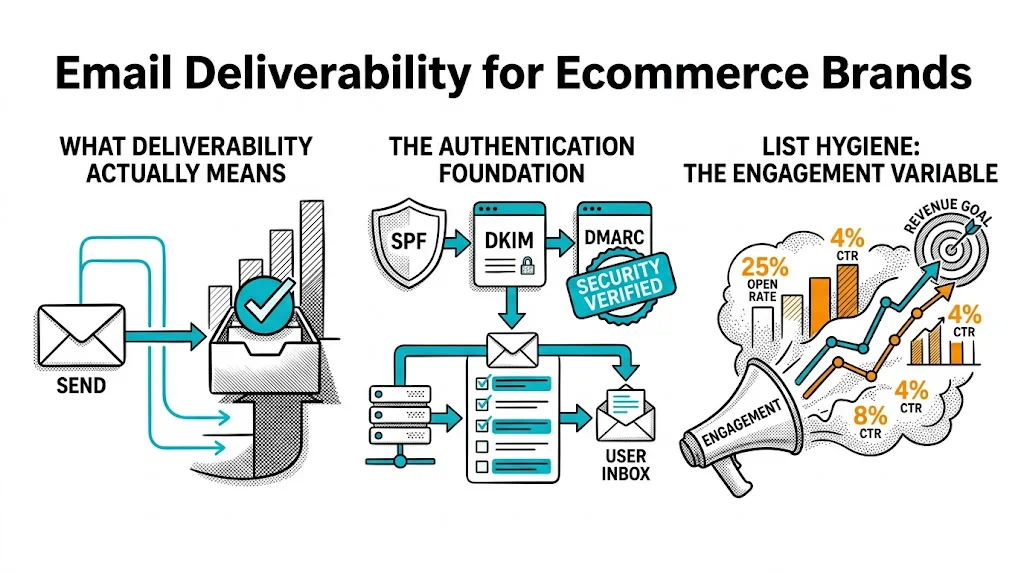
Deliverability has two layers:
Delivery rate: Did the email successfully reach the recipient's email server? This measures whether the email was accepted (not bounced). Most emails from established brands have high delivery rates (95%+) because bounce management removes bad addresses over time.
Inbox placement rate: Of the emails that were delivered, how many landed in the inbox (vs. spam or promotions folder)? This is the meaningful metric. An email that lands in the Promotions tab in Gmail is technically "delivered" but has a fraction of the open rate of an inbox email.
Most brands measure open rate and click rate. When these drop, they assume the content or subject lines are the problem. Often the real problem is inbox placement — emails are going to spam, and only the small percentage of subscribers who check their spam folder ever see them.
The technical foundation of email deliverability is three DNS records that tell email providers your emails are legitimate:
SPF defines which servers are authorised to send email from your domain. It is a DNS TXT record that looks like:
v=spf1 include:sendgrid.net include:klaviyo.com ~all
This tells email providers: "Emails from our domain that come from SendGrid or Klaviyo servers are legitimate."
Without SPF: email providers have no way to verify your emails are not being spoofed, which reduces trust and inbox placement.
DKIM adds a cryptographic signature to every email you send. The signature is generated with a private key, and email providers verify it against a public key published in your DNS.
For ecommerce brands using Klaviyo, Mailchimp, or similar ESPs: the platform generates DKIM keys for you and provides the DNS records to add. The process takes 10 minutes if you have access to your domain's DNS settings.
Without DKIM: emails fail authentication checks and are more likely to be filtered to spam, even if their content is perfectly clean.
DMARC builds on SPF and DKIM to specify what should happen when an email fails authentication: quarantine it (spam folder) or reject it (block delivery entirely).
A minimal DMARC record:
v=DMARC1; p=none; rua=mailto:dmarc@yourbrand.com
p=none is the starting policy — it monitors failures but does not act on them. Once you have confirmed SPF and DKIM are configured correctly, you can escalate to p=quarantine or p=reject for stronger protection against email spoofing in your brand's name.
Without DMARC: your domain is more vulnerable to phishing attacks using your brand's email address, and major email providers (particularly Google and Yahoo) have been increasingly requiring DMARC for commercial sending.
Use Google's MX Toolbox or your ESP's built-in authentication check to verify all three records are correctly configured before every major campaign.
Authentication handles the technical layer. List hygiene handles the engagement layer.
Email providers like Gmail use engagement signals (opens, clicks, replies, moves to inbox from spam) to evaluate whether your mail is wanted. A list with a large inactive segment drags your engagement rate down, which reduces inbox placement across your entire list — including for your active, engaged subscribers.
A hard bounce means the email address is permanently invalid (account deleted, domain does not exist). Most ESPs automatically suppress hard bounces after one occurrence. Ensure this is enabled.
Hard bounce rate above 2% signals a list quality problem — likely from old list imports, manual additions without email verification, or lack of double opt-in.
A soft bounce means temporary delivery failure (recipient's mailbox is full, server temporarily unavailable). ESPs typically retry soft bounces 3–5 times before suppressing. This is handled automatically by most platforms.
The most important list hygiene practice for D2C brands. As described in the re-engagement email campaigns guide:
A clean, engaged list of 10,000 subscribers will outperform a dirty list of 50,000 on both open rate and deliverability metrics.
Spam traps are email addresses placed by email providers and anti-spam organisations to identify senders who are importing bad lists. They look like legitimate addresses but are never used for legitimate signups.
How to avoid spam traps:
If you hit a spam trap, your sending domain's reputation can be severely damaged, affecting inbox placement for all your subscribers.
Do not send every campaign to your full list. Segment by engagement level and send more frequently to engaged subscribers, less frequently to low-engagement subscribers.
A practical segmentation:
This approach protects your sending reputation by keeping your active campaign engagement rates high.
If you are using a new sending domain, new dedicated IP, or migrating to a new ESP, you cannot immediately send high volumes. Providers treat sudden high volumes from new senders as suspicious.
Warm up gradually:
During warming, monitor bounce rates, complaint rates, and spam folder placement closely.
Consistent sending cadence (same days of the week) builds a predictable pattern that helps email providers classify your mail. Irregular sending (nothing for 3 weeks, then 5 emails in 2 days) looks like burst-sending spam behaviour.
For Indian D2C audiences, high-performance send windows: 8–10 AM (morning commute), 12–1 PM (lunch), 8–10 PM (evening relaxation). Test send time with your list — the optimal window varies by audience.
| Metric | Healthy range | Concern threshold |
|---|---|---|
| Hard bounce rate | Under 0.5% | Above 2% |
| Spam complaint rate | Under 0.08% | Above 0.1% |
| Open rate (active list) | 20–45% | Below 15% |
| Inbox placement rate | Above 90% | Below 80% |
Google Postmaster Tools: Free Google tool that shows your domain and IP reputation with Gmail. Essential for any brand sending significant volume to @gmail.com addresses (which is most of your list).
MXToolbox: Checks if your sending domain or IP is on any public blacklists. Check monthly and after any sudden drop in open rates.
Litmus or Email on Acid: Email rendering and spam filter testing tools that preview your email across major clients and flag potential spam triggers before you send.
Your ESP's native reporting: Klaviyo, Mailchimp, and similar platforms report bounce rates, complaint rates, and unsubscribe rates per campaign. Review after every campaign.
Telecom provider email domains: A non-trivial share of Indian subscribers use @rediffmail.com or @sify.com addresses (older providers). These providers have less sophisticated spam filtering than Gmail/Outlook but also lower engagement rates. Monitor bounce rates separately for these domains.
Mobile email clients: Over 70% of Indian users open email on mobile. Email clients like Samsung Mail and default Android Mail use different spam filters than Gmail. Test rendering and deliverability across these clients.
Diwali send volume: Many brands significantly increase send frequency during the Diwali shopping season (October–November). A sudden 3x increase in send volume triggers deliverability problems. Begin increasing volume 4–6 weeks before peak season and warm up gradually.
Audit authentication quarterly. DNS records can be accidentally deleted during domain renewals or CMS migrations. Check SPF, DKIM, and DMARC are still correctly configured every three months.
Use double opt-in for new subscribers. Double opt-in (confirmation email required before adding to list) reduces spam trap hits and invalid addresses. It reduces list growth rate slightly but improves list quality significantly.
Monitor complaint rate per campaign. A spike in spam complaints from a specific campaign indicates the subject line, content, or audience was wrong. Investigate immediately rather than letting it compound.
Do not re-use suppressed subscribers. Once a subscriber is suppressed for inactivity, do not re-import them from a CRM export or other source. The suppression exists to protect your deliverability.
For more on email strategy, see the Email & Retention pillar guide and the article on re-engagement email campaigns.