From the conversion glossary
Concepts referenced in this article, defined.
Concepts referenced in this article, defined.
Run rigorous A/B tests and personalize every visit on Shopify or any storefront — no engineers required.
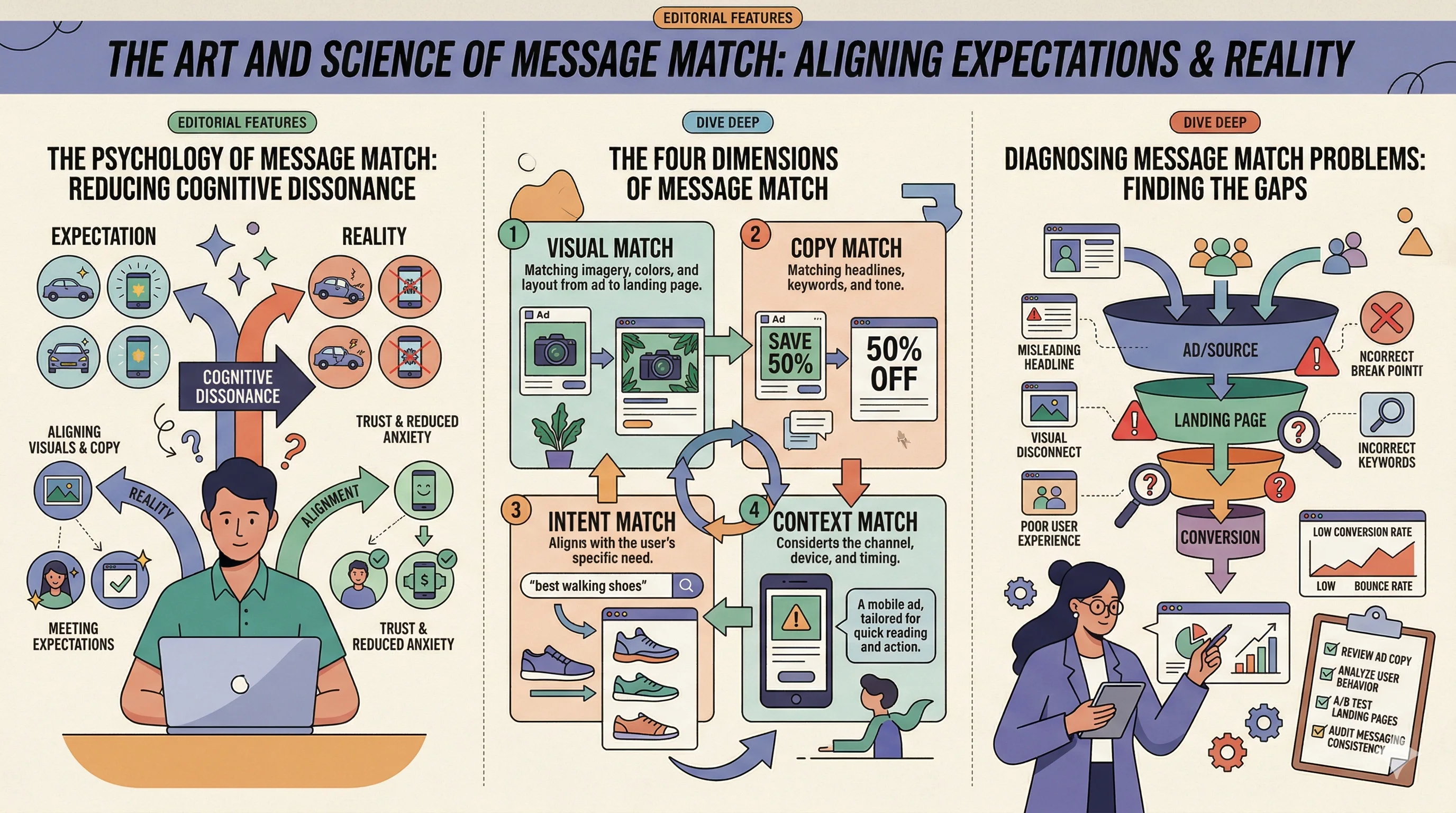
Message match is the single most impactful landing page optimization that most D2C brands get wrong. When a customer clicks your ad promising "11% CVR boost for Shopify brands" and lands on a homepage about your company, conversion drops—not because the offer is bad, but because the experience is discontinuous. The customer's mental model set by the ad ("I'm going to learn about this specific offer") is immediately shattered. Message match is about protecting that continuity, from the ad headline through to the landing page CTA.
When someone clicks an ad, they've made a small commitment based on a specific promise. Their brain is in a specific mode: "I'm looking for X, and this ad says it has X."
If they land on a page that immediately confirms X—"Yes, you're in the right place, here's X"—they continue with elevated confidence. The decision momentum carries through.
If they land on a page that doesn't immediately confirm X—a homepage, a generic collection, a mismatched message—cognitive dissonance kicks in. "Is this the right place? Did I click the right thing?" The mental energy spent re-orienting is borrowed from the energy needed to convert. Bounce rate rises; conversion drops.
This effect is not subtle. The gap between high-match and low-match experiences regularly produces CVR differences of 30–50%—the same traffic, the same offer, the same product, performing dramatically differently based solely on the continuity of the experience.
Message match isn't just about repeating the headline. It involves alignment across four dimensions:
1. Verbal match: The headline and key phrases on the landing page should directly echo the ad copy. If the ad says "Get 21% more conversions," the landing page shouldn't say "Improve your store's performance." The specific language creates a recognition moment.
2. Visual match: The images or visual style of the landing page should align with the ad creative. An ad featuring a model in a specific product using a specific styling should lead to a page showing the same product in a similar visual context.
3. Intent match: The landing page should address the specific intent implied by the ad. An ad targeting "best protein for weight loss" should land on a weight-loss-specific context page, not the full supplement catalog.
4. Audience match: The tone, imagery, and examples on the landing page should match the audience the ad targeted. An ad targeted at Indian women 25–35 interested in sustainable beauty should land on a page featuring relatable models, culturally relevant references, and the specific brand values that audience cares about.
Before improving message match, diagnose where your current gaps are.
The scan test: Open your ad in one window and your landing page in another. In 5 seconds of looking at the landing page, can you identify the exact offer or promise the ad made? If not, you have a message match problem.
The question test: Ask five people who haven't seen your ad to look at your landing page and describe what the main offer or value proposition is. Then ask five people who've seen your ad to do the same. If the descriptions differ significantly, there's a match gap.
The UTM analysis: Check your Google Analytics or Shopify analytics for conversion rates by UTM source and landing page. If your "vitamin-c-serum-promo" campaign traffic converts at 0.8% while your branded search traffic converts at 3.2% on the same product page, message mismatch (not product or price) is likely the cause.
The heatmap review: Session recordings of ad-traffic visitors often show them scrolling quickly looking for the specific thing the ad promised, then bouncing when they can't find it quickly. This behavioral pattern is diagnostic of message mismatch.
Step 1: Map your ads to intents
List every active ad group or creative. For each, write a one-sentence description of:
This mapping becomes your landing page brief.
Step 2: Match headline to ad promise
The H1 on the landing page should contain the core promise of the ad. If the ad says "Certified Organic Skincare Starting at ₹499," the headline might be "Certified Organic Skincare — Starting From ₹499. Real Ingredients, Real Results."
The customer's internal monologue: "Good, I'm in the right place. This is what I came for."
Step 3: Show the specific product or offer immediately
If the ad featured Product X, Product X should be the first thing visible on the landing page. Not a related product, not a category, not a promotional banner about something else—Product X.
Step 4: Mirror the emotional register
If the ad was aspirational ("Skin so bright, you'll stop wearing filters"), the landing page copy should have similar emotional energy. If the ad was factual ("Clinically tested, dermatologist approved"), the landing page should lead with evidence, not aspiration.
Step 5: Maintain the offer through to checkout
If the ad promised a discount, make that discount immediately visible on the landing page (ideally auto-applied to cart). Customers who see an ad discount and then have to search for the discount code at checkout lose trust and often abandon.
The most effective brands create dedicated landing pages for each significant ad group—not one landing page for all traffic.
Why this matters:
An ad targeting new-to-D2C buyers (interested in basic skincare, price-sensitive) should land on a different page than an ad targeting skincare enthusiasts (interested in advanced ingredients, willing to spend on quality). The same product, different message, different social proof, different CTA emphasis.
For a D2C brand running 5–10 ad groups:
This sounds like a lot of work. With a tool like CustomFit.ai, it's actually manageable—you create one base landing page and variants that adjust specific elements (headline, hero image, testimonials) based on URL parameters (UTM), without rebuilding pages from scratch.
The practical mechanism for message match at scale is UTM parameters.
When you build your ad links, include UTM parameters:
?utm_source=meta&utm_campaign=vitaminc-serum&utm_content=brightening-variant
On your landing page, CustomFit.ai (or similar tools) can read these parameters and show a specific variant of the page tailored to that campaign.
Result: The "brightening-variant" Meta ad lands on a landing page version emphasizing brightening results. The "anti-aging-variant" Meta ad lands on a version emphasizing anti-aging benefits. Same page URL; different content served to each visitor based on their ad entry point.
This is personalization at the top of the funnel—and it directly addresses the message match problem at scale.
Run A/B tests to quantify message match impact and optimize variants.
Test 1: Homepage vs. landing page
Variant A: Send campaign traffic to homepage Variant B: Send campaign traffic to a message-matched landing page
This baseline test establishes the magnitude of the message match opportunity. In most cases, the landing page wins by 20–50% CVR. The gap size tells you how much opportunity you've been leaving on the table.
Test 2: Tight vs. loose match
Variant A: Landing page headline exactly mirrors ad copy Variant B: Landing page headline is related but not verbatim
This tests whether exact verbal match outperforms conceptual match.
Test 3: Visual match
Variant A: Landing page hero image matches the ad creative Variant B: Landing page hero image is different from ad creative
Tests whether visual continuity (or discontinuity) affects CVR.
CustomFit.ai enables all of these tests on Shopify without developer involvement—route UTM parameters to page variants, split traffic, and analyze results.
For Google Search campaigns, message match works slightly differently. The "ad" is the search query + ad headline. Message match means the landing page should directly address the specific search intent.
Example:
Search query: "ayurvedic hair oil for hair fall in India" Ad headline: "Ayurvedic Hair Oil for Hair Fall — See Results in 21 Days" Landing page headline: "Clinically Tested Ayurvedic Hair Oil: 21-Day Hair Fall Reduction"
The keyword, the ad, and the landing page all address the same specific intent—hair fall specifically, ayurvedic specifically, and a time frame for results.
If this search traffic went to a generic "hair care collection" page, conversion would drop significantly even with a good ad.
Links: Landing Page Optimization | Conversion Rate | Personalization | Landing Page Optimization Pillar | Landing Page vs Homepage | Landing Page Copy Headlines