From the conversion glossary
Concepts referenced in this article, defined.
Concepts referenced in this article, defined.
Run rigorous A/B tests and personalize every visit on Shopify or any storefront — no engineers required.
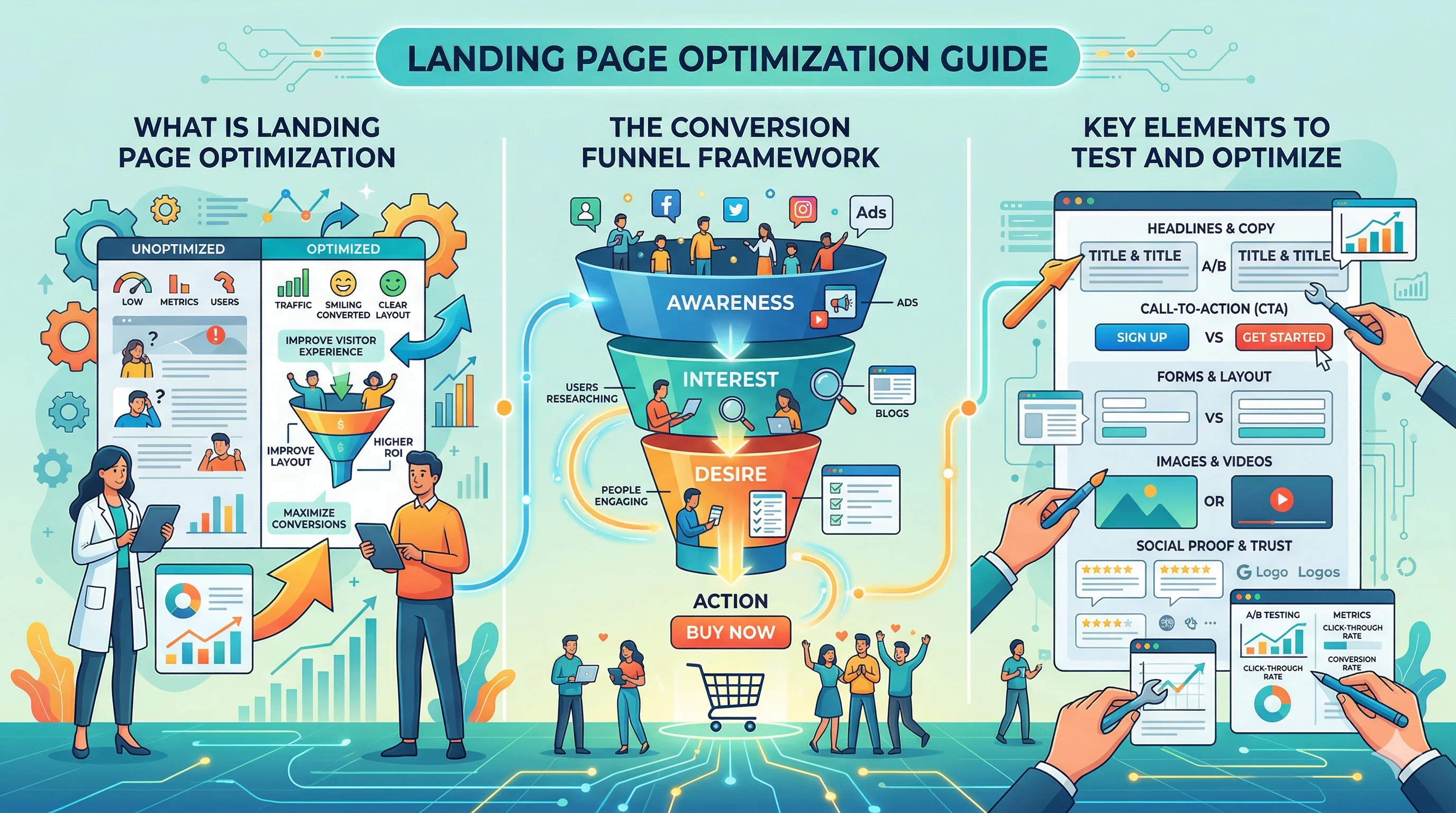
Landing page optimization is the process of systematically improving a campaign landing page to convert more paid or organic visitors into buyers. A well-optimised landing page directly reduces your cost per acquisition, improves ROAS, and lets you scale ad spend profitably. The highest-impact changes — headline, hero image, and CTA — can be tested without a single line of code in under 30 minutes.
A landing page is a standalone web page designed to receive traffic from a specific source — a Meta ad, a Google Shopping campaign, an influencer link, a WhatsApp broadcast — and convert that traffic into a desired action. For D2C ecommerce, that action is almost always a purchase, though it may also be an email signup, quiz completion, or WhatsApp opt-in.
Landing page optimization is the practice of testing and improving every element of that page to increase conversion rate and revenue per visitor. Unlike product page optimization (which improves an existing catalogue page), landing page optimization often involves creating a dedicated, distraction-free page that strips away navigation, cross-sells, and anything that is not relevant to the specific campaign.
What landing page optimization covers:
For any brand spending money on paid advertising, the landing page is where ad spend becomes revenue — or does not. A ₹50,000/month Meta ads budget driving traffic to a 2% CVR landing page generates 200 orders per month (assuming ₹500 average traffic cost per 5,000 visitors). Optimising that page to 4% CVR doubles your orders without increasing ad spend. That is the core value proposition of landing page optimization.
The ROAS multiplier: Every percentage point increase in landing page CVR directly improves your Return on Ad Spend. If your current ROAS is 2.5x and you improve your landing page CVR by 30%, your ROAS approaches 3.25x — without touching your ad targeting, creative, or bidding strategy.
The CPA reducer: Cost per acquisition (CPA) = Ad spend ÷ Orders. A landing page that converts at 4% instead of 2% halves your CPA. For Indian D2C brands where blended CAC is a critical profitability lever, landing page CVR is as important as CPM and CTR in ad accounts.
D2C India-specific pressure:
The bounce rate problem: Most paid traffic landing pages see bounce rates of 50–70%. Every visitor who bounces is a paid acquisition that generated zero revenue. Even reducing bounce rate by 10 percentage points from 60% to 50% increases the pool of engaged visitors by 25% — with no additional ad spend.
Before testing, understand your current state. Collect:
Pull these from your analytics tool by traffic source. Paid social traffic, organic search traffic, and email traffic may behave very differently on the same landing page.
Structure hypotheses around what you observed:
"Because 65% of mobile visitors scroll to below the hero section before bouncing (session recording), we believe adding a benefit-led subheadline directly beneath the hero image will reduce bounce rate and increase CTA click rate."
Prioritise by expected impact × traffic volume × ease of implementation. Headline tests are highest priority (seen by 100% of visitors), followed by hero image, CTA, and social proof placement.
With CustomFit.ai:
No developer, no staging environment, no code deployment.
Wait for statistical significance — at least 95% confidence with 100+ conversions per variant. Ship the winner. Document the test. Start the next experiment.
Built around a single SKU or product family. The entire page focuses on that product — benefits, proof, FAQ, CTA. No navigation to distract. Used for performance marketing campaigns where the ad promotes a specific product.
Built for campaign audiences that may be interested in a category (e.g., "all moisturisers for oily skin"). Presents 3–5 curated products with a filter or quiz to guide selection. Useful for prospecting campaigns where shopper intent is less specific.
Built around a specific offer — "Diwali 30% off your first order," "Free shipping + free gift on orders above ₹999." The page is transactional and urgency-driven. Evergreen structure with seasonal content swaps tested throughout the year.
A multi-step quiz ("Find your perfect skincare routine in 60 seconds") that personalises product recommendations and increases engagement. Quiz funnels typically outperform direct product pages for cold paid social traffic because they build investment before asking for the purchase.
Specifically designed for retargeting segments. These visitors have seen your ads or visited your site. The landing page can reference their previous interaction: "Still thinking about [product]? Here's what 2,000+ customers say."
1. Match your headline to your ad copy. Message match is the single highest-impact landing page element. If your ad says "India's #1 Ayurvedic Hair Oil — 4.9★ from 50,000 reviews," your landing page headline should say the same thing in the same tone. Mismatched pages cause instant bounces.
2. Lead with benefits, not features. "Reduces hairfall in 30 days" outperforms "Contains Bhringraj, Amla, and Neem extract" for cold audiences. Features matter for warm, research-mode visitors — place them lower on the page in an expandable section.
3. Put social proof above the fold on mobile. Indian D2C shoppers are sceptical of direct-to-consumer brands they have not heard of. Showing "4.8★ from 18,400 reviews" or "Used by 2 lakh+ customers" in the hero section — before asking for the sale — dramatically reduces the trust barrier.
4. Use a single, clear primary CTA. Every distraction on a landing page is a conversion killer. Remove navigation menus. Limit to one primary CTA (e.g., "Shop Now" or "Get 20% Off"). If you need a secondary CTA, make it smaller and visually subordinate.
5. Design mobile-first, not mobile-adapted. Build and test on mobile first. Over 78% of Indian paid traffic arrives on mobile. A desktop-first design adapted to mobile will have suboptimal information hierarchy, tap targets, and scroll experience.
6. Address the top purchase anxieties explicitly. For first-time customers, the main anxieties are: Is this product genuine? Will it work for me? What if I want to return it? Can I pay on delivery? Answer each of these directly on the landing page — not in a linked FAQ page — using icons, badges, and short copy.
7. Test video in the hero section. A 15–30 second product demonstration or testimonial video in the hero section increases time-on-page and CVR for most D2C categories. Test autoplay (muted, with captions) vs. click-to-play to find what works for your audience.
8. Create urgency that is real, not manufactured. "Only 47 units left" is a cliché that sophisticated shoppers ignore. Real urgency — "Order by 5pm for next-day delivery to Mumbai," "Sale ends Sunday" — converts because it is verifiable. Test urgency copy variants to find language that does not feel manipulative.
9. Optimise load speed to under 2 seconds. Use WebP images, a CDN, and deferred scripts. Each 1-second improvement in load time increases CVR by approximately 7%. For landing pages running paid ads, load speed is effectively a cost of customer acquisition — slow pages are expensive pages.
10. Run post-purchase surveys on landing page buyers. Ask "How did you hear about us?" and "What convinced you to buy today?" on the order confirmation page. Landing page buyers who came from specific campaigns often reveal the persuasive elements that closed the sale — insights that should inform your next iteration.
| Platform | No-Code Landing Page Editor | Message Match Testing | D2C Metrics | Shopify Native | Price |
|---|---|---|---|---|---|
| CustomFit.ai | Yes | Yes | Yes (RPV, AOV) | Yes | From $99/mo |
| Unbounce | Yes | Partial | No | Partial | From $99/mo |
| VWO | Partial | Partial | Limited | Partial | From $200/mo |
| Instapage | Yes | Yes | No | No | $299+/mo |
| Optimizely | No | Yes | Limited | No | Enterprise |
CustomFit.ai for landing page testing: CustomFit.ai is built for Shopify D2C brands that want to test landing pages, product pages, and the full purchase funnel in one platform. The visual editor requires no code; the targeting engine supports 1000+ attributes including UTM parameters (so you can test different landing page variants for different ad campaigns). See CustomFit.ai vs VWO for a head-to-head comparison.
Bellavita's paid social campaigns during the wedding gifting season drove traffic to a generic product page. Using CustomFit.ai, they created campaign-specific landing pages that matched the ad creative: gifting imagery, "Order by Thursday for wedding weekend delivery" urgency copy, and a "Gift this" CTA instead of "Add to Cart."
The message-matched landing page produced an 11% CVR increase over the generic product page. The revenue impact on a high-traffic gifting campaign was significant.
Lesson: The same product, at the same price, on a message-matched landing page can outperform a standard product page purely through context and relevance.
Consider a D2C skincare brand running a quiz funnel landing page for cold Meta traffic. Instead of sending prospecting traffic to a product page, the quiz asks four questions ("What's your skin type?" "What's your main concern?" "How often do you use serums?") before recommending a personalised routine.
Quiz funnel pages typically see 60–70% completion rates on cold traffic and convert at 3–5x the rate of direct product pages for cold audiences. The personalisation increases purchase confidence and reduces return rates.
A D2C brand in the home fragrance category tested a Diwali landing page with two variants:
The variant produced a 22% higher CVR during the 10-day campaign window. The countdown timer and delivery guarantee reduced the most common festive purchase anxiety: "Will it arrive in time?"
Mistake 1: Sending all traffic to the homepage. The homepage is optimised for brand discovery, not conversion. Campaign traffic needs a purpose-built destination that continues the ad's message, not a distraction-filled homepage.
Mistake 2: Testing headline and hero image simultaneously. If both elements change and the variant wins, you do not know which drove the result. Test one element at a time unless you have sufficient traffic for multivariate testing.
Mistake 3: Building pages with slow load times. A landing page with 4MB of uncompressed images will lose a significant share of your paid traffic before it even loads. Compress every image and test load speed on a real mobile device on a 4G connection before launch.
Mistake 4: Using stock photography that looks generic. Indian D2C shoppers respond to authentic imagery — real customers, real results, Indian faces and contexts. Generic stock images reduce credibility, particularly for beauty and wellness brands where the product is on or in someone's body.
Mistake 5: Not tracking micro-conversions. If your landing page has a multi-step flow (scroll → CTA click → product page → cart → checkout), tracking only the final purchase misses the opportunity to see where in the funnel the variant is winning or losing.
Mistake 6: Removing the page after the campaign ends. Landing pages that perform well are valuable assets. Archive them, document their CVR data, and reuse the structure for future campaigns in the same category.
Advanced landing page personalisation uses UTM parameters to dynamically change the headline based on the ad that brought the visitor. If the ad headline was "India's Best Hair Growth Oil," the landing page headline automatically reads the same. This is message match at scale — no separate landing page per ad required. CustomFit.ai supports UTM-based personalisation through its targeting engine.
"Delivered to your door tomorrow" is more convincing than "2–5 business days" — but only if it is accurate. Geo-targeting lets you show metro-specific delivery ETAs ("Next-day delivery in Mumbai") to Tier 1 visitors and standard ETAs to other cities. This single personalisation can meaningfully reduce cart abandonment rate by confirming delivery speed before the purchase decision.
For any landing page, run this systematic test sequence:
Each test informs the next. Within 2–3 months, you will have a data-driven above-the-fold that outperforms your launch version by 30–50%.
For COD-heavy Indian D2C brands, adding a WhatsApp CTA ("Chat to order on WhatsApp") alongside the standard checkout CTA can capture fence-sitters who prefer assisted purchase. Test the WhatsApp CTA as a secondary action — it should not cannibalise the primary checkout flow but should serve as a recovery mechanism for visitors who are close to buying but need a nudge.
What is landing page optimization? Landing page optimization is the process of improving a standalone web page — typically the destination for paid ads or campaign traffic — to increase the percentage of visitors who complete a desired action, such as a purchase or email signup.
What is the average conversion rate for a landing page? Average ecommerce landing page conversion rates are 2–4%. Top-performing pages in beauty, wellness, and fashion D2C categories achieve 6–12% by combining strong message match, fast load times, and compelling social proof.
What is 'message match' and why does it matter? Message match means the headline and imagery on your landing page directly mirrors the copy and creative of the ad that brought the visitor there. Poor message match — where the ad promises X but the page shows Y — is the single biggest cause of paid traffic bounce on landing pages.
How is a landing page different from a product page? A product page is part of your main store navigation. A landing page is a standalone, distraction-free page designed for a specific campaign or traffic source, often with no navigation menu, a single CTA, and copy tailored to the campaign audience.
How long should a landing page be? Length should match the complexity of the product and the visitor's awareness level. Cold paid social traffic needs a longer page that builds context and trust. High-intent search traffic may convert on a shorter, direct page. Test both.
Does page speed affect landing page conversion rates? Yes. Each 1-second delay reduces conversion rate by ~7%. For paid traffic landing pages — where you are paying per visitor — slow load times directly increase your cost per acquisition. Target under 2 seconds on mobile.
Can I run A/B tests on landing pages without a developer? Yes. CustomFit.ai's no-code visual editor lets you create and test landing page variants — headlines, images, CTA copy, layouts — without touching code. Tests can go live in under 30 minutes.
What elements should I test first on a landing page? Test headline and hero image first — they are seen by 100% of visitors and have the highest impact on bounce rate. Then test CTA text and placement. Social proof position and trust signals are the next highest-leverage elements.
Stop paying for traffic that doesn't convert. CustomFit.ai gives D2C brands on Shopify a no-code visual editor to test landing pages, product pages, and the full funnel — no developer needed.