From the conversion glossary
Concepts referenced in this article, defined.
Concepts referenced in this article, defined.
Run rigorous A/B tests and personalize every visit on Shopify or any storefront — no engineers required.
You spend ₹80 to get a click. Then that click lands on a page that feels nothing like the ad they clicked, has no clear next step, and loads in 5 seconds. You just paid ₹80 to bounce a customer. For most Indian D2C brands running paid media, landing page quality is the biggest gap between ad spend and revenue. Here is how to build landing pages that actually convert paid traffic — with distinct guidance for Google, Meta, and emerging platforms.
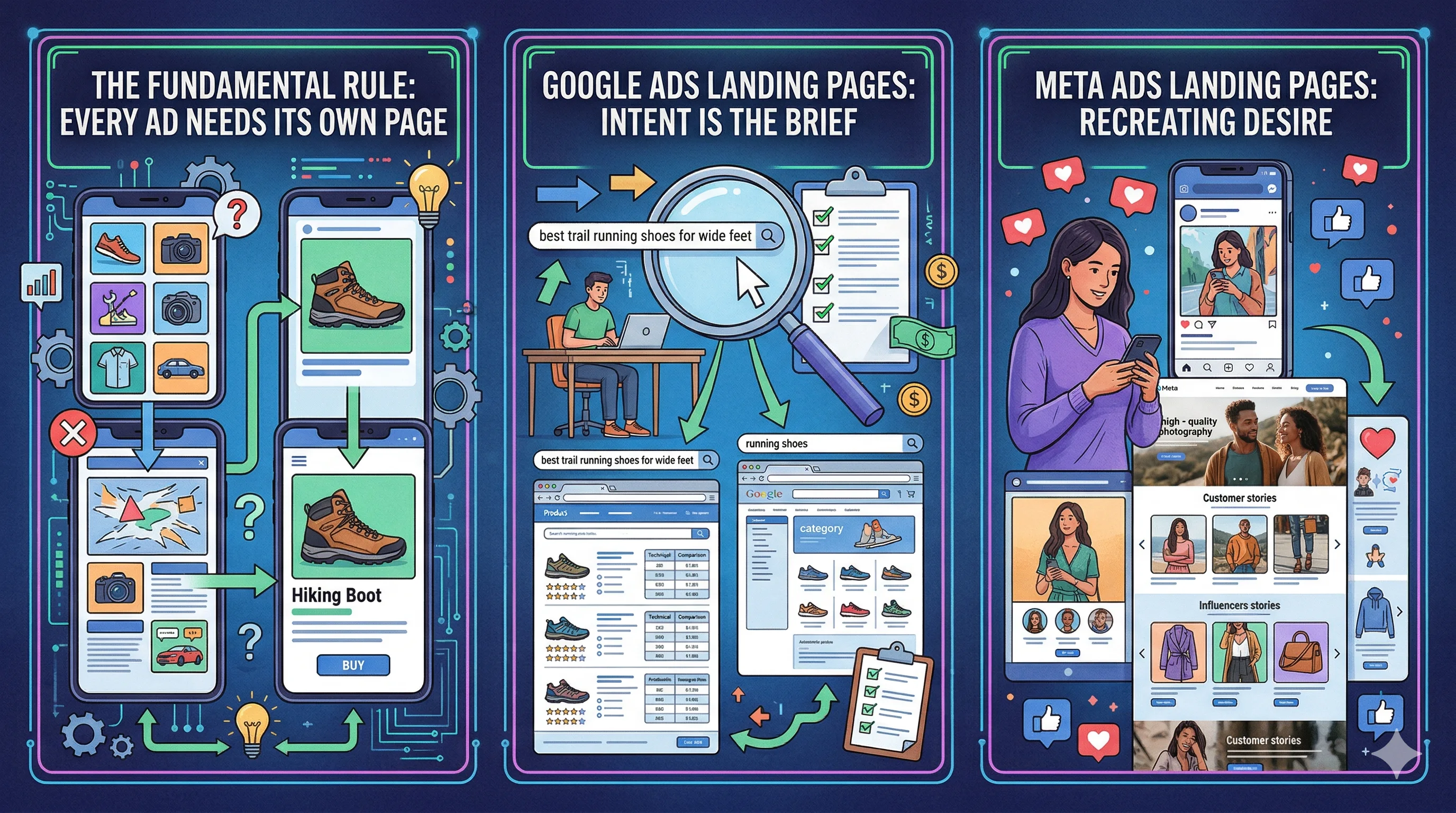
The biggest mistake in paid media is sending everyone to the same page — usually the homepage or main product page.
Your homepage is built for all visitors. Your landing page should be built for one specific visitor, coming from one specific ad, with one specific intention.
The math makes this clear: A ₹50 lakh annual ad spend with a 2% conversion rate generates X revenue. Improving landing page CVR to 3.5% generates the same revenue from ₹28 lakh of ad spend. The landing page investment pays back faster than any campaign optimization.
Google search visitors have already declared their intent. Someone who searches "best vitamin C serum for dark spots India" and clicks your ad wants exactly that — not your entire skincare catalogue.
Match the search intent exactly: If your ad targets "best protein powder for weight loss women India," your landing page headline should be: "India's Best Protein Powder for Women's Weight Loss — [Your Claim]."
Above the fold must deliver on the search query:
Answer-first structure: Google searchers want information. Give them what they searched for in the first screen. Then sell. The sequence is: Satisfy intent → Build trust → Convert.
For high-intent queries ("buy vitamin C serum", "ashwagandha capsules price"): Take them directly to the product with streamlined buying path. Price, reviews, add-to-cart — everything above the fold.
For research queries ("how to reduce dark spots", "does ashwagandha help sleep"): Start with the answer to their research question, then transition to your product as the solution. This matches the consideration stage intent rather than pushing a direct buy.
Shopping ad clicks come with specific product intent — the customer saw your product photo, title, and price in the SERP. Your landing page should be the exact product page they saw in the ad, with:
Any disconnect between the Shopping ad and the product page (different image, price discrepancy, different product) will cause immediate bounce.
Google's Quality Score directly affects your cost per click. Relevant, fast, and well-structured landing pages lower your CPC by improving Quality Score. For every ₹50 lakh you spend on Google Ads, landing page relevance can determine ₹5–15 lakh in wasted vs. efficient spend.
Key Quality Score factors for landing pages:
Meta (Instagram + Facebook) visitors were not searching for you. They were scrolling, and your ad interrupted them. The job of the landing page is different: you must re-establish the desire the ad created, quickly, before they return to scrolling.
Your Meta ad creative is the first moment of desire. The landing page must be the immediate second moment:
If the ad is a video showing a product result (before/after skin transformation): The landing page opens with the same transformation imagery, followed by the product that creates it.
If the ad is a limited-time offer ("Diwali sale — 20% off this weekend"): The landing page opens with the same offer, prominent deadline, and clear CTA. Any delay in confirming the offer causes doubt.
If the ad is a founder story or brand values story: The landing page continues that story — not a product page, but a narrative landing page that deepens the brand connection before converting.
Message match is even more critical on Meta than Google because the interruption cost is higher. A visitor who clicked an Instagram ad about "glowing skin in 30 days" but lands on a generic "Shop Skincare" page experiences a jarring disconnect.
Exact headline mirror: The first line of your landing page should use the same language as your ad headline. If the ad says "The face wash that actually works for oily skin," the landing page says "Finally — A Face Wash That Works for Oily Skin."
Same visual language: The color palette, model, and visual style of the landing page should feel like a continuation of the ad creative. Jarring visual discontinuity reads as an untrustworthy redirect.
For cold-to-consideration Meta traffic (broad audience, new brand discovery):
For retargeting Meta traffic (visitors who have seen your site):
The structure is compressed. These visitors already know your brand. They need:
Shorter page, higher urgency, more specific offer. CustomFit.ai can serve different landing page experiences to new vs. returning visitors using personalization — a retargeting click gets a shorter, offer-led page, while a new visitor gets the full funnel page.
Instagram is predominantly mobile, predominantly visual, and predominantly used in moments of leisure or inspiration — not active purchase intent.
Instagram landing page priorities:
Shoppable Instagram posts: If driving traffic from shoppable posts, the page should be the specific product that was tagged — not your home page.
TikTok is not yet dominant for Indian D2C (Moj, Josh, and Reels are the Indian equivalents), but the principle applies:
Video-ad traffic from short-form platforms comes from:
Landing page adaptations for short-form video traffic:
Running 3 different campaigns simultaneously (awareness, retargeting, loyalty) requires 3 different landing pages — or at minimum, 3 different experiences.
How to manage at scale:
Option 1: Dedicated Shopify pages per campaign — more work but complete control.
Option 2: CustomFit.ai targeting rules — serve different landing page experiences based on traffic source, UTM parameters, or audience segment, without creating separate pages. This means one URL can show different headlines, hero images, and CTAs to Google Ads traffic vs. Meta Ads traffic vs. email traffic.
Option 3: UTM-based personalization — detect UTM campaign tags and swap specific page elements. A visitor from utm_campaign=diwali_sale sees the Diwali-specific hero; a visitor from utm_campaign=awareness_broad sees the standard product hero.
Paid landing pages are the highest-value testing environment because every test result directly improves ROAS.
Tests to prioritize:
Message match test: Does the headline use ad copy verbatim vs. a brand-interpreted version? (Verbatim usually wins for Google; brand voice wins for Meta)
Social proof position: Above the product description vs. below vs. in the hero?
Urgency elements: Does adding a countdown timer or low-stock indicator increase CVR?
Page length: Full-information page vs. condensed decision-support page for retargeting traffic?
CTA specificity: "Shop Now" vs. "Get Glowing Skin" vs. "Start Your 30-Day Trial"
Run each test for minimum 2 weeks or 500 conversions per variant. Use statistical significance as your decision threshold — a result that has not reached 95% significance should not drive strategy.
CustomFit.ai handles test setup, variant serving, and significance calculation automatically, letting you focus on interpreting results and planning the next iteration.
Build a landing page for each major campaign type: Google search, Meta cold audience, Meta retargeting, email, and influencer traffic each deserve their own page or experience.
Never change landing pages during a campaign without A/B testing the change. Uncontrolled changes make it impossible to understand what moved performance.
Track assisted conversions: Some visitors click a Meta ad, leave, then return via Google search and buy. Attribution modeling matters for understanding the true role of each landing page in the customer journey.
Optimize for mobile first, then desktop. Indian paid traffic is 80%+ mobile across platforms.
Set landing page KPIs before the campaign launches: CVR, revenue per visitor, and time-on-page targets. Optimization without a target is directionless.
Use heatmaps on paid landing pages weekly: Heatmap data from paid traffic is more reliable than organic traffic (more consistent intent profile) and tells you exactly where visitors engage and where they drop.
Every rupee of paid media performs better when it lands on a page designed for that specific traffic. The landing page is not where your campaign ends — it is where the conversion actually happens.