Push notifications are one of the most underused high-ROI channels for Indian D2C brands. While everyone competes on Meta ad costs and email open rates, a well-structured push notification strategy delivers re-engagement at a fraction of the cost — often under ₹0.10 per notification — and can convert subscribers at 2–5% for behavioral triggers like cart abandonment and price drops.
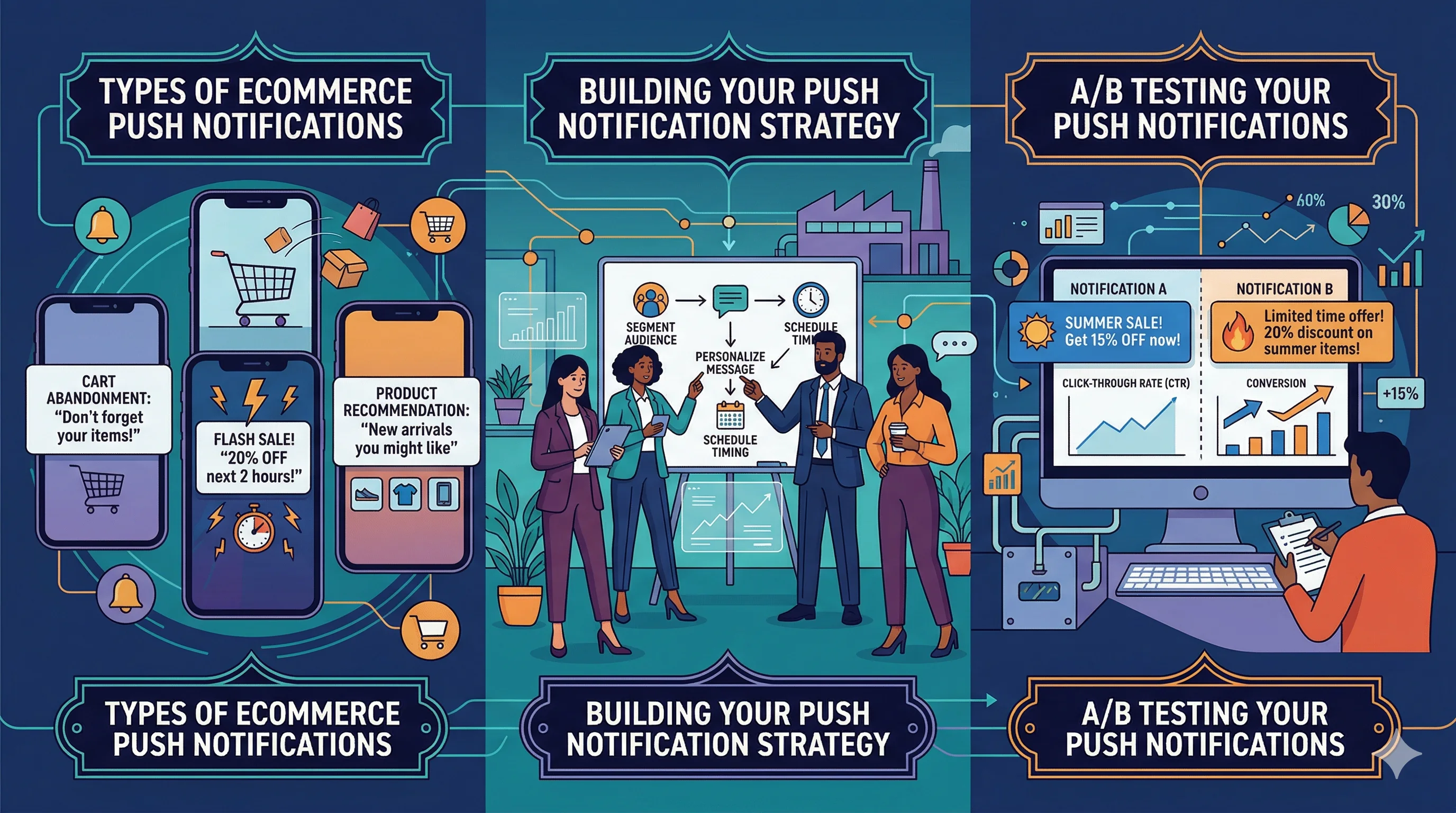
Types of Ecommerce Push Notifications
Before building a strategy, map the notification types available to you:
Transactional (always-on, non-promotional)
- Order confirmation
- Shipping dispatched
- Out for delivery
- Delivered confirmation
- Return processed
These are expected and trusted. They build habit and keep your brand top-of-mind in a positive context.
Behavioral Triggers (high-intent, non-intrusive)
- Cart abandonment: "You left something behind — complete your order and get free shipping"
- Browse abandonment: "Still thinking about [Product]? It's running low"
- Price drop: "The [Product] you saved just dropped to ₹799"
- Back in stock: "Good news — [Sold-out item] is back. Grab it before it sells out again"
- Wishlist restock: same as above but personalized to wished items
- Replenishment reminder: "It's been 28 days since you ordered your Vitamin C serum — time to reorder?"
Promotional (campaign-based)
- Flash sales (2–4 hour window)
- Category-specific sales tied to a user's browsing history
- New product launches (segmented to buyers of the relevant category)
- Festive offers (Diwali, Holi, summer sale)
Re-engagement
- Win-back notifications for users inactive 30, 60, or 90 days
- Loyalty milestone notifications ("You're just ₹200 away from Gold status")
Building Your Push Notification Strategy
For Shopify brands without a dedicated app, web push is the most accessible entry point. Options that integrate directly:
- PushOwl — Shopify-native, strong behavioral trigger workflows
- OneSignal — broader platform with web and app push
- Pushify — Shopify-specific with ecommerce templates
- CustomFit.ai — for A/B testing landing page experiences that push traffic lands on
The tool matters less than the strategy behind it. Start with one tool and use it well rather than juggling three.
Step 2: Grow Your Subscriber List
Push notification opt-in prompts should appear:
- 30–60 seconds after a visitor arrives (not immediately on page load)
- After a positive interaction: after they add to cart, after they view 3+ products, after reading a blog post to the end
- On the order confirmation page ("Get shipping updates and exclusive offers")
A/B test the timing: many brands find that showing the opt-in prompt after add-to-cart has a 2–3x higher acceptance rate than showing it immediately on arrival.
The opt-in copy matters more than the timing. "Get exclusive offers and order updates" outperforms the default browser prompt by 40–60%.
Step 3: Segment Before You Send
Sending every push to every subscriber is the fastest path to high unsubscribe rates. Segment by:
Behavioral segments:
- Bought in the last 30 days (active customers)
- Bought 31–90 days ago (at-risk customers)
- No purchase in 90+ days (lapsed)
- Cart abandoners
- Browse abandoners
Category interest:
- Skincare buyers
- Hair care buyers
- Supplement buyers
- Buyers above ₹1,500 AOV (premium segment)
Geographic:
- Metro vs. tier-2/3 cities (COD preference, festival timing, language)
CustomFit.ai can align your push notification landing pages to segments — so when a tier-2 city lapsed customer gets a re-engagement push, they land on a page that highlights COD availability and a "Welcome back" offer specific to their location.
Step 4: Write Push Copy That Gets Tapped
Push notification copy is extremely constrained: typically 40–90 characters for the title, 50–100 characters for the body. Every word must earn its place.
Principles for high-performing push copy:
- Lead with the value, not the brand: "50% off ends in 3 hours" beats "Bellavita Summer Sale — 50% off sitewide"
- Use numbers: "₹400 off" is more compelling than "Flat discount on selected items"
- Create specific urgency: "4 hours left" beats "Limited time offer"
- Personalize where possible: "[First name], your saved item is back in stock" lifts CTR by 15–25%
- Match copy to the notification type: Transactional notifications should be informative, not salesy; promotional ones can push harder
Copy templates that work for Indian D2C:
| Type | Title | Body |
|---|
| Cart abandonment | "Your cart is waiting ₹" | "Complete your order — free shipping today only" |
| Price drop | "Price drop on your wishlist" | "₹1,199 → ₹799. Grab it now — stock limited" |
| Back in stock | "It's back! 🙌" | "[Product] is back. Last time it sold out in 2 days" |
| Flash sale | "4-hour sale: 40% off" | "Ends at midnight. Shop skincare + supplements" |
| Replenishment | "Time for a refill?" | "Your 28-day supply of Vitamin C runs out soon" |
Step 5: Time Your Notifications
Timing significantly affects click-through rate. For Indian ecommerce:
- Best days: Tuesday, Wednesday, Thursday. Weekend pushes get buried in social noise.
- Best times: 8–9 AM (morning commute), 12–1 PM (lunch scroll), 7–9 PM (evening wind-down)
- Avoid: Late night (after 10 PM) unless it's a flash sale ending at midnight — late-night pushes feel intrusive and drive unsubscribes
For behavioral triggers, send immediately for cart abandonment (within 30–60 minutes of abandonment, before intent cools). Price drop and restock notifications also benefit from near-real-time sending.
A/B Testing Your Push Notifications
Run experiments on:
Test 1: Emoji vs. no emoji in title
Emojis in push titles increase CTR by 10–20% for most D2C categories — but test with your audience, as health/supplement brands often see the reverse.
Test 2: CTA specificity
"Shop now" vs. "Get 40% off" vs. "Claim your discount" — specific action copy outperforms generic CTAs.
Test 3: Send time
Split your list 50/50 and send the same notification at 8 AM vs. 7 PM. Track CTR and conversion rate, not just opens.
Test 4: Notification frequency
Test sending 1 promotional push per week vs. 2 per week over 4 weeks. Monitor unsubscribe rate and revenue per subscriber — this tells you the optimal cadence for your audience.
Beyond open rate, track:
- CTR (click-through rate): Opens / Clicks — industry benchmark is 3–8% for ecommerce
- Conversion rate: Clicks that result in purchase — target 2–5% for behavioral triggers
- Revenue per notification: Total revenue attributed / Notifications sent
- Unsubscribe rate: If above 0.5% per send, you're sending too many or targeting too broadly
- 30-day subscriber churn rate: How many opt-in subscribers have unsubscribed within a month? Above 15% signals poor opt-in copy — you're attracting the wrong expectations
Tips / Best Practices
- Never send more than 2 promotional pushes per week. Unsubscribe spikes happen fast when brands over-send.
- Combine push notifications with landing page optimization. A great push notification landing on a bad page wastes 90% of your effort. Use CustomFit.ai to A/B test the page visitors land on.
- Create a festive notification calendar. Map your push campaigns to the Indian festive calendar (Holi, Eid, Onam, Navratri, Diwali, Christmas) 6 weeks in advance.
- Use push for restock notifications aggressively. Back-in-stock pushes have some of the highest conversion rates of any trigger (5–12%) because the recipient has proven high intent.
- Test Hindi copy for tier-2/3 audiences. A push notification in Hindi or Hinglish can outperform English copy by 20–40% for regional audiences.
Key Takeaways
- Behavioral triggers (cart abandonment, price drop, restock) convert 3–8x better than promotional blasts — build those automations first.
- Segment your push list by recency, category interest, and location before sending anything promotional.
- Optimal timing for Indian D2C: Tuesday–Thursday, mornings (8–9 AM) and evenings (7–9 PM).
- Measure revenue per notification, not just open rate — a 3% CTR that drives ₹50 per notification beats a 10% CTR that drives ₹5.
- The landing page your push traffic arrives on is half the conversion equation — use CustomFit.ai to test and optimize it without developer help.
Learn more: Marketing Channels Pillar | SMS Marketing for Ecommerce | D2C Growth Pillar