From the conversion glossary
Concepts referenced in this article, defined.
Concepts referenced in this article, defined.
Run rigorous A/B tests and personalize every visit on Shopify or any storefront — no engineers required.
Social media is where Indian D2C brands build audiences, but turning those audiences into buyers requires a different playbook than paid search or email. Social traffic is scroll-interrupted, not intent-driven — visitors were not looking for you. Converting them means earning attention in seconds, matching the promise of the content they came from, and removing every possible friction before they remember they were supposed to be watching Reels. Brands that get this right see conversion rates of 3–6% from social; brands that don't see under 0.5%.
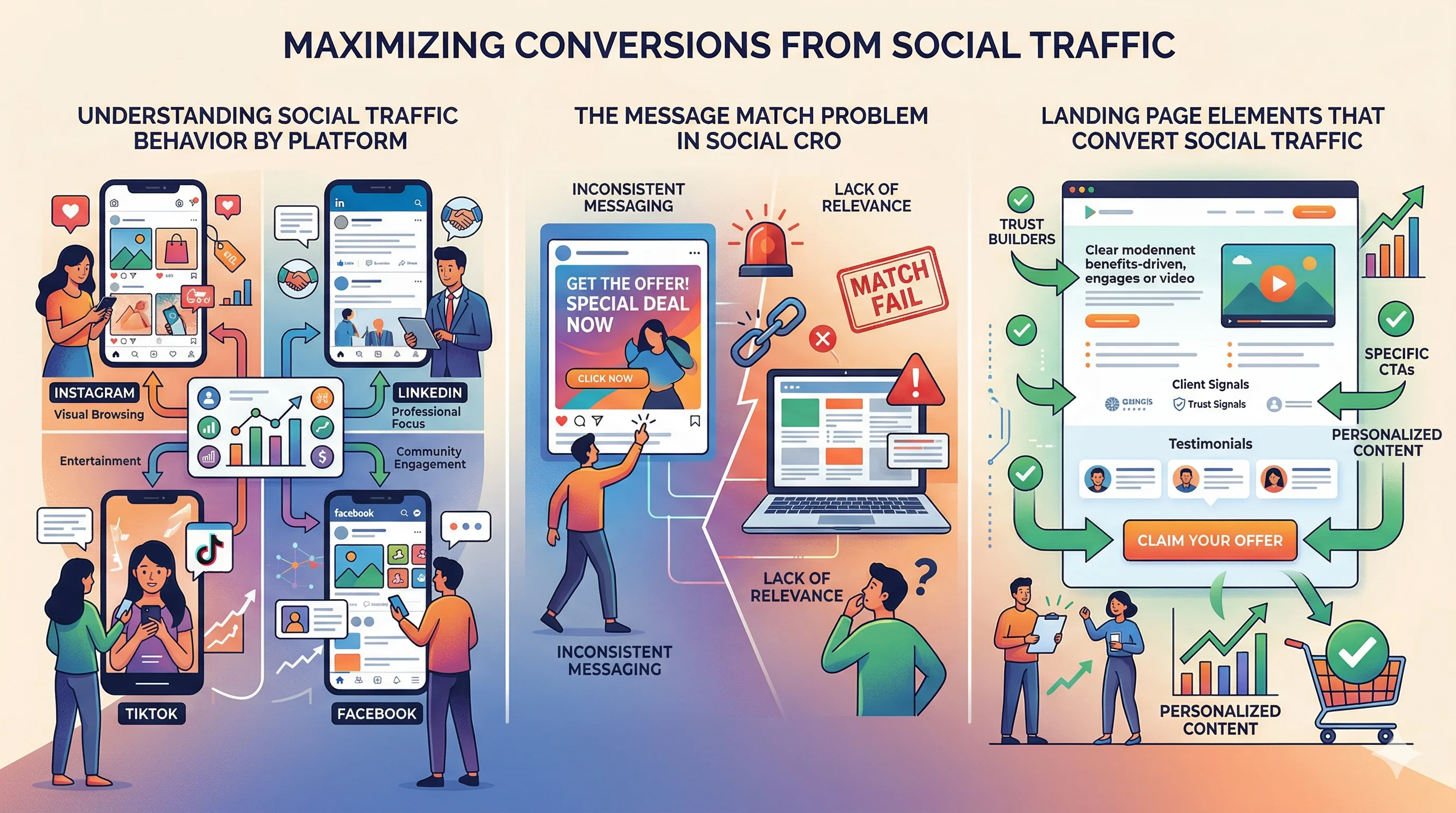
Different platforms send buyers with different mindsets. Treating all social traffic the same is one of the most common and costly mistakes in D2C CRO.
Instagram drives the highest volume of social traffic for beauty, fashion, skincare, and food D2C brands in India. Visitors from Instagram bio links or Stories swipe-ups are in a "discovery mode" — they're open to buying but haven't decided yet. Key behaviors:
YouTube visitors arrive with higher intent than Instagram. Someone who watched a 10-minute review video of your supplement before clicking is further down the conversion funnel. These visitors read more, compare more, and convert at higher rates — but they're slower to decide. Long-form product pages with detailed ingredient information, comparison tables, and video testimonials work well.
WhatsApp traffic from broadcast lists, groups, or business accounts is your warmest social audience — they opted in. These visitors convert at 3–8x the rate of cold Instagram traffic. Treat WhatsApp CTA links like email clicks: personalize the landing page with their name (if known) or their purchase history.
For B2B-adjacent D2C (corporate gifting, wellness at work, premium F&B), LinkedIn traffic is growing. It's desktop-heavy, high-AOV, and interested in brand story and certifications over price.
The number-one reason social traffic bounces is message mismatch. Your Reel shows a "₹499 glow serum that replaced my entire skincare routine" — and the link drops the visitor on your homepage showing 40 products and a brand banner.
That's a message match failure. The visitor's brain was primed for one thing; they arrived to something completely different.
Fix it by mapping every post or ad to a specific landing experience:
| Content Type | Traffic Destination |
|---|---|
| Product showcase Reel | Product page with matching hero image |
| "Get the look" post | Collection page filtered by products in the post |
| Influencer collab | Co-branded landing page with influencer's discount code |
| Educational content | Blog post with soft product integration |
| Limited offer post | Dedicated sale page with countdown |
CustomFit.ai can automatically show different page experiences based on UTM parameters — so your "Influencer A" traffic sees Influencer A's testimonial on the landing page, while "Instagram Bio" traffic sees your brand's bestseller layout.
If your Instagram post used warm, golden-hour photography, your landing page should not open with harsh studio white. Color palette, photography style, and even language tone should feel like the same creative team made both. This is the fastest way to reduce bounce rate from social.
A small touch — "You found us on Instagram. Here's the serum from that Reel." — signals to the visitor that they're in the right place. This works especially well for influencer traffic where the audience has a relationship with the creator.
Social media visitors are conditioned to trust peer validation over brand claims. Move your star rating, review count, and one standout review quote above the fold. A "4.8★ from 8,200 reviews" shown before the price outperforms showing the price first for social traffic.
Your Add to Cart button must be:
For traffic arriving from specific social posts, consider a navigation-lite layout — logo only in the header, no menu links. Every navigation link is an exit path. For brand-new visitors from social, you want them focused on the one thing the post promised, not exploring your full catalogue.
Run these experiments on your highest-traffic social landing pages:
Test 1: Landing page vs. product page Create a stripped-down landing page (no navigation, single product, social proof front-loaded) and compare it against your standard Shopify product page. Most brands see a 20–40% lift from a dedicated landing page.
Test 2: UGC hero vs. brand photography For Instagram traffic especially, test a customer photo (with permission) or creator content in the hero against your professional product shot. UGC often wins on social-origin traffic by 15–25%.
Test 3: Review placement Control: reviews below the fold Variant: star rating + one key quote above the fold, full reviews section lower Expected lift: 10–18% in add-to-cart rate
Test 4: COD visibility for Instagram traffic Add "Cash on Delivery Available" as a badge under the ATC button specifically for mobile traffic from Instagram. Test against the control (no mention). For tier-2/3 audiences, this can shift CVR by 20–35%.
Test 5: Offer framing for social "20% off" vs. "Save ₹400" vs. "Get for ₹1,199 instead of ₹1,499" — test all three. The rupee-saving frame often converts best for Indian buyers because it's concrete.
Social media attribution is messy. Most brands undercount social conversions because:
Best practice attribution stack for Indian D2C social traffic:
Attribution accuracy matters because it determines your budget allocation. If you're systematically undercounting Instagram's contribution, you're underfunding your best channel.
Organic social (non-paid posts, bio links, Stories, Reels) typically converts at 0.5–2% — lower than paid but with near-zero cost. Paid social (Meta ads, creator partnerships with paid distribution) converts at 2–5% when landing pages are optimized.
The optimization playbook is the same for both — message match, mobile-first design, social proof, frictionless CTA — but the urgency of getting it right is higher for paid, where every unoptimized click costs money.
See the full breakdown: Organic vs Paid Traffic Conversion Rates
Compare your options: CustomFit.ai vs Google Optimize alternatives | CustomFit.ai vs VWO
Learn more: Marketing Channels Pillar | Organic vs Paid Traffic Conversion | CRO Pillar