From the conversion glossary
Concepts referenced in this article, defined.
Concepts referenced in this article, defined.
Run rigorous A/B tests and personalize every visit on Shopify or any storefront — no engineers required.
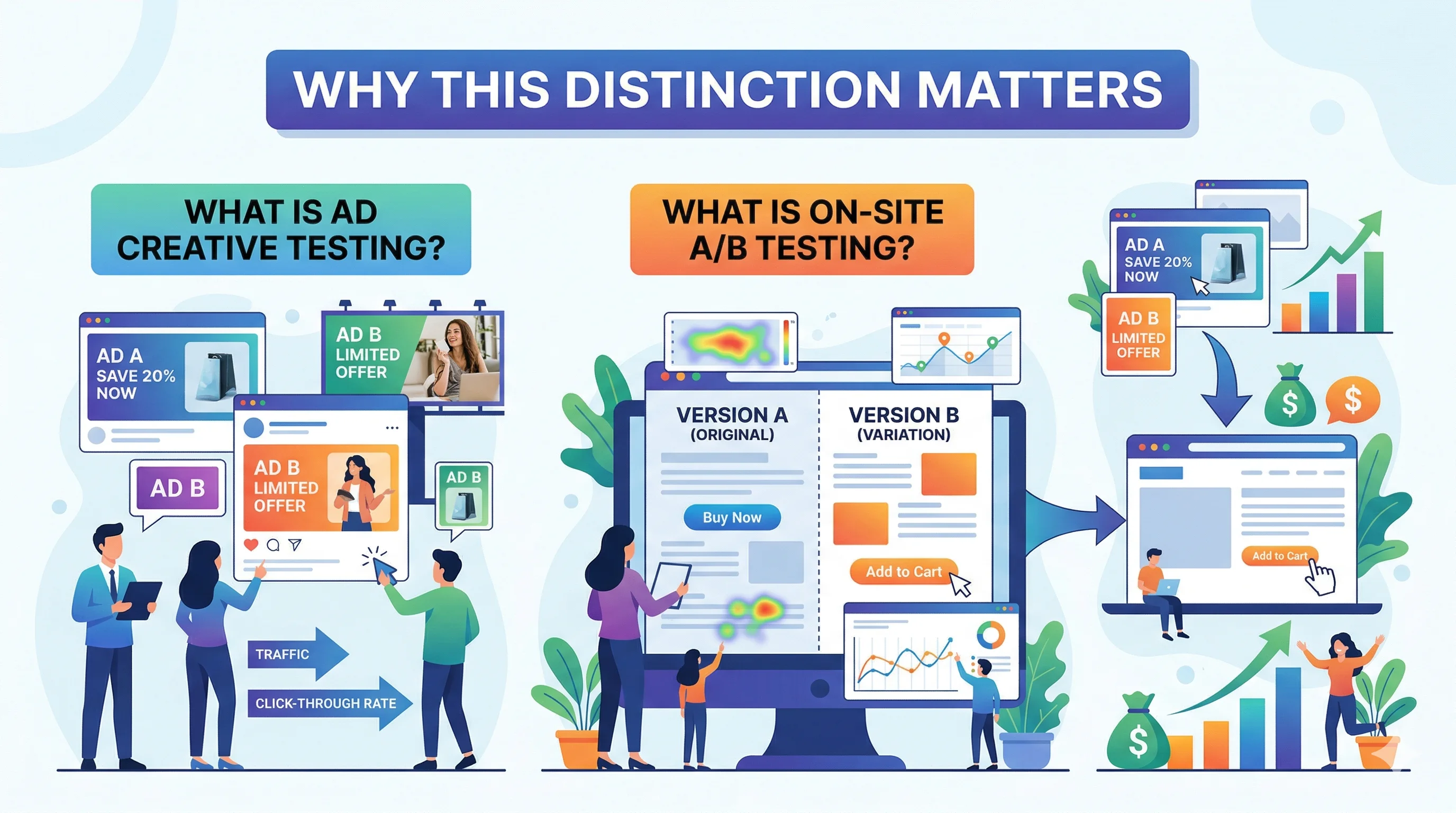
Ad creative testing finds the best-performing ad to get users to click. On-site A/B testing finds the best-performing page to get those users to buy. Both are essential, and confusing the two is one of the most expensive mistakes D2C performance marketers make. Run them together, but track them separately.
Imagine you run a Meta ad for your skincare brand. You test two creatives — video A (founder story) gets a 4% CTR, video B (ingredient close-up) gets a 2% CTR. You scale video A.
But your landing page was designed for video B's audience — ingredient-curious shoppers. Video A's audience (emotional buyers drawn to the founder story) lands on a page full of ingredient science, feels confused, and leaves.
Your ROAS drops even as your CTR improved.
This is the gap. Ad creative testing and on-site A/B testing must be aligned — but they operate in different systems with different success metrics.
Ad creative testing — sometimes called ad split testing or creative A/B testing — runs inside the ad platform (Meta Ads Manager, Google Ads, or any DSP). You show different ad variants (images, videos, copy, headlines, CTAs) to similar audience segments and measure which drives:
What it can tell you:
What it cannot tell you:
The ad platform's job ends at the click.
On-site A/B testing (also called website A/B testing or split testing) runs on your own website. You show different versions of a page — different headlines, CTA buttons, product images, layout, social proof placement — to split your actual web traffic and measure:
What it can tell you:
What it cannot tell you:
Think of your paid traffic funnel in two halves:
[Ad Platform]                    [Your Website]
Creative → Click → Landing Page → Product Page → Cart → Checkout → Purchase
|___ Ad Creative Testing ___|    |_______ On-Site A/B Testing _________|
Both halves need optimization. Optimizing only the ad (high CTR, bad landing page) burns ad budget. Optimizing only the landing page (great CVR, bad ad creative) means you're squeezing a small trickle of visitors instead of growing the flow.
The real power comes from connecting the two:
Ad creative tests inform landing page hypotheses. If your "limited edition Diwali gift set" ad wins on creative, your landing page test should explore Diwali-specific urgency copy, festive imagery, and gift-angle headlines.
Landing page tests reveal audience insights. If a variant that emphasizes "dermatologist-tested" lifts CVR 12% for visitors from skincare-focused ad sets, that signal belongs back in your creative brief.
Message match is the bridge. When ad copy and landing page copy use the same language and promise the same thing, users experience continuity — and continuity converts. See message match for the full breakdown.
| Factor | Ad Creative Testing | On-Site A/B Testing |
|---|---|---|
| Where it runs | Ad platform (Meta, Google) | Your website |
| Primary metric | CTR, CPC, CPA | CVR, Revenue/visitor |
| Who controls it | Paid media team | Marketing/CRO team |
| Traffic required | High (1,000s of impressions) | Moderate (200–500 conversions/variant) |
| Tool required | Platform's built-in tester | CustomFit.ai, VWO, etc. |
| Impact scope | Top of funnel | Mid to bottom of funnel |
| Speed of results | 3–7 days | 1–4 weeks |
Use ad creative testing when:
Use on-site A/B testing when:
Use both simultaneously when:
1. Changing both the ad and the landing page at the same time. If CTR drops and CVR also drops, you won't know which caused what. Change one variable at a time.
2. Declaring a winner too early. Meta's algorithm optimises for your objective — if your objective is "link clicks," a creative that drives unqualified clicks wins even if it produces zero sales. Set your campaign objective to "Purchase" or "Add to cart" and wait for enough events before calling a winner.
3. Ignoring mobile behaviour. In India, 70%+ of D2C traffic is mobile. An ad that performs well on desktop creative tests may attract a different audience than the one that converts on your mobile site. Segment your session recording data by device.
4. Testing the wrong element first. For on-site testing, start with the element that has the highest traffic and the highest drop-off — usually the above-the-fold hero section. Don't test button colours until you've validated the core offer and headline.
Month 1:
Month 2:
Month 3:
Keep a shared test log. Both teams (paid media and CRO) should log every active test with start date, hypothesis, and status. This prevents the attribution chaos of overlapping changes.
Use UTM parameters religiously. Tag every ad with utm_campaign, utm_content (for creative variant), and utm_medium. Your on-site testing tool should read these to let you filter results by traffic source.
Statistical significance matters for both. Don't pause a Meta ad creative test after 500 impressions, and don't declare an on-site winner after 50 conversions. Use a significance calculator — aim for 95% confidence.
Festive season = higher stakes, faster cycles. During Diwali or end-of-year sales, traffic spikes and tests reach significance faster. Pre-plan your creative and on-site test hypotheses 4 weeks before the season starts.
Related reading: