From the conversion glossary
Concepts referenced in this article, defined.
Concepts referenced in this article, defined.
Run rigorous A/B tests and personalize every visit on Shopify or any storefront — no engineers required.
Size-related hesitation is the leading conversion killer in fashion ecommerce. A customer who isn't confident about sizing won't buy—and a customer who buys the wrong size returns, costing you reverse logistics, restocking, and often the customer relationship. Size guide optimization is one of the highest-ROI investments a fashion D2C brand can make: it lifts conversion rate at the top (more buyers confident enough to purchase) and improves margins at the bottom (fewer returns).
Returns are the silent margin killer of fashion ecommerce. Industry data consistently shows that 40–60% of fashion returns are size-related—the item didn't fit as expected. For Indian fashion D2C brands, this problem is compounded by:
A single investment in better size guidance can reduce returns by 20–40% and lift CVR by 5–15% simultaneously—because the same information that reduces post-purchase returns also gives pre-purchase buyers the confidence to click "Add to Cart."
Most fashion brand size guides are inadequate. A table showing "S = 36 inches, M = 38 inches" without context doesn't help a customer who doesn't know their chest measurement and has no idea if the brand runs true to size.
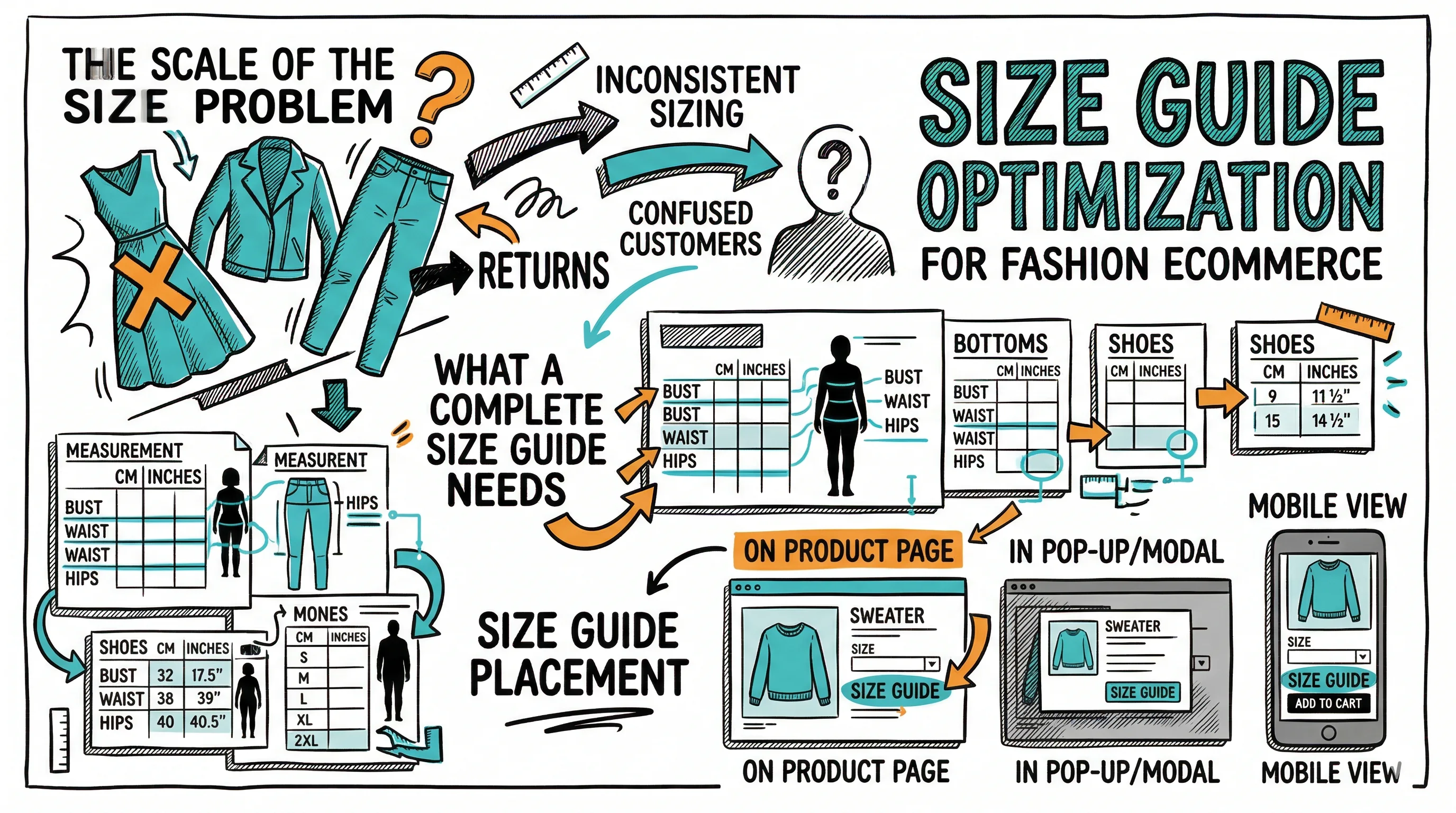
A complete size guide includes:
1. Measurement chart in centimeters
Indian customers often understand centimeters better than inches for body measurements. Include: chest (bust), waist, hip, length/height, and inseam for lower body garments. Provide centimeter measurements in a clear table, not just generic S/M/L/XL labels.
2. How to measure (with visuals)
Tell customers exactly how to take each measurement. "Measure around the fullest part of your chest, keeping the tape horizontal" is actionable. A simple line drawing showing where to measure eliminates ambiguity. This is where many brands fail—they provide the chart but not the instructions.
3. Model information
For every product listing that includes a model, state: model height, weight (optional but helpful), and size worn in the photos. "Our model is 5'6" (168cm) and wears a size M" gives customers an immediate visual reference.
4. Brand-specific fit notes
Every brand has sizing quirks. "This style runs small—we recommend sizing up if you're between sizes." "Our kurtas are cut for a relaxed fit through the hips." These notes, when honest, build trust and reduce mismatch.
5. Fabric and stretch information
Does the fabric have stretch (elastane content)? Is it structured or drapey? Fabric behavior significantly affects fit—a fitted kurta in woven cotton fits very differently from the same size in a stretch jersey. State this clearly.
6. Care instructions' impact on size
Some fabrics shrink with washing. State expected shrinkage clearly: "This cotton blend may shrink up to 5% on first wash—we recommend sizing up if you're between sizes."
Even the best size guide fails if customers can't find it during the purchase decision.
Best placement options:
Size selector accordion/pop-up: A size guide link immediately adjacent to the size selector is the gold standard. When a customer is choosing between M and L, the size guide needs to be one click away—not buried in a footer link or a separate URL.
Inline size guide: For simpler products, embedding a condensed size table directly on the product page (in an accordion below the size selector) is even better than a separate pop-up.
Persistent size guide button: A floating or sticky "Size Guide" button that remains visible as the customer scrolls is particularly effective on mobile, where size uncertainty often derails mobile add-to-carts.
What to avoid: Linking to a separate size guide page that requires page navigation. Customers in the decision-making flow abandon when required to navigate away and back.
Indian fashion D2C brands serving ethnic wear categories face sizing complexity that western fashion doesn't:
Category-specific measurement conventions:
Indian size number conventions (size 36, 38, 40 for women's ethnic wear) exist alongside western S/M/L/XL. Include both in your size charts.
Regional fit preferences: Body proportions vary across regions—broader shoulders in certain geographies, different hip-to-waist ratios. If your brand caters to a specific region, or if you're expanding nationally, consider whether your size chart reflects regional fit needs.
Beyond static size charts, technology can meaningfully improve size confidence and conversion:
Size recommendation apps: Tools like Kiwi Sizing, Bold Size Chart, or Size Me collect customer measurements and recommend the best size for a specific product. These reduce cognitive load significantly—instead of comparing measurements to a chart, the customer inputs their measurements and gets a clear recommendation.
Virtual try-on: Available through select Shopify apps, virtual try-on lets customers see how a garment looks on a virtual model that matches their body type. Still emerging in Indian fashion, but showing strong CVR lift data for brands that implement it well.
Social sizing: "47 people with your measurements chose size M for this product" uses crowd-sourced data to provide size recommendations. Reduces decision anxiety by showing what others like them chose.
A/B testing size guide placement: CustomFit.ai enables testing size guide placement without developer work—test whether a size guide pop-up adjacent to the size selector vs. a separate size guide page link drives better add-to-cart rates.
The brand that tells you honestly "this runs small, size up" earns more trust than the brand that leaves you guessing and returns the wrong size.
Honest fit notes—even when they acknowledge limitations—build brand credibility and reduce returns:
These notes also serve as SEO content—customers searching "does [brand] run true to size" or "is [brand] kurta true to size" are answered directly on the page.
The test of size guide optimization is your return rate, not just your CVR.
Track these metrics:
Links: Conversion Rate Optimization | Bounce Rate | Product Page Optimization Pillar | Product Page Layout Best Practices | Product Photography Conversions | D2C Brand Growth