From the conversion glossary
Concepts referenced in this article, defined.
Concepts referenced in this article, defined.
Run rigorous A/B tests and personalize every visit on Shopify or any storefront — no engineers required.
A/B testing for lead generation means running controlled experiments on every element that influences whether a visitor submits their contact information — headlines, form design, CTA copy, lead magnets, and landing page layout. Lead generation is a distinct optimization goal from direct purchase conversion, and it requires its own testing framework. Brands that test their lead gen systematically typically achieve 20–40% higher submission rates from the same traffic — without changing their acquisition spend.
Lead generation and direct purchase optimization share the same methodology (hypothesis, split, measure, iterate) but differ in what you measure and what you optimize:
Purchase conversion: Optimizing for immediate transaction — add to cart, checkout completion, payment success.
Lead gen conversion: Optimizing for contact capture — email submission, quiz completion, free trial sign-up, phone number entry.
Lead gen tests require tracking an additional dimension: lead quality. A landing page variant that doubles email submissions from low-intent traffic has less value than a variant that generates 50% more submissions from high-intent buyers. Track downstream behavior (email engagement, trial activation, first purchase) to distinguish quantity from quality.
For Indian D2C brands with subscription or high-LTV product lines (Kapiva, Plum, Pilgrim), email and WhatsApp lead capture is often worth more than a single purchase transaction. The test that optimizes this funnel entry point compounds over the customer lifetime.
The headline is the first determinant of whether a visitor engages with your lead capture element:
Test one framing approach at a time. In Indian D2C, problem-led and social proof-led headlines consistently outperform generic benefit headlines for beauty and wellness categories.
This is the highest-impact structural variable for lead generation:
Number of fields:
Reducing from 5 to 2 fields typically lifts submission rate 25–40%. The cost is less data per lead. Test whether the volume gain outweighs the data loss.
Field ordering:
Phone number inclusion:
Form placement:
CTA text moves conversion rates by 5–20% in most lead gen contexts:
First-person CTA copy ("Get My Free Guide") consistently outperforms second-person ("Get Your Guide") in most D2C lead gen contexts — test to confirm for your specific audience.
The lead magnet (the offer in exchange for contact details) is the core value proposition of your lead gen funnel:
Format:
Topic specificity:
Specific, hyper-targeted lead magnets consistently outperform generic guides. For Mamaearth or mCaffeine, "Top 10 ingredients to avoid if you have sensitive skin" outperforms "Skin care guide" in submission rate and in downstream email engagement.
Sample size for lead magnet tests: You need at least 50 leads per variant before comparing downstream quality metrics. Submission rates can be compared with 200+ page visitors per variant.
Exit-intent pop-ups typically capture 2–4% of otherwise-departing visitors. Time-delayed pop-ups have higher show rates but lower conversion rates. Test for your specific traffic composition.
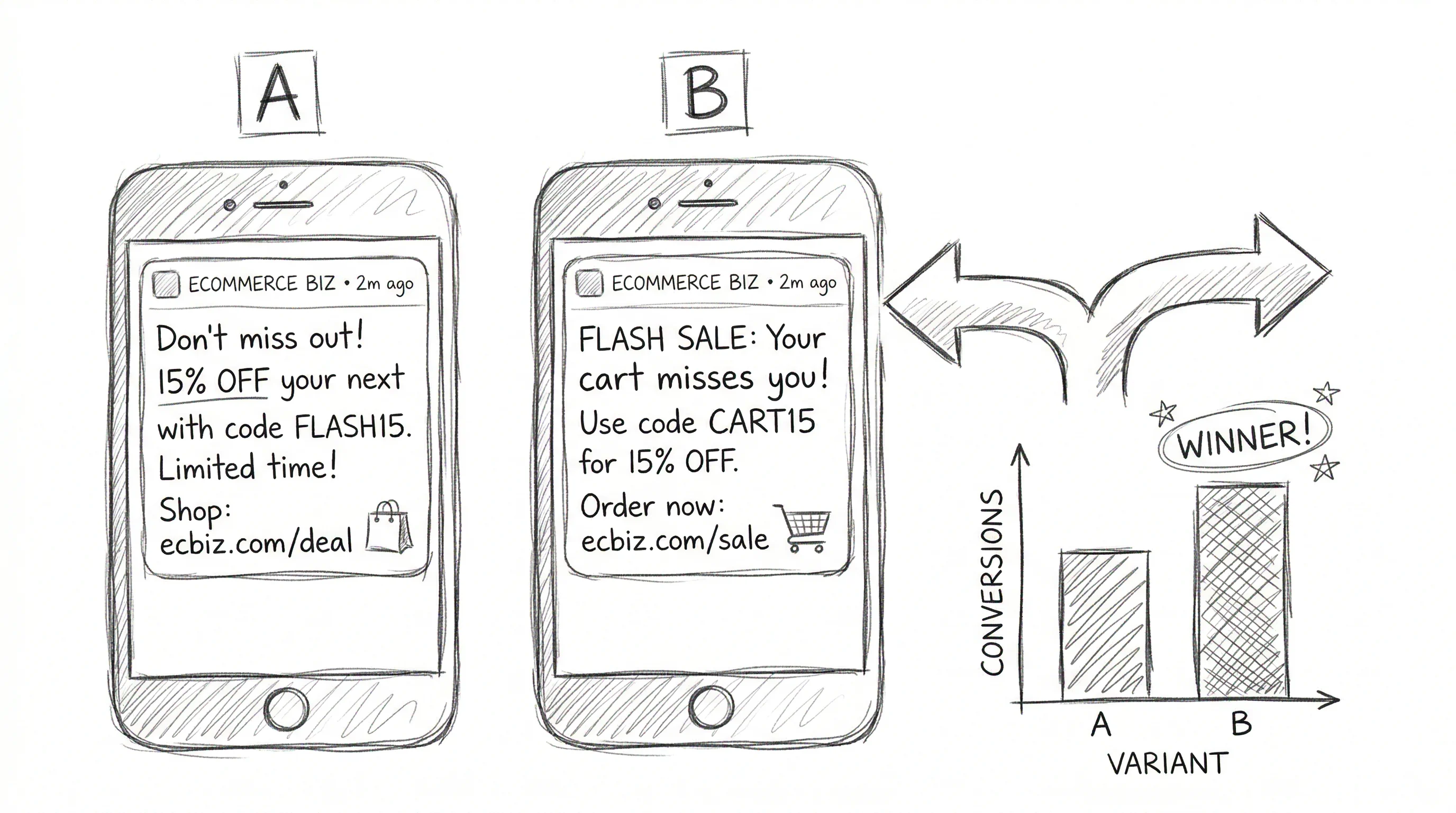
Step 1: Define success metrics
Primary: Submission rate (leads / page visitors) Secondary: Lead quality (email open rate, trial activation rate, first purchase within 30 days) Guardrail: Bounce rate (a pop-up that drives mass exits is a net loss)
Step 2: Choose one variable
Common high-priority sequence: form fields → headline → CTA text → lead magnet format → trigger/timing
Step 3: Determine sample size
For detecting a 5-percentage-point difference in a 15% baseline submission rate (e.g., testing whether form simplification lifts rate from 15% to 20%):
For pop-up tests with lower show rates (pop-up shown to 30% of visitors): multiply required traffic by 3x.
Step 4: Run the test
Use CustomFit.ai, Google Optimize (or its successor), or a dedicated pop-up tool (Privy, OptiMonk, Popup Maker) that supports A/B testing. Ensure both variants are tracked with the same analytics implementation.
Step 5: Analyze and decide
If submission rate difference is statistically significant at 95% confidence: deploy winner. If not: continue test until you reach significance or hit your maximum test duration.
The submission rate is only half the picture. Test variants that produce lower-quality leads can appear to win on volume while losing on revenue.
Track these quality signals for leads from each variant:
A variant that generates 30% more submissions but produces leads with 40% lower trial activation is a net loss on LTV.
Testing the pop-up without testing the landing page. The page visitors see when they do not interact with the pop-up has equal importance. Test both independently.
Measuring only submission rate. Volume without quality leads to bloated email lists with poor revenue per subscriber.
Not suppressing pop-ups for existing subscribers. Running a lead capture test on visitors who are already email subscribers inflates your submission count and contaminates results.
Using different traffic sources for each variant. If Variant A gets organic traffic and Variant B gets paid traffic, any difference in submission rate is attributable to traffic quality, not your test element.
Not tracking to CRM. If you are generating leads for a sales team, ensure test variant data flows into your CRM so you can track lead-to-deal conversion rates by variant.
Related reading: