From the conversion glossary
Concepts referenced in this article, defined.
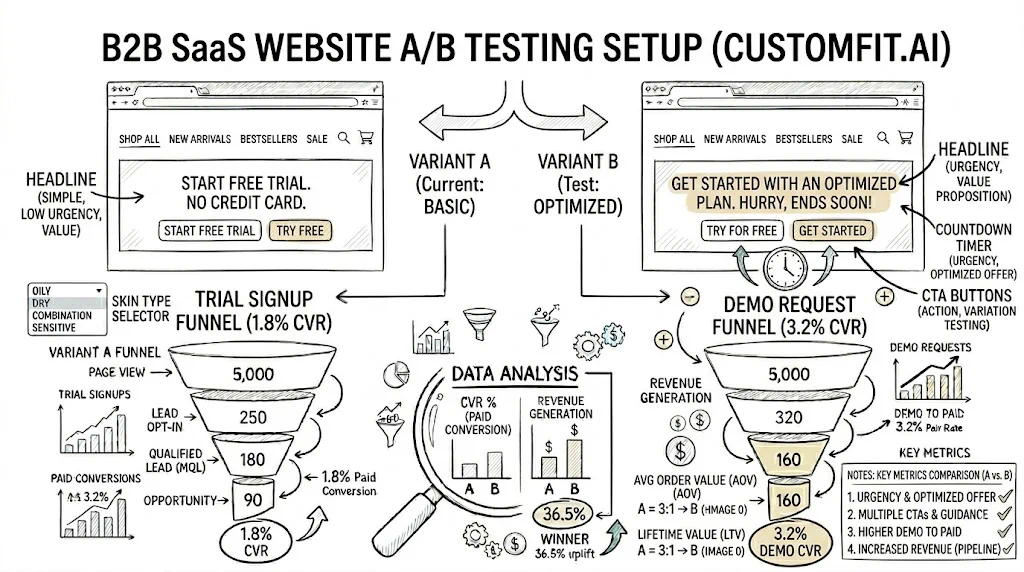
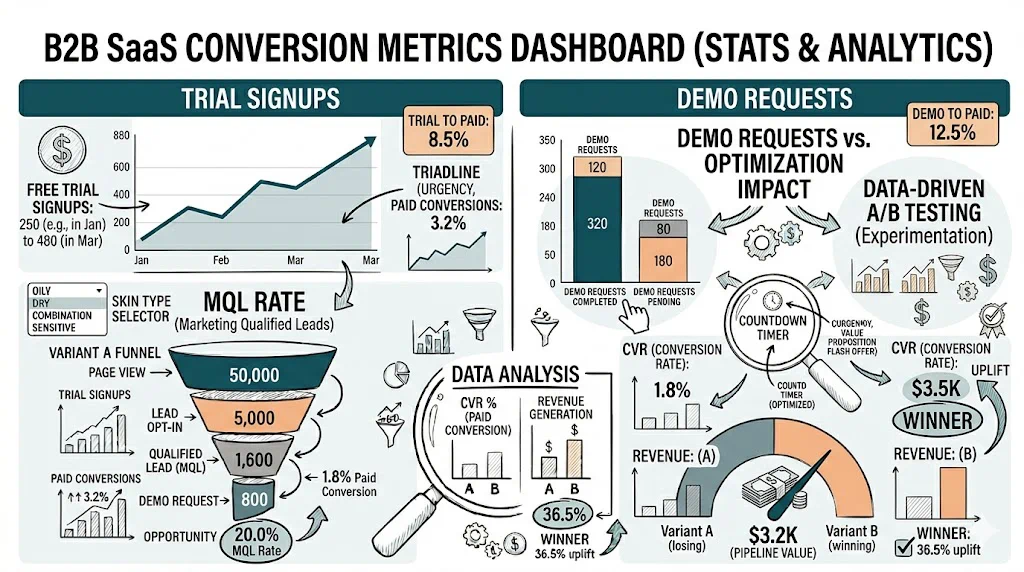
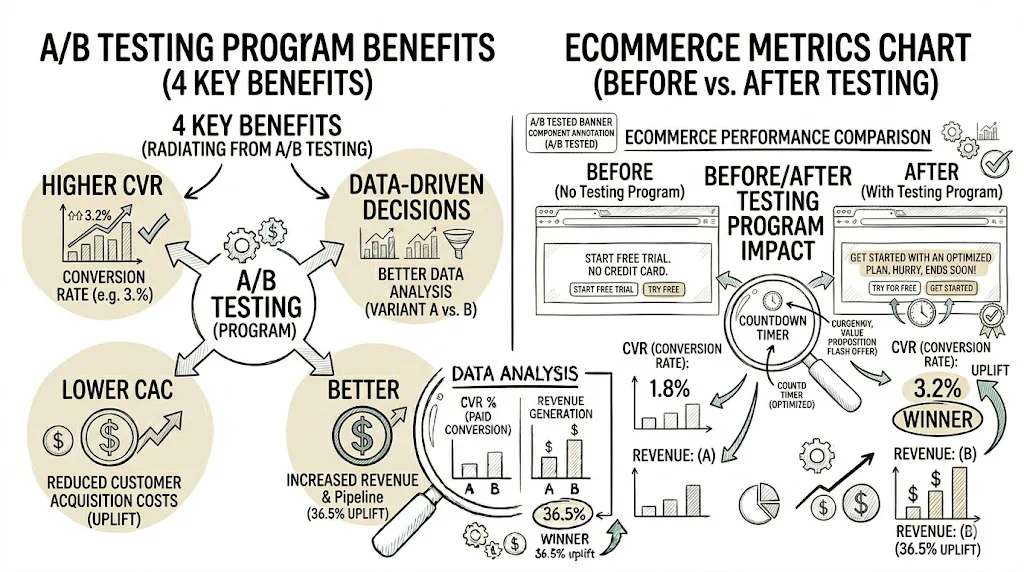
A/B testing's top benefits: higher conversion rates, data-driven decisions, lower CAC, and better ROI from existing traffic. See real D2C results.
Concepts referenced in this article, defined.
Run rigorous A/B tests and personalize every visit on Shopify or any storefront — no engineers required.
Every rupee you spend on ads, influencers, or SEO delivers a return that's directly capped by your conversion rate. If 2% of your visitors buy, you're leaving 98% of your paid traffic money on the table. A/B testing is the systematic practice of shrinking that gap — and it's the highest-ROI activity in your marketing stack precisely because it multiplies the return on everything else.
A 1% improvement in CVR doesn't just add 1% more revenue. It makes every ad campaign, every email, every WhatsApp blast 1% more efficient. Permanently. That's the core insight behind A/B testing, and it's why brands that build a testing culture consistently outgrow brands that rely on intuition.
This is the most direct benefit. You already have visitors — A/B testing extracts more revenue from the traffic you're paying for.
Most Indian D2C brands treat conversion rate as a fixed variable. They spend more on Meta ads to drive more traffic, assuming CVR is what it is. But CVR is a function of your page experience, and your page experience is changeable. A skincare brand that lifts CVR from 1.8% to 2.2% on ₹15 lakh/month in ad spend has effectively created ₹3.3 lakhs in additional monthly revenue without increasing ad budget by a rupee.
HiPPO stands for Highest Paid Person's Opinion. In most ecommerce teams, product page design, pricing display, and copy are decided by whoever has the most seniority or the loudest voice. This is expensive and wrong.
A/B testing replaces opinion with evidence. When your founder says "make the button red" and your designer says "keep it minimal", you don't have a design debate — you run a test. Whichever version converts better wins, regardless of who advocated for it. This shift in culture saves significant time and removes the emotional friction that kills velocity in growing teams.
Customer acquisition cost (CAC) is calculated as: ad spend ÷ number of customers acquired. A/B testing reduces CAC by increasing the denominator — more customers from the same spend — without touching the numerator.
If you're acquiring 500 customers a month on ₹10 lakh in ad spend, your CAC is ₹2,000. Lift CVR by 15% through A/B testing and you're acquiring 575 customers for the same ₹10 lakh. CAC drops to ₹1,739. For a brand spending ₹50 lakh a month on performance marketing, that difference at scale is substantial.
Individual A/B test wins are small. Their compounding effect over 12–24 months is transformative.
Say you run a modest testing programme — one test per month, averaging 8% improvement per winning test (with roughly half your tests winning). After 12 months, your conversion rate has compounded through 6 winning tests. A starting CVR of 1.5% becomes roughly 2.4% through compounding. That's a 60% improvement in conversion efficiency from systematic testing alone, with no change in traffic or ad spend.
This is why brands that start A/B testing early build durable competitive advantages. The gap between a brand that has tested for 3 years and one that just started is not a 3-year gap — it's a permanent structural advantage in unit economics.
Most ecommerce redesigns fail silently. A brand spends ₹8–15 lakh on a full site redesign, launches it, and watches conversion rate drop 12%. By the time they've identified the problem and reverted, they've lost weeks of revenue.
A/B testing makes change safe. Instead of launching a new product page design to 100% of traffic, you launch it to 10% and measure the impact for two weeks. If it hurts conversions, you end the test. If it helps, you roll it out. The cost of a bad change drops from "weeks of lost revenue" to "a minor traffic allocation for a fortnight."
Every A/B test teaches you something about how your customers think. Even losing tests are valuable — if "Free shipping above ₹499" outperforms "Free shipping above ₹299", that's a data point about your customers' price sensitivity. If a founder's story in the product description outperforms a list of ingredients, you now know your audience values narrative over specification.
Over time, these learnings accumulate into genuine customer intelligence that informs not just your website but your product development, marketing messaging, and pricing strategy.
Your competitor can copy your pricing, your product formulation, or your ad creative within weeks. They cannot easily copy 24 months of A/B testing learnings that are embedded in every decision your team makes.
Testing culture — the discipline of forming hypotheses, measuring results, and shipping winners — is an organisational capability, not a feature. It compounds in the same way that individual test results do. Brands that build this capability early find that it creates a durable edge that fast followers struggle to replicate.
The benefits above aren't theoretical. Indian D2C brands are running structured A/B testing programmes and seeing measurable results.
Bellavita — one of India's fastest-growing personal care brands — achieved an 11% lift in conversion rate through a structured A/B testing programme. That lift, held across their traffic volume, translates to crores in incremental annual revenue from a testing programme, not from additional ad spend.
Kapiva, the Ayurvedic wellness brand, recorded a 9.48% CVR improvement through focused experimentation on their product pages and checkout flow. For a brand in the competitive health supplement space where customer acquisition costs are high, this improvement meaningfully changes their unit economics.
Both brands run their testing through CustomFit.ai — a platform built specifically for D2C ecommerce brands that want to implement testing without engineering dependency or complex setup.
The pattern across high-performing D2C brands is consistent: they treat their website as a conversion machine that gets incrementally better every month, not as a fixed asset that gets redesigned every 18 months.
This table illustrates the revenue impact of CVR improvements across different monthly traffic levels, assuming an average order value of ₹1,200:
| Monthly Visitors | Baseline CVR | Revenue/Month | After +1% CVR | After +2% CVR | After +3% CVR |
|---|---|---|---|---|---|
| 50,000 | 2.0% | ₹12,00,000 | ₹13,80,000 | ₹15,60,000 | ₹17,40,000 |
| 1,00,000 | 2.0% | ₹24,00,000 | ₹27,60,000 | ₹31,20,000 | ₹34,80,000 |
| 2,00,000 | 2.0% | ₹48,00,000 | ₹55,20,000 | ₹62,40,000 | ₹69,60,000 |
| 5,00,000 | 2.0% | ₹1,20,00,000 | ₹1,38,00,000 | ₹1,56,00,000 | ₹1,74,00,000 |
A brand doing ₹1 crore a month with 1,00,000 monthly visitors and a 2% CVR adds ₹3.6 lakh in monthly revenue from a 1% absolute CVR improvement. That's ₹43.2 lakh per year — from a testing programme that costs a fraction of that amount.
The ROI of A/B testing is not a percentage. It's a multiplier on every other marketing investment you make.
The instinct when conversion rate is low is to redesign. "Our site looks dated, let's rebuild it." This is an expensive, slow, and risky approach to the same problem that A/B testing solves faster and cheaper.
| Approach | Cost | Time to Result | Risk | Learning |
|---|---|---|---|---|
| Full redesign | ₹8–20 lakh | 3–6 months | High (CVR often drops post-launch) | Low (too many variables changed) |
| A/B testing programme | ₹15,000–50,000/month for tools | 2–4 weeks per test | Low (losers don't ship) | High (each test teaches something specific) |
A redesign is a bet. A/B testing is a series of evidence-backed decisions. A brand that runs 12 well-designed tests over the same period a redesign takes will typically achieve more CVR improvement with less risk and deeper customer insight.
This doesn't mean redesigns are never warranted — sometimes your codebase is genuinely broken or your brand identity needs updating. But "conversion rate is low" is a reason to run tests, not to redesign.
The fastest path from "knowing A/B testing helps" to "seeing CVR lift in your analytics":
Step 1: Audit your funnel. Where are users dropping off? Your product page → add-to-cart rate, add-to-cart → checkout rate, and checkout → purchase rate are your three key ratios. The lowest ratio is your highest-leverage starting point.
Step 2: Form one specific hypothesis. Based on your funnel audit, identify the single change most likely to move the needle on your worst-performing step.
Step 3: Set up your test with proper sample size. Use a sample size calculator to determine how long your test needs to run. Don't end tests early.
Step 4: Run to statistical significance. 95% confidence level is the minimum. Let the data tell you the winner.
Step 5: Ship, document, and repeat. Build the cadence. One test per month, systematically, is enough to produce the compounding results Bellavita, Kapiva, and hundreds of other D2C brands have achieved.
CustomFit.ai makes this process accessible to any D2C brand — no developer tickets required, no code changes needed. Tests go live in minutes, not weeks.
Related reading:
Start A/B Testing Your Store Today
1,000+ D2C brands use CustomFit.ai to run A/B tests — without code, without developer tickets.
14-day free trial · No credit card required · Setup in under 30 minutes.