From the conversion glossary
Concepts referenced in this article, defined.
Concepts referenced in this article, defined.
Run rigorous A/B tests and personalize every visit on Shopify or any storefront — no engineers required.
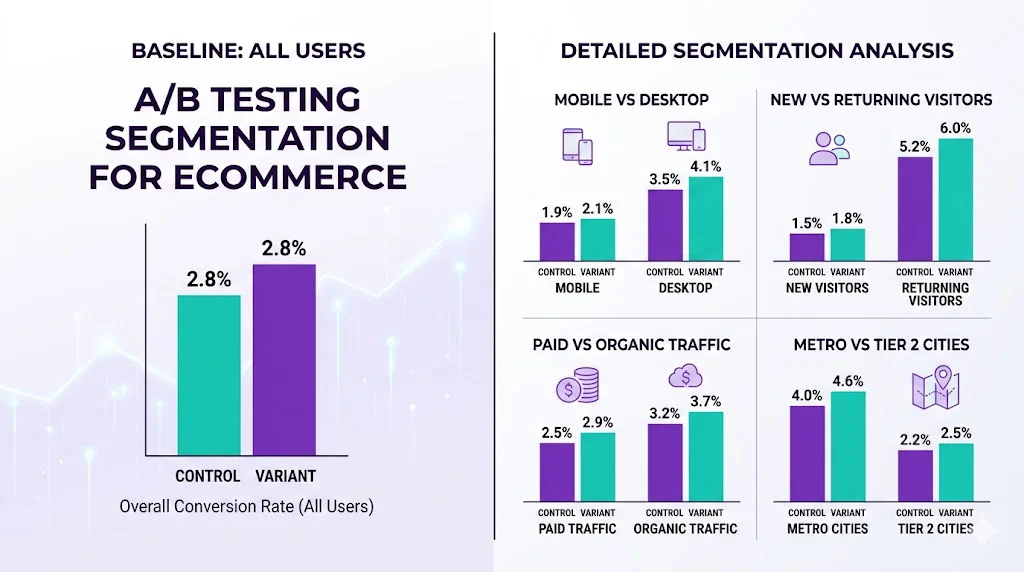
A/B test segmentation means breaking down your test results by audience groups — device type, traffic source, geography, new vs returning visitors — to understand whether your variant works differently for different customer segments. Overall test results hide critical variation: a variant that lifts overall conversion by 8% may be delivering +22% for mobile visitors and -5% for desktop visitors. Segmentation reveals this hidden variation, preventing you from rolling out changes that hurt some of your best customers.
Consider this scenario: Your A/B test shows variant B lifts overall conversion rate from 2.1% to 2.4% — a 14% relative improvement, statistically significant. You roll it out.
But segment analysis would have revealed:
The overall positive result masked the desktop damage. Mobile traffic dominated the aggregate result. By rolling out the variant to all users, you've actually hurt desktop conversion — which might be your higher-AOV, higher-intent segment.
This scenario isn't hypothetical. It's common in ecommerce A/B testing, especially for Indian D2C brands where mobile and desktop audiences are often dramatically different in intent, behavior, and conversion patterns.
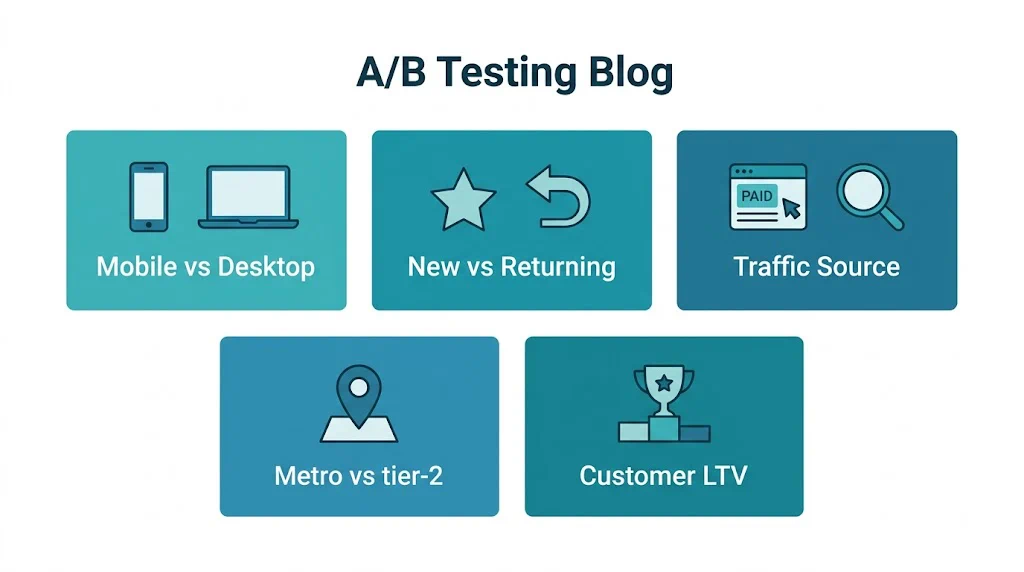
The most critical segmentation for Indian D2C brands. Mobile users in India come from dramatically different contexts:
A headline that works well on desktop may be completely different from what converts on mobile. Always analyze A/B test results by device type first.
New visitors and returning visitors are fundamentally different audiences:
A variant that adds extensive trust signals may lift new visitor conversion significantly but be irrelevant (or cluttering) for returning visitors who already trust you.
Visitors from different sources arrive with different intent levels:
A variant designed to educate and build trust (longer product descriptions, FAQ sections) may be unnecessary for Google Shopping visitors who arrived already knowing what they want.
For Indian D2C brands, geographic segmentation is often revealing:
A test adding premium trust signals (certifications, lab testing) may lift Tier 2 conversion more than metro conversion if metro visitors already have sufficient trust.
If you have customer data integrated with your testing tool:
For tests involving pricing presentation, bundle offers, or loyalty messaging, customer history segmentation is often the most revealing.
Most testing platforms include built-in segment analysis. In CustomFit.ai, you can analyze test results filtered by:
Pre-specified vs exploratory segmentation:
Pre-specified segments: Segments you define before the test runs. These have higher statistical validity because you haven't gone fishing for patterns.
Exploratory segments: Segments you analyze after seeing overall results to understand what's driving them. These are hypothesis-generating, not conclusive.
A best practice: pre-specify 2–3 key segments before launching any test (almost always including device type). Analyze all other segments as exploratory and use findings to design follow-up tests.
Analyzing many segments simultaneously increases your chance of finding a "significant" result by random chance — this is the multiple comparisons problem (also called the "multiple testing problem" or "p-hacking" risk).
If you analyze your test results across 20 different segments, you'd expect at least one segment to show a statistically significant result (at 95% confidence) purely by chance — even if the variant has no real effect in that segment.
How to protect against this:
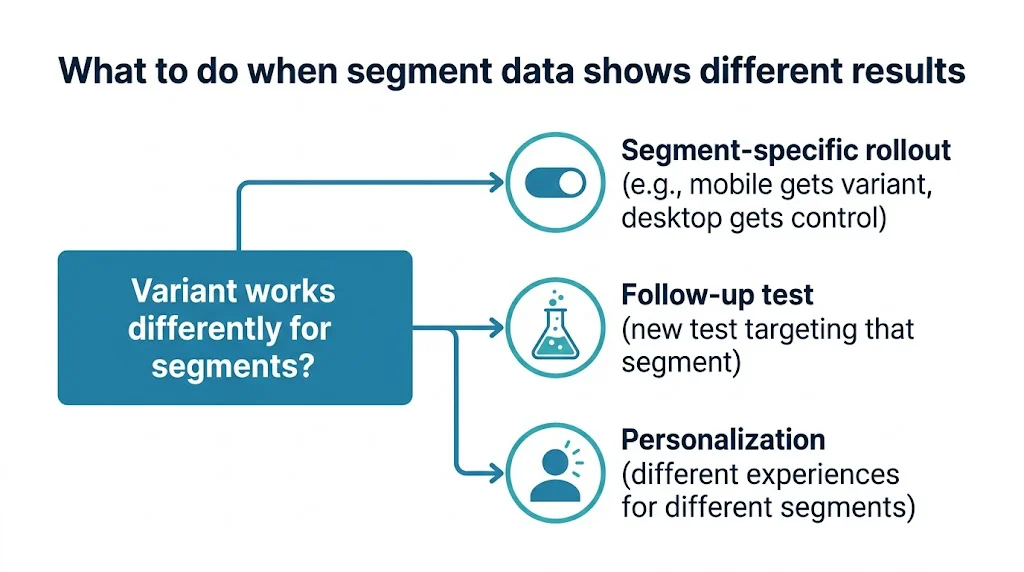
When segment analysis reveals that a variant works differently across segments, you have several options:
Option 1: Roll out to the segment it helps, not site-wide If variant B lifts mobile conversion by 22% but hurts desktop by 8%, implement the variant for mobile visitors only and show the control to desktop visitors. Most testing tools (including CustomFit.ai) support audience-specific rollouts.
Option 2: Design a segment-specific follow-up test If exploratory segment analysis shows interesting results (but with low sample size in that segment), design a new test targeting that specific segment with more traffic allocation.
Option 3: Run a personalization experiment If different segments consistently prefer different experiences, the right long-term approach is personalization — showing different default experiences to different segments based on their characteristics. CustomFit.ai's personalization engine enables this for Shopify stores.
Always analyze device type first. For Indian D2C stores where 65–80% of traffic is mobile, the mobile vs desktop split is the single most important segment. If your overall test result is positive, check whether mobile and desktop are both positive before rolling out.
Don't over-segment. Analyzing your test across 15 different segments reduces the sample size in each segment significantly, making all segment results unreliable. Focus on the 3–5 segments that are most strategically relevant.
Use segment findings to inform personalization strategy. Consistently finding that Tier 2 city visitors respond differently from metro visitors is a signal that personalized experiences by location could lift conversion. CustomFit.ai makes this straightforward on Shopify.
Track segment performance over time, not just in tests. Your conversion funnel analytics should already be segmented by device type and traffic source. Compare these baseline segment metrics to your test segment findings for consistency.
Be careful about festive season segment distortions. During Diwali, the proportion of new visitors surges (gift buyers, deal seekers). Segment results during festive periods may not represent typical new visitor behavior for the rest of the year.