From the conversion glossary
Concepts referenced in this article, defined.
Concepts referenced in this article, defined.
Run rigorous A/B tests and personalize every visit on Shopify or any storefront — no engineers required.
The best A/B testing tools for small businesses are ones that work without a developer, fit within a ₹5,000–₹25,000/month budget, and integrate directly with your ecommerce platform. CustomFit.ai ($99/month), VWO's small business tier, and AB Tasty's starter plans are the top options for 2026. Enterprise platforms like Optimizely are overkill — they're built for teams of 10+ CRO specialists and cost 10–50× more than small businesses need to spend.
Small D2C brands — think a Mamaearth-scale startup, a bootstrapped skincare brand, or a 2-year-old specialty food brand — need tools that match their reality: lean teams, no dedicated developer, and a budget that needs to justify itself in revenue impact within 90 days.
A common objection: "We don't have enough traffic to A/B test." This is usually wrong.
If you have 1,500 unique visitors per month to your product pages, you can run a meaningful A/B test in 4–6 weeks on that page. A test that lifts your 3% CVR to 3.5% — a modest 17% relative improvement — translates to:
If your AOV is ₹1,200, that's ₹8,400–₹9,600 in additional monthly revenue from one test. At ₹8,199/month for CustomFit.ai, the math works from month one.
The brands that wait until they have "enough traffic" often wait until they've already spent years driving traffic to a suboptimal store experience.
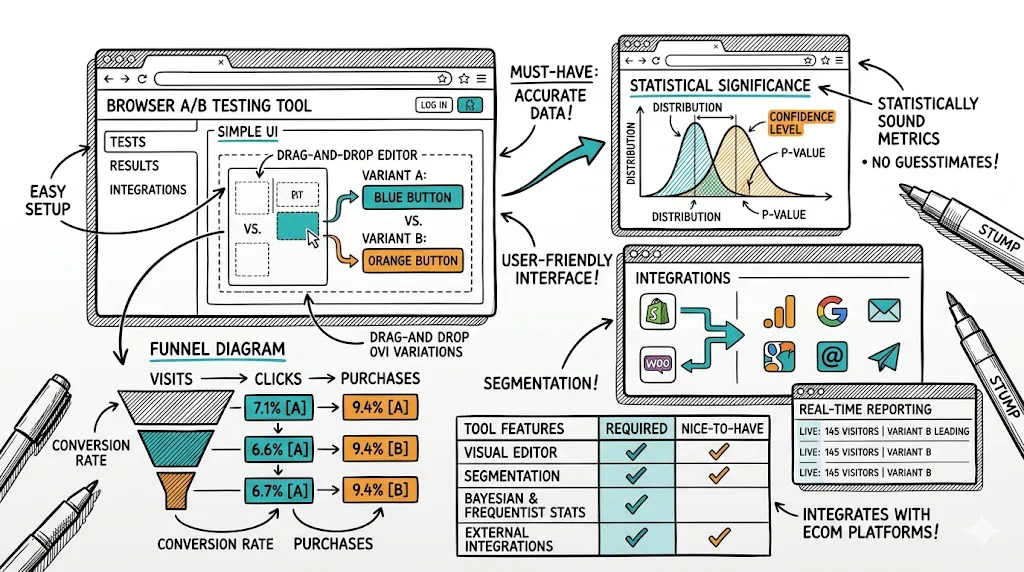
Before comparing options, here are the non-negotiable requirements for small teams:
No-code visual editor: You need to change headlines, button colors, images, and layouts without writing code. If your tool requires a developer for every test, it'll sit unused.
Statistical reporting built-in: The tool must tell you when a result is statistically significant and show confidence intervals — not just which variant has more conversions.
Shopify or platform native integration: Generic JavaScript tools work but require careful implementation to avoid SRM and caching issues. Native integrations handle this automatically.
Affordable pricing: Small businesses should not pay more than ₹15,000–₹25,000/month for a full-featured tool. Enterprise pricing is not appropriate.
Quick setup: If you need more than 2 hours to go live, the tool has too much friction for a small team.
Pricing: $99/month (~₹8,199). 14-day free trial, no credit card. Setup time: 15–30 minutes (Shopify app install) Developer required: No Key features:
Best for: Shopify D2C brands across beauty, apparel, health, and food categories. Brands like Bellavita (11% CVR improvement) and Kapiva (9.48% CVR improvement) are in this category.
Why it wins for small business: No developer dependency is the defining advantage. A founder or growth marketer can launch a test, track results, and roll out winners without involving engineering. At ₹8,199/month, it pays for itself with a single meaningful test result.
Limitations: Shopify-only. Not suitable for WooCommerce, Magento, or custom-built stores.
Pricing: Free tier (50K visitors/month, 1 experiment); Starter at $199/month Setup time: 1–2 hours (JavaScript snippet + Shopify integration) Developer required: Recommended for initial setup Key features:
Best for: Small businesses on WooCommerce, custom platforms, or those needing heatmaps bundled with A/B testing.
Limitations: The free tier's 1-experiment limit and 50K visitor cap are tight for active testing programs. Initial setup requires some technical knowledge.
Pricing: Quote-based (typically $500+/month for full features) Setup time: 2–4 hours Developer required: For advanced features Key features:
Best for: Brands moving from startup to growth stage with ₹5–20 crore annual revenue and a dedicated growth team. Likely too expensive and complex for most small businesses.
Pricing: Quote-based, typically ₹15,000–₹40,000/month Best for: Teams with developers who need server-side testing. Not ideal for no-code small business use cases.
Some brands run "A/B tests" by manually changing their website for 2 weeks, then comparing analytics from those periods. This is not an A/B test — it's not controlled, it conflates time periods with variants, and it has no statistical validity. Any business investing in growth should use a proper tool.
Use this decision tree:
Are you on Shopify?
Are you on WooCommerce/other platform?
What traffic volume do you have?
Once you've chosen a tool, follow this process for your first test:
Step 1: Identify your highest-traffic page with a conversion goal Your product page, homepage, or cart page. Not a category page you rarely optimize. You need enough traffic for statistical validity.
Step 2: Identify one specific friction point Look at your analytics: Where are visitors dropping off? High bounce rate on product page? Low add-to-cart rate? This tells you what to test. Use Hotjar or Microsoft Clarity (free) to watch session recordings.
Step 3: Form a hypothesis "If we add customer reviews above the add-to-cart button instead of below, add-to-cart rate will increase because shoppers need social proof before they act."
Step 4: Build the variant With CustomFit.ai's visual editor, you drag and drop the reviews section. No developer needed.
Step 5: Set your success criteria "Primary metric: add-to-cart rate. Minimum detectable effect: 15% relative lift. Run for 3 weeks or 2,000 visitors per variant, whichever comes later."
Step 6: Launch, monitor for SRM, wait for results Check SRM in the first 48 hours. Then don't touch the test until the pre-set end date.
Focus your first 3 tests on your highest-traffic pages — product page, cart, homepage. Don't test low-traffic pages until your team has testing experience.
Test one element at a time as a small team — multivariate tests require significantly more traffic. Start with simple A/B (2 variants).
Run tests for at least 7 days even if you reach significance earlier — weekly traffic patterns matter, especially for weekend-heavy shopping categories.
Keep a test log — document every test run, its hypothesis, results, and what you learned. This becomes your CRO playbook.
Don't test during major promotions — festive sale traffic is different from normal traffic. Results from Diwali sale periods won't generalize to normal weeks.
Use free heatmap tools alongside your testing tool — Microsoft Clarity is free and gives you session recordings to form better hypotheses.
Start with high-impact, low-risk tests — changing a headline or CTA copy is low risk and often high impact. Don't start by testing your entire product page redesign.
Related reading: Free A/B Testing Tools | How to Choose an A/B Testing Tool | How Long to Run an A/B Test | A/B Testing Statistical Significance | A/B Testing Pillar Guide