CustomFit.ai โ€” Website personalization, A/B testing and CRO for Shopify and D2C
Product
Features
โœฑ
Website Personalization
Adapt to each visitor's behavior & intent
โง–
A/B & Multivariate Testing
Rigorous experimentation
โœจ
AI CopilotNEW
Personalize with a prompt
๐Ÿค–
AI WingmanNEW
Auto-optimize toward winners
๐ŸŽฏ
AI Conversion OptimizerNEW
GPT-grade test ideas
โœŽ
No-Code Visual Editor
Drag-and-drop edit any element
โ–ฆ
Product Recommendations
Personalized recs that lift AOV
โš‘
Feature Flags
Ship safely with kill-switches
โ—ง
Chrome Extension
Edit your store in the browser
โง‰
Shopify, WooCommerce & more
All platform integrations
View all features โ†’
Use Cases
$
Price A/B Testing
Test price points to maximize revenue
โ–ฆ
Theme A/B Testing
Compare whole layouts & designs
๐Ÿ—‚
Template A/B Testing
Test whole PDP/PLP templates
๐Ÿท
Discount A/B Testing
Find the offer that converts
๐Ÿšš
Shipping A/B Testing
Thresholds, speed & copy
โœ
Content A/B Testing
Copy, images & reviews
๐Ÿ’ณ
Checkout Gateway A/B
Payments & one-click
โŒ–
Geo-Based Personalization
Per-location content & offers
โšก
Buyer-Intent Nudges
Exit-intent & retargeting
โ†”
Split-URL / Redirection
Full-page redirect tests
View all use cases โ†’
Solutions & Guides
โคข
Conversion Rate Optimization
The complete CRO guide
โง–
A/B Testing Software
Buyer's guide for D2C
๐Ÿ›’
Cart Abandonment Recovery
Win back lost carts
๐Ÿ“ฐ
Landing Page Optimization
Convert more paid traffic
S
Shopify A/B Testing
Test your store, no code
S
Shopify Personalization
Tailor the store per shopper
โ—”
First-Time Visitor Offers
Convert new shoppers with trust & offers
โ˜…
Repeat-Customer Experiences
Reward and re-engage loyal buyers
โ—Ž
Campaign-Matched Pages
Match the landing page to the ad
โŒ–
Location-Based Experiences
Currency, language & regional offers
Explore CRO โ†’
Customer stories
GIVA
+32%
conversion via personalized recs
GIVA
Mamaearth
+18%
revenue lift from PDP A/B tests
ME
The Sleep Company
+24%
AOV from product recommendations
TSC
Read customer stories โ†’
Integrations
SWsfGA+15
โœฆ
Not sure where to start?
Let AI Copilot pick your first tests

โ€œWe wake up to evidence-backed tests ready to deploy โ€” not a backlog of maybe ideas.โ€

AN
Anirudh S.
Growth ยท Chargebee
โ˜…โ˜…โ˜…โ˜…โ˜…4.8on G2 ยท 2,400+ brands
Talk to our team โ†’
Widgets
Integrations
Ecommerce & Checkout
Shopify
Shopline
Shoplazza
GoKwik
ShopFlo
Razorpay Magic Checkout
Breeze
Shiprocket
View all integrations โ†’
Analytics & Behavior
Google Analytics 4
Microsoft Clarity
Hotjar
Mixpanel
Amplitude
Heap
Adobe Analytics
Segment (CDP)
View all integrations โ†’
Engagement, CRM & More
Klaviyo
MoEngage
CleverTap
WebEngage
HubSpot
Salesforce
Slack
Meta Ads
View all integrations โ†’
CustomersPricing
Resources
CRO
โ–ค
Playbooks
Proven strategies to boost conversions
๐ŸŽ™
Interviews
D2C leaders & marketing experts
โ–ถ
Webinars
Live deep dives & product sessions
Learn
โœŽ
Blog
Tips, experiments & best practices
๐Ÿ“•
Free E-Books
Mastering personalization
๐Ÿ“–
Conversion Glossary
Every CRO term, defined
โœฆAI CopilotNEWLog inBook a demo
Start free trial
Select your platform โ€” Install in 2 minsWe'll tailor the setup
โšก Risk-free 14-day trial ยท No credit card ยท Cancel anytime
S
Shopify
Install from Shopify App Store
โ€บ
W
WooCommerce
Install the WooCommerce plugin
โ€บ
B
BigCommerce
Install from BigCommerce App Marketplace
โ€บ
SL
Shopline
Install from Shopline App Store
โ€บ
M
Salesforce / Magento
Install from the marketplace
โ€บ
SZ
Shoplazza
Install from Shoplazza App Store
โ€บ
WP
WordPress / Webflow
Install plugin or paste the script
โ€บ
โ—ง
Others
Custom-built on React, Next.js, etc.
โ€บ
Tip: pick your platform โ€” we handle the restBook a demo โ†’
Product
Website PersonalizationA/B & Multivariate TestingAI CopilotAI WingmanAI Conversion OptimizerNo-Code Visual EditorProduct RecommendationsFeature FlagsView all features โ†’
Use Cases
Price A/B TestingTheme A/B TestingTemplate A/B TestingDiscount A/B TestingShipping A/B TestingContent A/B TestingCheckout Gateway A/BGeo-Based PersonalizationBuyer-Intent NudgesSplit-URL / Redirection
Solutions & Guides
Conversion Rate OptimizationA/B Testing SoftwareCart Abandonment RecoveryLanding Page OptimizationShopify A/B TestingShopify Personalization
Explore
WidgetsIntegrationsCustomersPricing
Resources
BlogPlaybooksWebinarsInterviewsE-BooksConversion Glossary
Platforms
ShopifyShoplineShoplazzaChrome ExtensionAll integrations
Start free trialBook a demo
Homeโ€บBlogโ€บab testingโ€บSequential Testing in A/B Testing

Sequential Testing in A/B Testing

AKAshwin KumarCo-Founder & CEO, CustomFit.aiJanuary 15, 20257 min read
On this page
  1. The Problem with "Peeking" at Test Results
  2. How Sequential Testing Works
  3. Sequential Probability Ratio Test (SPRT)
  4. mSPRT (Mixture Sequential Probability Ratio Test)
  5. Bayesian Sequential Testing
  6. Sequential Testing vs Fixed-Horizon Testing
  7. When Sequential Testing Adds Value for Ecommerce
  8. Implementing Sequential Testing
  9. Common Mistakes with Sequential Testing
  10. Tips and Best Practices
  11. Key Takeaways
0%
Sequential Testing in A/B Testing

From the conversion glossary

Concepts referenced in this article, defined.

Definition
What Is Sequential Testing? Definition & Guide
Definition
What Is False Positive? Definition & Guide
Definition
What Is Variant? Definition, Formula & Guide
Definition
What Is Sample Size? Definition & Guide
Definition
What Is Significance? Definition, Formula & Guide
โ† Back to Ab Testing guide
Try CustomFit.ai

Run A/B tests and personalize your store without code. 14-day free trial, no credit card.

Start free trial โ†’
Share
XLinkedInEmail

Related articles

ab testing

Statistical Significance in A/B Testing: A Plain-English Guide

Statistical significance in A/B testing means there's less than a 5% chance your result is random. Here's what p-values, confidence levels, and sample size mean for your tests.

Sapna Joharยท 12 min read
ab testing

How A/B Testing Works: Step-by-Step Explained

A/B testing works by splitting traffic between two versions of a page, measuring which performs better on a conversion metric, and declaring a winner at statistical significance.

Sapna Joharยท 10 min read
ab testing

A/B Testing vs Split Testing: What's the Difference?

A/B testing and split testing are the same thing โ€” two names for the same experiment. Here's why the terms are used interchangeably and what actually matters.

Sapna Joharยท 7 min read

Start lifting conversions today.

Run rigorous A/B tests and personalize every visit on Shopify or any storefront โ€” no engineers required.

Start free trialBook a demo

Built for every D2C category

๐Ÿงด
Skincare
๐Ÿ’„
Beauty
๐ŸŒฟ
Wellness
โ˜•
F&B
๐Ÿ‘Ÿ
Apparel
๐Ÿ’
Jewelry
๐Ÿ›‹๏ธ
Home
๐Ÿผ
Baby
Live ยท Right now
Mamaearth โ€” free-shipping band +12.4% AOVGIVA โ€” festive collection page +34% revenueBellavita โ€” PDP CTA test +27.4% CVRKapiva โ€” Quiz-driven recs +9.48% CTRThe Sleep Co โ€” landing personalized 2ร— capturesPlum โ€” Returning shopper swap +18.2% CVRMamaearth โ€” free-shipping band +12.4% AOVGIVA โ€” festive collection page +34% revenueBellavita โ€” PDP CTA test +27.4% CVRKapiva โ€” Quiz-driven recs +9.48% CTRThe Sleep Co โ€” landing personalized 2ร— capturesPlum โ€” Returning shopper swap +18.2% CVR
Get in touch

Tell us about your store.

We reply within an hour during business hours. No sales pitch, no spam โ€” just answers from someone who's seen 2,400+ D2C stores.

โœ“ Reply within 1 hourโœ“ No spam, everโœ“ Free demo & setup help
โœ“ Thanks! We'll be in touch shortly.
CustomFit.ai

The all-in-one website personalization, A/B testing & CRO platform for high-growth D2C brands. Made by marketers, fueled by coffee.

in๐•โ—Žโ–ถf
Product
  • Features
  • A/B Testing
  • Personalization
  • AI Copilot
  • AI Wingman
  • AI Conversion Optimizer
  • Feature Flags
  • Widgets
  • Integrations
  • ROI Calculator
Platforms
  • Shopify
  • Shopline
  • Shoplazza
  • Salesforce
  • Chrome Extension
  • All Integrations
Resources
  • Blog
  • Playbooks
  • Webinars
  • GrowthFit Interviews
  • Free E-Books
  • Conversion Glossary
  • Case Studies
Compare
  • vs VWO
  • vs Optimizely
  • vs Google Optimize
  • vs Mutiny
  • vs Intelligems
  • vs Shoplift
  • vs AB Tasty
  • vs Convert
  • vs Kameleoon
Company
  • About Us
  • Partners
  • CustomFit Awards
  • Recognition
  • Contact
  • Privacy Policy
  • Terms & Conditions
ยฉ 2026 CustomFit.ai ยท Valley Monks Pvt Ltd ยท Made by marketers, fueled by coffee, and obsessed with conversions.
SOC 2 Type II ยท GDPR ยท CCPA ยท ISO 27001

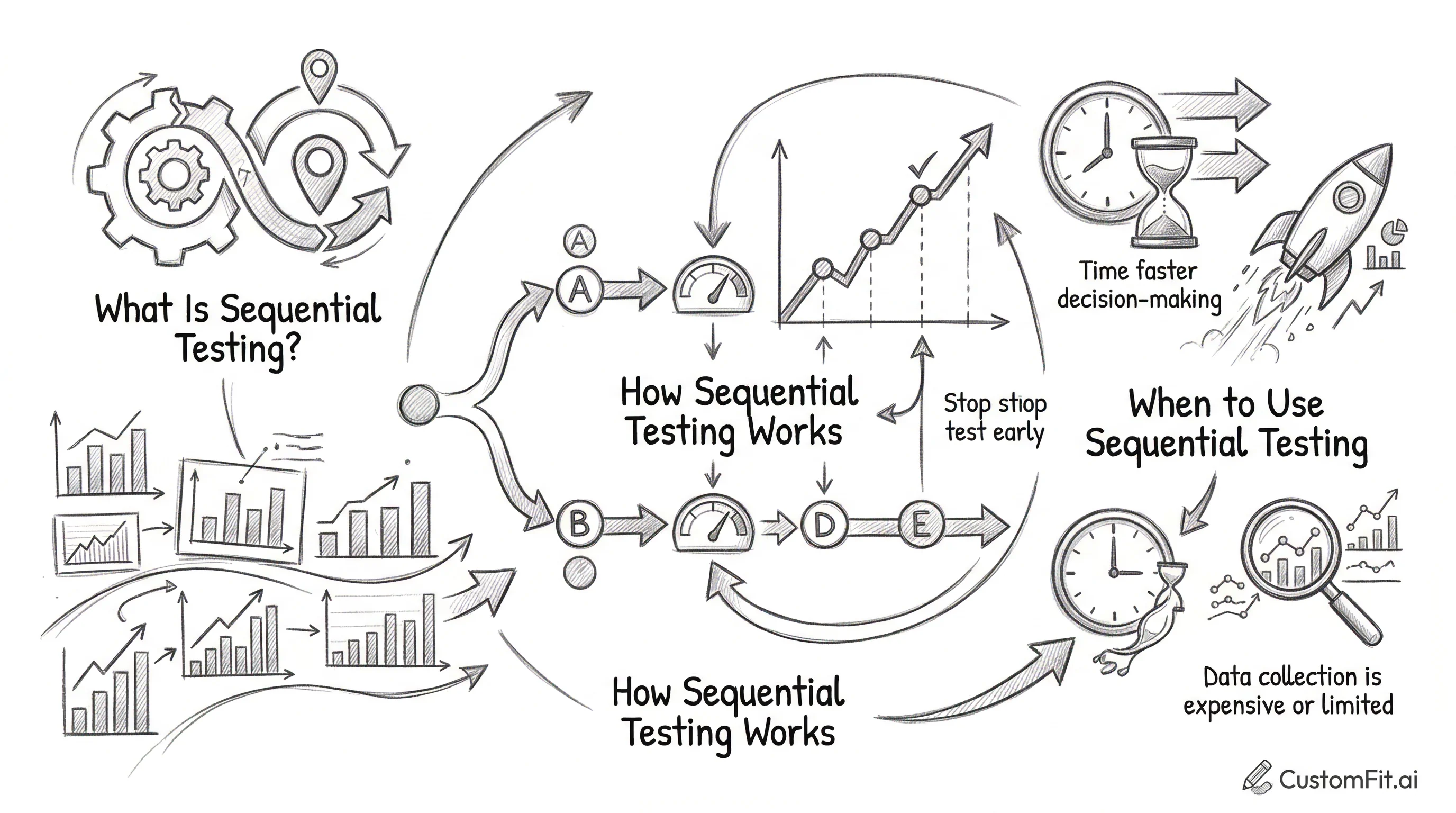
Sequential testing is a statistical approach that allows you to monitor A/B test results continuously and make valid decisions before reaching a fixed sample size โ€” without inflating false positive rates. Unlike standard fixed-horizon testing (which requires you to pre-specify a sample size and not peek at results), sequential testing adjusts significance thresholds as data accumulates, enabling earlier decisions on clear winners or losers. It's particularly valuable for time-sensitive ecommerce tests and low-traffic stores where reaching fixed sample sizes takes too long.

The Problem with "Peeking" at Test Results

The most common A/B testing mistake is checking results before the test reaches its target sample size โ€” and stopping the test when you see a significant result. This is called "peeking" and it dramatically inflates false positive rates.

Here's why: if you check a test every day for 30 days and stop whenever you see p < 0.05, your actual false positive rate is much higher than 5%. You're essentially running 30 hypothesis tests (one per day) but only reporting the favorable one.

Studies show that peeking and stopping early can inflate false positive rates to 25โ€“30% โ€” meaning one in three "winning" variants is actually no better than the control.

The conventional solution: Don't peek. Pre-specify your sample size, collect all the data, then analyze once. This is statistically rigorous but often impractical:

  • A test might take 3 months to reach the pre-specified sample size
  • A clearly terrible variant continues running, hurting conversion
  • Business urgency (upcoming festive campaign, product launch) demands faster decisions

Sequential testing provides a statistically valid alternative.

How Sequential Testing Works

Sequential testing uses methods that adjust the significance threshold over time to account for multiple looks at the data. The key approaches:

Sequential Probability Ratio Test (SPRT)

The original sequential testing method developed by Abraham Wald in 1945. At each observation (or batch of observations), it calculates a likelihood ratio that determines whether to:

  • Conclude the variant is better
  • Conclude the variant is worse
  • Continue collecting data (the result is still uncertain)

SPRT is theoretically elegant but sensitive to distributional assumptions and pre-specified effect sizes.

mSPRT (Mixture Sequential Probability Ratio Test)

A modern enhancement of SPRT that mixes over possible effect sizes rather than requiring a single pre-specified effect size. mSPRT is used by companies like Airbnb, Booking.com, and Netflix for continuous monitoring of their A/B tests.

The math: rather than testing against one specific alternative (e.g., "the variant is exactly 10% better"), mSPRT tests against a weighted mixture of possible effect sizes โ€” making it more robust to uncertainty about the expected effect.

Bayesian Sequential Testing

Bayesian approaches don't use p-values at all. Instead, they calculate the probability that variant B is better than variant A โ€” expressed as "there's a 83% chance B is better." This probability updates continuously as data accumulates.

Bayesian sequential testing has no fixed-horizon requirement by design. You can check results at any time and get a meaningful, interpretable probability statement โ€” though you should still define decision thresholds (e.g., "stop when we're 95% confident B is better, or 95% confident it's not").

CustomFit.ai's statistical engine uses Bayesian methods that allow continuous monitoring without peeking inflation โ€” well-suited to the smaller sample sizes of typical D2C ecommerce stores.

Sequential Testing vs Fixed-Horizon Testing

FactorFixed-HorizonSequential Testing
Sample sizePre-specifiedFlexible, test ends when conclusion reached
Can peek at results?No (inflates false positives)Yes (by design)
Stops early?NeverYes, when a conclusion is reached
Statistical guaranteeType I error rate = ฮฑType I error rate โ‰ค ฮฑ across all peeks
ComplexitySimplerMore complex (requires correct method)
Best forPlanned experiments with fixed timelinesOngoing experimentation, time-sensitive tests

When Sequential Testing Adds Value for Ecommerce

Festive season campaigns: During Diwali, Republic Day, or Holi campaigns, you may only have 7โ€“10 days to run a test before the campaign ends. Sequential testing allows you to identify a clear winner faster โ€” or stop a clearly losing variant before it costs you more festive traffic.

Product launches: A new product page launching on a specific date needs to be optimized quickly. Sequential testing's early-stopping capability lets you identify the better variant within the launch window.

Budget-constrained traffic: If you're spending โ‚น50,000/day on paid traffic to test a new landing page, running a clear loser for 4 more weeks at $5 significance costs โ‚น14 lakh in wasted spend. Sequential testing stops the loser faster.

Low-traffic stores: Sequential methods that allow earlier decisions (when the probability threshold is met rather than a fixed sample size) are particularly useful for stores where reaching a pre-specified fixed sample takes months.

Implementing Sequential Testing

Most major testing platforms are moving toward always-valid inference:

Statsig: Uses sequential testing methods by default โ€” you can check results at any time without inflating false positives.

Optimizely: Stats Accelerator uses adaptive sampling and early stopping with false positive controls.

VWO: Bayesian engine allows continuous monitoring without fixed-horizon requirements.

CustomFit.ai: Uses Bayesian methods that provide always-valid probability statements.

For teams running analysis in Python or R, libraries like always_valid (Python) and the OptimalDesign package (R) implement mSPRT and related methods.

Common Mistakes with Sequential Testing

Using sequential testing as an excuse to peek without controls. Sequential testing is not permission to peek at standard (fixed-horizon) A/B test results. If your testing tool uses fixed-horizon statistics, peeking still inflates false positives regardless of how you frame it. Sequential testing requires a correctly implemented sequential method โ€” not just checking results more often.

Confusing "95% probability B is better" with 95% confidence. Bayesian probability statements are not the same as frequentist confidence levels. A "90% probability B is better" from a Bayesian sequential test doesn't mean the result would be significant at the 10% level in a frequentist test. Interpret each approach on its own terms.

Stopping too early without a decision threshold. Sequential testing still requires pre-specified decision thresholds โ€” "we'll call a winner when we're 95% confident" or "we'll stop at 10,000 visitors if no clear winner emerges." Without thresholds, teams stop tests based on impatience rather than statistical logic.

Tips and Best Practices

Use sequential testing for operational flexibility, not as a shortcut. The value of sequential testing is that it allows valid decisions when you genuinely need to make them early โ€” not that it makes tests faster by default. Many sequential tests will still run to full sample.

Pair sequential testing with minimum test duration rules. Even with sequential methods, respect a minimum run time of 7โ€“14 days to capture weekly behavioral variation. A test that reaches significance in 3 days may be capturing a novelty effect or weekend traffic anomaly, not a real behavioral difference.

Understand the guarantee your method provides. Different sequential testing methods make different guarantees. mSPRT guarantees false positive rate control across all sample sizes. Bayesian methods provide probability statements that require interpretation. Know what your tool is calculating before you act on it.

Document your sequential testing decision thresholds before the test starts. Pre-register your decision rules: "We'll declare a winner at 95% posterior probability B is better. We'll stop the test at 30,000 visitors if no conclusion is reached." This prevents motivated reasoning from driving early termination.

Key Takeaways

  • Sequential testing allows continuous monitoring of A/B test results without inflating false positive rates โ€” unlike peeking at standard fixed-horizon tests.
  • The most common implementations are mSPRT (frequentist) and Bayesian sequential testing โ€” both provide always-valid inference.
  • Sequential testing is most valuable for time-sensitive ecommerce tests (festive campaigns, product launches) and for stopping clearly losing variants faster.
  • Peeking at standard A/B test results without sequential methods inflates false positive rates to 25โ€“30% โ€” don't do it.
  • CustomFit.ai uses Bayesian statistical methods that allow continuous monitoring without fixed-sample-size requirements.
  • Always set decision thresholds before the test starts โ€” sequential testing doesn't mean stopping whenever the number looks good.