From the conversion glossary
Concepts referenced in this article, defined.
Concepts referenced in this article, defined.
Run rigorous A/B tests and personalize every visit on Shopify or any storefront — no engineers required.
Acquiring a new D2C customer in India costs ₹400–800 depending on category and channel. Getting that same customer to buy again costs ₹50–100. If you are spending more on acquisition than retention, your unit economics will never work. The most profitable D2C brands in India — Mamaearth, Kapiva, Plum — have built retention systems that compound value over time. This guide gives you the specific strategies that drive repeat purchase for Indian D2C brands.
A D2C brand with a 20% repeat purchase rate at 90 days is roughly twice as profitable as a brand with a 10% repeat rate — assuming similar acquisition costs. The math works like this:
Brand B can profitably spend 2x more on acquisition and grow faster while remaining profitable. This is why customer lifetime value is the most important metric in D2C.
The challenge: most D2C brands treat retention as an afterthought. They focus on acquisition metrics (ROAS, CPM, CPA) and ignore the post-purchase experience that determines whether customers come back.
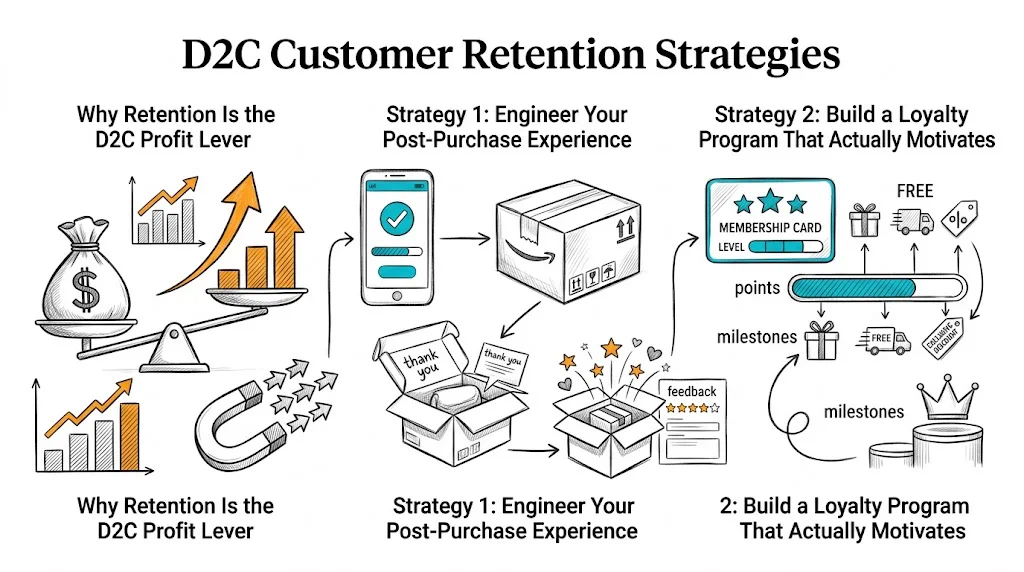
The 72 hours after a first purchase are the highest-leverage retention window. A customer who just bought from you is engaged, curious, and forming an impression. Here is the sequence that works:
Hour 1 — Order Confirmation (SMS + WhatsApp + Email):
Day 2–3 — Shipping Update:
Day of Delivery — Usage Guide:
Day 7 — Check-in:
Day 14 — Review Request:
Day 45–60 — Replenishment Nudge:
This sequence should be automated via email + WhatsApp. WhatsApp open rates in India are 90%+. Email open rates are 20–30%. Use both.
A loyalty program does not need to be complex. Even a simple points system increases repeat purchase by 15–20% for most D2C brands.
Points structure:
Tiers (optional, but effective for high-AOV brands):
Gamification elements:
Mamaearth's loyalty program uses a simple points system with tier progression. It drives 30%+ of their revenue from repeat customers who are engaged with their points balance.
For Shopify brands, loyalty apps like Smile.io, LoyaltyLion, or Flits can be set up in a day and integrate with your email/WhatsApp tools.
If your product is consumed regularly — supplements, personal care, food, coffee — a subscription model is your highest-leverage retention tool.
Why subscription works for D2C retention:
Subscription offer mechanics:
Subscription communication:
Kapiva uses subscription for its daily wellness drinks and supplement range. Subscribers represent their highest-CLV customer segment and drive a disproportionate share of revenue stability.
Not all retention strategies work equally for all customers. Use segmentation to personalize retention efforts:
RFM segments (Recency, Frequency, Monetary — see RFM analysis):
| Segment | Definition | Strategy |
|---|---|---|
| Champions | High R, F, M | Early access, referral program, brand ambassador |
| Loyal | High F, moderate M | Loyalty tier upgrade, subscription nudge |
| At Risk | Previously high F, now lapsing | Win-back campaign, product recommendation |
| Lost | Long since last purchase | High-value re-engagement offer |
| New | Single purchase | Post-purchase sequence, onboarding |
Behavioral personalization on-site:
CustomFit.ai's 1000+ targeting attributes include customer purchase history, allowing you to personalize the website experience for each retention segment — without developer involvement.
Every D2C brand has customers who bought once and never returned. A systematic win-back program can recover 10–20% of them.
Win-back sequence:
Win-back for high-value customers: Personal outreach. For customers who spent ₹3,000+ and have not returned in 90 days, a personalized WhatsApp message from a real person (not a bot) has measurably higher response rates.
Timing for Indian D2C: Schedule win-back campaigns around festive seasons. A customer who has lapsed is far more likely to re-engage during Diwali when gifting intent is high.
The highest-retention D2C brands have built communities where customers congregate regardless of whether they are actively buying:
WhatsApp community: A brand-run WhatsApp group or community focused on the category (skincare routines, fitness tips, parenting advice) that features the brand without being a sales channel.
Instagram close friends or broadcast channel: Share early access, behind-the-scenes, and exclusive content with your most engaged customers.
User-generated content programs: Brands that get customers to create and share content have effectively built a community habit. Customers who post about your brand are far more likely to buy again.
Plum's skincare community on Instagram generates organic engagement that keeps the brand top of mind even between purchases — at zero incremental cost.
Measure your 90-day repeat purchase rate every month. If it is falling, investigate the post-purchase sequence first, then product quality, then offer relevance.
WhatsApp first for Indian audiences. WhatsApp open rates and response rates dramatically outperform email for most Indian D2C customer segments. Invest in WhatsApp automation.
Make replenishment frictionless. A single "reorder" button in a WhatsApp message converts better than a 5-step checkout. Reduce clicks in the re-purchase flow.
Test your win-back offers with A/B testing. Does a ₹50 discount outperform a free gift? Does "we miss you" copy outperform product-focused copy? Test to know.
Track cohort analysis: Know what percentage of customers from each acquisition month are still active at 3, 6, and 12 months. This shows whether retention is improving over time.
Do not discount too aggressively for retention. Heavy discounting trains customers to wait for sales. Use value-adds (free samples, early access, bonus points) before reaching for discount codes.
Survey churned customers. Ask customers who unsubscribe or stop buying why they left. Even a 5% response rate gives you actionable insight into what to fix.
The D2C brands that build real businesses are the ones that turn first purchases into lasting relationships. Every rupee spent on retention compounds — unlike acquisition spend, which resets each month.