From the conversion glossary
Concepts referenced in this article, defined.
Concepts referenced in this article, defined.
Run rigorous A/B tests and personalize every visit on Shopify or any storefront — no engineers required.
The best D2C brands in India — Mamaearth, Bellavita, Kapiva, Sugar Cosmetics — do not just run ads and hope for sales. They build systems that move customers from first discovery through purchase and into loyal advocacy. That system is a marketing funnel, and for D2C brands, it has unique characteristics that marketplace sellers and traditional retailers never deal with. This guide breaks down each stage of the D2C funnel with tactics that work for Indian brands.
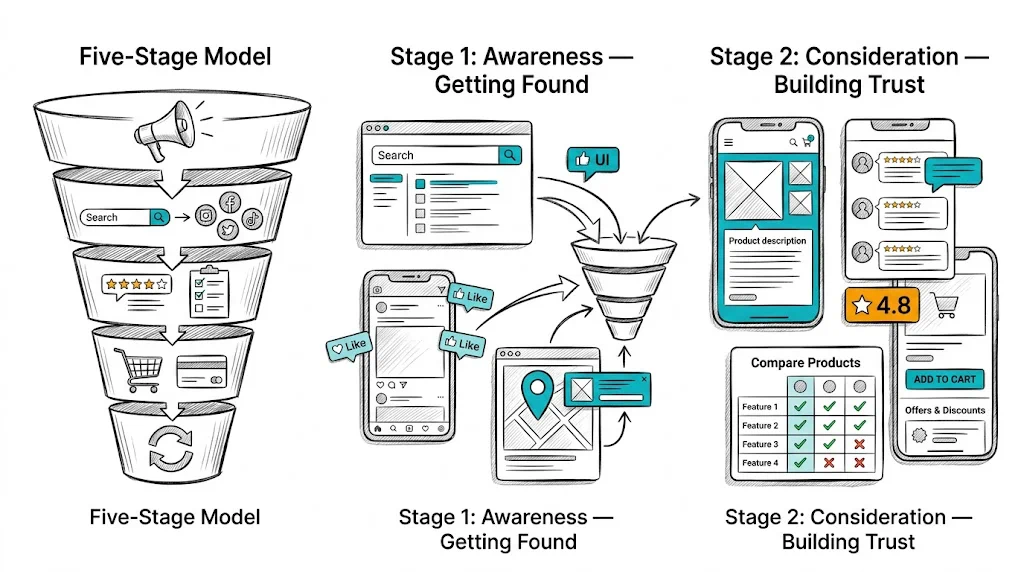
Unlike a simple awareness-to-purchase model, a D2C funnel has five distinct stages because D2C brands own the entire customer relationship:
The magic of D2C is that you control every stage. The challenge is that you must also invest in building every stage yourself.
Most D2C brands in India begin awareness building through paid social (Meta/Instagram) because organic reach alone is too slow. But awareness is not just advertising.
Meta (Instagram + Facebook): For most Indian D2C categories — beauty, personal care, food, fashion — Meta drives the highest volume of new customer discovery. Key formats:
Google Search and Shopping: Captures intent-driven traffic. Someone searching "caffeine face wash India" is closer to purchase than someone seeing an Instagram ad. Prioritize Google for categories with clear search volume.
YouTube: Long-form video works for complex products — supplements, skincare actives, tech accessories. Tutorial-style content builds trust that drives purchase weeks later.
Influencer marketing: India's creator economy is the world's second largest. Nano-influencers (5K–50K followers) in specific niches drive better conversion rate than mega-influencers for most D2C products. Budget ₹3,000–15,000 per post for nano-creators in beauty and lifestyle.
Content SEO: Blog content targeting category keywords (like this article) builds awareness among customers researching before they are ready to buy. Long-tail traffic from "best caffeine face wash for oily skin India" converts better than broad brand awareness traffic.
Word of mouth: For personal care and food, referrals from friends remain the highest-trust awareness channel. Build referral mechanics early — double-sided referral codes, WhatsApp shareable links.
A customer who has discovered your brand now evaluates whether you are worth buying from. This stage happens primarily on your website — and it is where most D2C brands lose money they do not know they are losing.
Your product page does the selling work that a retail salesperson does in a store. It must answer:
Kapiva's product pages include ingredient breakdowns with Ayurvedic references and clinical study citations. Plum shows a "free from" list prominently. Bellavita uses before/after customer photos. Each brand has figured out what builds trust for their specific customer.
Use heatmaps to understand which sections customers engage with and which they skip. Sections with low engagement that are meant to build trust are a warning sign.
Social proof is the primary trust signal for D2C brands without offline presence:
For Indian audiences specifically, regional language reviews perform better than English-only reviews for Tier 2/3 audiences. Consider asking for Hindi, Tamil, or regional language reviews.
A/B test your product page elements to improve add-to-cart rate. CustomFit.ai lets you test headline copy, image order, review placement, and CTA color without developer help.
Consideration converts to purchase at checkout. The gap between add-to-cart and completed purchase — cart abandonment rate — averages 70%+ for Indian D2C brands. Every percentage point of checkout improvement is free revenue.
Account creation friction: Forcing account creation before checkout kills conversion. Offer guest checkout as the default.
Surprise shipping charges: Show shipping costs early — ideally on the cart page. Hidden shipping fees at checkout cause high abandonment.
Too many form fields: Indian customers are often on mobile with small keyboards. Minimize required fields. Auto-fill address from pincode where possible.
Limited payment options: In India, UPI, cards, net banking, COD, and BNPL (Simpl, LazyPay) all matter. Fewer options = more abandonment.
Test each of these using A/B testing. Kapiva saw measurable improvements in checkout completion rate after adding a money-back guarantee badge above the pay button.
This is where D2C brands build defensible businesses. The brands that win long-term — Mamaearth (now listed), Sugar Cosmetics, Boat — have strong repeat purchase rates that reduce their dependency on paid media.
The 72 hours after first purchase shape whether a customer comes back. Execute:
Order confirmation: Immediate SMS + WhatsApp with order details and expected delivery date.
Shipping update: When dispatched, with tracking link.
Product usage guide: Day 1 of delivery — "Your [product] has arrived! Here's how to get the best results." Include a how-to video or guide. This reduces returns and increases satisfaction.
Check-in at Day 7: "How is [product name] working for you?" — simple WhatsApp message that creates a conversation and catches dissatisfied customers before they churn silently.
Review request at Day 14: Ask for a review with a photo. Offer a ₹50 coupon as thank-you. This builds your social proof pipeline.
Replenishment reminder at Day 45–60: For consumables, trigger a "Time to restock?" message at the expected usage end date. This is one of the highest-converting retention touches.
Advocacy is the highest-leverage stage because it is essentially free customer acquisition. A D2C customer who advocates for your brand brings in new customers at near-zero CAC.
Referral program: "Give ₹100, Get ₹100" — simple, clear, shareable via WhatsApp. Mamaearth's referral program drove significant early growth by turning happy customers into acquisition channels.
UGC campaign: Hashtag campaigns with branded packaging that customers photograph. Brands that design packaging for Instagram get free content at scale.
Community building: A WhatsApp community or Facebook group for brand fans. Kapiva's Ayurveda community generates organic content and creates brand evangelists.
Net Promoter Score: Track NPS quarterly. Customers who score 9–10 are your potential advocates. Reach out to them personally. Offer them exclusive early access to new products in exchange for honest reviews.
The most effective D2C funnels treat different customer segments differently:
CustomFit.ai's 1000+ targeting attributes let you personalize website experiences for each segment — showing different homepage banners, product page content, and checkout offers based on where each customer is in the funnel.
Map your funnel with data first: Use funnel analysis to find where customers drop off. Fix the biggest leak first.
Do not optimize awareness before fixing conversion: Spending more on ads when your checkout converts at 0.8% is pouring money into a leaky bucket.
Email and WhatsApp work together: Email for long-form content and retention. WhatsApp for transactional messages and time-sensitive offers. Run both.
Measure customer LTV by acquisition channel: Instagram-acquired customers may have different LTV than Google-acquired customers. This insight shapes where you invest.
Test every funnel stage: A/B test ad creative (awareness), product page layout (consideration), checkout flow (conversion), and retention email subject lines. Small improvements compound.
Festive seasons are funnel accelerators: During Diwali, Navratri, and Onam, all funnel stages compress — customers move from awareness to purchase faster. Have extra inventory, faster shipping, and conversion-optimized landing pages ready.
The brands that map, measure, and systematically optimize each stage of their D2C funnel are the ones that build defensible businesses at scale.