From the conversion glossary
Concepts referenced in this article, defined.
Concepts referenced in this article, defined.
Run rigorous A/B tests and personalize every visit on Shopify or any storefront — no engineers required.
Fashion is both the largest and the hardest D2C category in India. With RTO rates averaging 25–35%, size uncertainty as the primary purchase blocker, and brutal competition from Myntra, Ajio, and Meesho, Indian fashion D2C brands need to outperform on conversion just to break even. The brands that succeed — Bewakoof, The Souled Store, Snitch, Bombay Shirt Company — have each cracked specific conversion challenges. Here is what they do and how to apply it to your store.
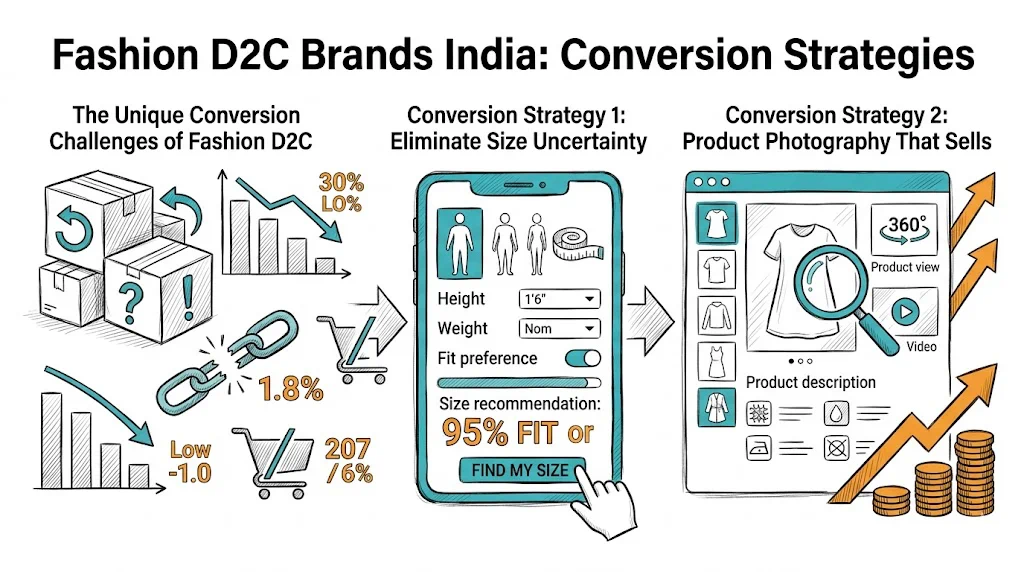
Before tactics, understand why fashion converts worse than other D2C categories:
Size uncertainty: A customer cannot try on clothing online. Even with a size guide, doubt remains. This leads to abandonment, multi-size orders (which inflate RTO), or purchase avoidance entirely.
Fit and drape uncertainty: A photograph cannot fully communicate how fabric drapes on a body, how stretch feels, or whether a silhouette works for different body types.
High RTO: Fashion RTO in India averages 25–35% — far higher than personal care (5–12%) or electronics (8–15%). Every return costs ₹120–180 in forward + reverse logistics.
High seasonality: Fashion is intensely seasonal — collections go stale, inventory builds up, and margin compression through discounting is common.
Trend velocity: What is desirable this week may be outdated in 30 days. Product page relevance decays faster than almost any other category.
These challenges are real — but each one is addressable with the right tactics.
Size uncertainty is your biggest conversion killer. Here is how to address it:
A size chart with numbers is not enough. Provide:
Show the same garment on models of different body types, heights, and skin tones. Brands like Snitch show products on 2–3 models of different builds. This dramatically reduces "will this look right on me?" uncertainty.
Customer-uploaded photos in reviews: Enable and encourage customers to upload photos of themselves wearing the product. These are the most powerful trust signals in fashion because they show real body diversity.
Brands with higher SKU counts benefit from AI-powered size recommendation tools. These tools ask for height, weight, and fit preference, then recommend a size with a confidence level ("95% of customers with your measurements find size L fits well").
Even a simple "Fit Quiz" — 3 questions about body shape and fit preference — can increase conversion rate by 8–15% for fashion D2C brands by making customers more confident in their size choice.
Fashion converts on images. Every photo decision affects add-to-cart rate.
Test image order using A/B testing. The Souled Store found that starting with a lifestyle model image (rather than flat product) increased their add-to-cart rate significantly.
Short 10–15 second product video showing fabric in motion can increase conversion by 8–12%. For ethnic wear especially, seeing how fabric moves is critical to the purchase decision.
Fashion reviews must go beyond "great quality!" to be useful. Encourage customers to specify:
Social proof that includes this detail dramatically reduces size-related purchase hesitation. Bewakoof and The Souled Store's review sections consistently include this kind of specific, actionable detail.
Incentivize photo reviews: Offer ₹50–100 coupon for reviews with photos. Fashion UGC from real customers in real contexts is more persuasive than any brand photography.
High RTO in fashion starts with uncertain purchase decisions. Fix conversion and you fix RTO:
For COD orders — which drive most fashion RTO — implement a COD confirmation flow (automated WhatsApp confirmation within 1 hour of order placement). This filters out casual or accidental orders before they ship.
Incentivize prepaid: "Pay online, save ₹50 + guaranteed delivery by [date]." Even a small prepaid incentive shifts customers from COD to prepaid and cuts RTO by 40–60% for that order cohort.
See our complete RTO reduction guide for the full playbook.
Fashion has genuine urgency — styles sell out, collections end, sizes go first. Use real urgency signals:
The key word is "honestly." Fake urgency ("Only 1 left!" when you have 200) damages trust when discovered. Authentic scarcity converts because it is real.
Fashion checkouts have specific issues that general ecommerce advice misses:
Variant selection confusion: If a product comes in 8 colors and 6 sizes, the variant picker can overwhelm. Use a clear size/color grid UI rather than dropdowns.
Size chart accessible from checkout: Many customers want to verify their size one more time at checkout. Make the size guide accessible from the cart page without navigating away.
"Save to wishlist" option: Fashion buyers frequently browse and return. A wishlist function captures intent from browsers who are not ready to buy today but will return. Connect your wishlist to your email/WhatsApp re-engagement sequence.
EMI and BNPL options: For AOVs above ₹1,500, showing "Starting at ₹500/month on Bajaj Finance" or "Pay in 3 with Simpl" meaningfully improves checkout completion for considered purchases.
Clear return policy summary at checkout: "Free returns within 7 days" shown at checkout reduces abandonment from customers who are nervous about buying clothing online.
Fashion personalization opportunities are significant:
Category-based personalization: If a customer bought kurtas, show them ethnic wear sections. If they bought Western casuals, show that.
Size-based filtering: Once you know a customer's size, default to filtering the catalogue to their size, eliminating the frustration of falling in love with a product that does not come in their size.
Seasonal and occasion-based recommendations: "New arrivals for Diwali" for customers who bought ethnic wear previously. "Summer-ready shirts" for customers in Rajasthan or Tamil Nadu as temperatures rise.
CustomFit.ai's 1000+ targeting attributes include purchase history, enabling this personalization on your Shopify store without developer involvement.
Photograph your products on at least two different body types. This single change has the highest impact on reducing size uncertainty for the widest range of customers.
Prioritize fabric description over style description. Customers know what they want to look like; they do not know whether your "cotton blend" feels heavy or light, structured or drapey.
A/B test your size guide placement. Should the size guide be in a popup? Inline below the variant selector? A separate tab? Test to find what reduces bounce and increases add-to-cart.
Use funnel analysis to find your biggest drop-off point. Is it product page to cart? Cart to checkout? Checkout to payment? Fix the biggest leak first.
Track average order value and test "complete the look" bundles at cart. Fashion lends itself to outfit completion — "Customers who bought this kurta also bought these palazzos" is a natural cross-sell.
Make your return policy exceptionally clear. Fashion conversion is directly correlated with return policy confidence. "Free returns within 7 days, no questions asked" should be visible on every product page.
Run festive collection landing pages separately from your regular catalogue. Dedicated Diwali or Eid collection pages with festive-specific messaging convert better than sending traffic to your standard catalogue.
Fashion D2C in India rewards brands that build confidence in the purchase decision. Every conversion strategy ultimately answers one question: "Will this look good on me and will buying be risk-free?" Answer that question better than your competitors, and your conversion rates will follow.