From the conversion glossary
Concepts referenced in this article, defined.
Concepts referenced in this article, defined.
Run rigorous A/B tests and personalize every visit on Shopify or any storefront — no engineers required.
India's food and beverage D2C market is one of the fastest-growing verticals in Indian ecommerce, projected to reach ₹8,000–10,000 crore by 2027. But growing a profitable F&B D2C brand in India requires navigating challenges specific to the category: taste uncertainty, high COD return rates, short product shelf life, FSSAI compliance, and intense competition from both traditional FMCG brands and well-funded D2C peers. This playbook covers exactly how India's best F&B D2C brands grow profitably — from customer acquisition and conversion rate optimization to repeat purchase and unit economics.
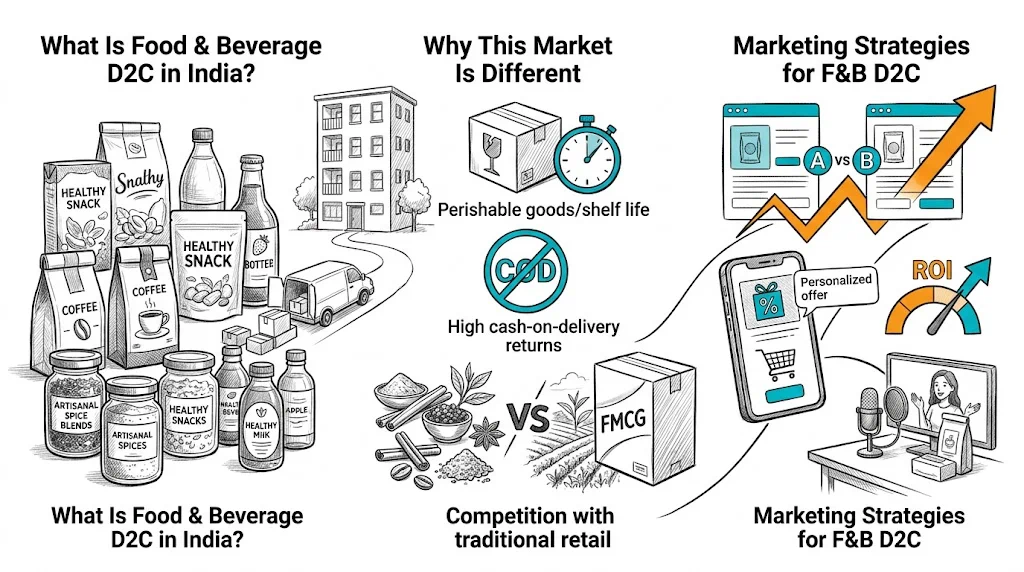
Food and beverage direct-to-consumer (D2C) brands in India sell food, snack, beverage, and nutrition products directly to end consumers through their own website or app, rather than through traditional retail distribution or marketplaces. This model gives F&B brands direct access to their customers, better margin control, and the ability to build brand relationships through data and personalization.
The Indian F&B D2C space spans multiple sub-categories:
What unites these categories: consumers who are health-conscious, increasingly skeptical of FMCG ingredient quality, and willing to pay a premium for transparency and provenance — but who face genuine taste uncertainty before trying a new brand.
Unlike fashion, electronics, or even personal care, food products carry fundamental sensory uncertainty. Customers cannot taste your product before buying. This single factor — taste risk — explains why F&B D2C brands have:
Every marketing and CRO decision for an F&B D2C brand must account for taste uncertainty.
India's F&B D2C brands face uniquely challenging COD dynamics. COD orders in food categories return at 25–35% in many brands' experience — nearly double the rate for fashion or beauty. Reasons include: customers ordering on impulse without commitment, inability to inspect the product before paying, and logistical complexity (some customers genuinely aren't home at delivery time).
The cost of each COD return in F&B: ₹100–₹150 in reverse logistics + potential product loss (perishable items often can't be resold). For a brand with ₹600 AOV and ₹180 COGS, a 30% COD return rate can make COD orders contribution-margin-negative.
The Food Safety and Standards Authority of India (FSSAI) regulates what Indian F&B brands can say in their advertising and labeling. Common compliance errors that result in ad rejection or removal:
F&B D2C marketing teams need FSSAI compliance built into their content creation workflow, not treated as an afterthought.
India's festive calendar — Diwali, Navratri, Holi, Eid, Raksha Bandhan, regional festivals — creates demand spikes for specific food categories. Gifting (dry fruits, chocolates, specialty snacks) surges during Diwali. Fasting foods (sabudana, rajgira, singhare ka atta) spike during Navratri. Sweets surge around multiple festivals.
Regional taste preferences also vary dramatically. Products that sell well in Maharashtra may have limited appeal in Bengal, where sweet profiles and spice tolerance differ significantly. F&B D2C brands must either build regional SKUs or target their national campaigns at their best-fit regional markets.
Discovery (top of funnel):
Consideration (middle of funnel):
Conversion (bottom of funnel):
Retention (post-purchase):
For consumable F&B products, subscription (autoship) is the single most powerful unit economics lever. The math:
The 4.8x LTV improvement from subscription completely changes the economics of customer acquisition. An F&B brand can afford to acquire customers at a much higher CAC when a meaningful portion converts to subscription.
Brands positioned on health claims, clean labels, and specific nutritional benefits. Example brands: Yoga Bar, Eat Better, True Elements. Key marketing challenge: distinguishing from commodity "healthy food" without making unpermissible health claims.
Marketing approach: Ingredient transparency, certifications (organic, non-GMO, FSSAI-compliant), before/after lifestyle positioning, recipe content, nutritionist partnerships.
Typical Shopify CVR: 1.8–3%, improving to 3–5% after 12 months of CRO.
Protein powders, Ayurvedic nutrition, adaptogens, and functional supplements marketed as food (not drugs). Example brands: Kapiva, OZiva, Wellbeing Nutrition. Straddles F&B and health/wellness categories.
Marketing approach: Clinical study references (where FSSAI-compliant), health influencer partnerships, detailed ingredient education, certification badges (ISO, organic, Ayush certified).
Premium positioning, often with provenance stories (single-origin chocolate, farm-fresh dairy, hand-made preserves). Example brands: Paul & Mike, Nourish Organics, Farmery Fresh. Strong gifting potential.
Marketing approach: Founder story, craft narrative, gifting campaigns around festivals, food blogger/chef partnerships, premium packaging, limited editions.
Traditional Indian foods with modern D2C distribution: pickles, chutneys, regional snacks, traditional sweets. Example brands: Naagin Sauce, Veeba, The Whole Truth. Often highly regional in consumer appeal.
Marketing approach: Regional pride, traditional recipe heritage, modern packaging, cross-cultural curiosity (regional foods as discovery for non-regional consumers), high social media virality potential.
High-consideration, high-trust-threshold category. Example brands: Slurp Farm, Timios, Nourish Organics (baby). Parents require extensive ingredient transparency and certifications before purchasing.
Marketing approach: Pediatric endorsements, organic certifications, minimal ingredient lists, parent community building, parenting influencer partnerships.
In a market saturated with "healthy" and "delicious" claims, ingredient transparency is the most effective differentiator. Show your full ingredient list prominently, explain each ingredient, and highlight what you've excluded (no added sugar, no preservatives, no artificial flavors). This builds trust with health-conscious buyers and creates shareable, educational content.
The single most effective CRO tactic for F&B D2C brands is reducing the cost of the first trial. A ₹99–₹149 trial pack with shipping included converts new visitors at significantly higher rates than asking them to commit to a ₹799 full-size product on the first visit. Price the trial to cover COGS — not to make money — and model the LTV of trial-to-repeat-purchaser conversion to justify the acquisition cost.
A prominently displayed money-back guarantee ("Didn't like the taste? We'll refund you") directly addresses the #1 objection for first-time F&B buyers. The refund rate on genuine satisfaction guarantees is typically 3–8%, far lower than the conversion rate improvement it drives (often 15–25% for new visitors). Test the guarantee placement and copy with A/B testing.
Always offer COD. But actively work to convert COD orders to prepaid through checkout incentives (₹30–₹50 discount for prepaid, "instant UPI" fast checkout prominence). The margin difference between COD and prepaid (factoring in return rates) is significant. For most F&B brands, successfully shifting 20–30% of COD buyers to prepaid improves net margin by 3–5 percentage points.
If you offer a subscription, test its placement: on the product page (before add to cart), in the cart, in post-purchase flow, and via email 7 days after the first purchase. Most F&B brands find that post-purchase subscription offers (after the customer has tried the product and liked it) convert at 2–3x the rate of pre-purchase subscription offers.
New visitors need trust signals and taste reassurance. Returning visitors need to see their product history and an easy path to reorder. Use CustomFit.ai's no-code personalization to show different homepage experiences to each segment — returning purchasers see their previously bought items and a reorder prompt, while new visitors see your bestseller range and trial pack offer.
India's festive seasons are predictable. Plan your Diwali gifting range (and its packaging) 90+ days in advance. Create content (gift guides, "best Diwali snacks" roundups) that can rank organically before the season. Set up festival-specific personalization rules in CustomFit.ai so returning visitors during Diwali season see a "Diwali Gift Sets" banner automatically.
Food content that teaches customers how to use your product creates SEO traffic, reduces post-purchase regret (customers who know what to do with your product are more satisfied), and generates UGC when customers share their results. A recipe blog section optimized for search ("quick millet breakfast recipes," "protein smoothie with ashwagandha") attracts precisely the right audience for health F&B brands.
WhatsApp has 90%+ open rates in India, compared to 20–30% for email. For consumable products where you know approximate consumption timelines (a 30-day supply finishes in ~30 days), a WhatsApp reorder reminder at day 22–25 is one of the highest-ROI retention tactics available. Use it sparingly — once per consumption cycle — to maintain opt-in rates.
For F&B D2C, a marketing campaign's success cannot be measured by orders alone. A campaign that drives ₹5,00,000 in GMV at a 35% return rate is significantly less valuable than one that drives ₹4,00,000 at a 10% return rate. Build return rate tracking into your campaign performance dashboards and use it to evaluate channel and creative quality.
| Tool | Best For | Key Feature | Starting Price |
|---|---|---|---|
| CustomFit.ai | CRO + personalization for Shopify | No-code A/B testing, new/returning visitor segments | $99/mo |
| Klaviyo | Email + SMS marketing | Subscription flow automation, post-purchase sequences | $20/mo |
| WhatsApp Business API | India-specific retention | Reorder reminders, COD confirmation, order updates | Variable |
| ReCharge | Subscription management | Autoship, subscription analytics, customer portal | $99/mo |
| Okendo | Reviews and UGC | Product reviews with photos, taste verification | $49/mo |
| Loop Returns | Return management | Shopify-native COD return tracking, exchange offers | $59/mo |
Why CustomFit.ai for F&B D2C: India's F&B D2C market needs personalization at scale without developer overhead. CustomFit.ai's no-code visual editor lets your marketing team set up new vs returning visitor experiences, trial pack promotion tests, and money-back guarantee placement tests — all without engineering support. The 1000+ targeting attributes include visitor behavior, traffic source, and device type, enabling precise personalization for each customer segment.
Compared to VWO, CustomFit.ai's native Shopify integration means subscription and product data are natively available for targeting. Compared to Optimizely, there are no enterprise contracts or lengthy implementations.
Kapiva, one of India's leading Ayurvedic D2C brands, used behavioral targeting and conversion optimization to improve their overall CVR by 9.48%. Their approach:
The combination of improved first-purchase conversion and higher subscription conversion improved their LTV:CAC ratio significantly, enabling reinvestment in growth.
Yoga Bar built their growth model around subscription. Their product page UI prominently features subscription pricing alongside one-time pricing, with a clear value comparison. Over 40% of their revenue comes from subscribers.
Their CRO strategy: A/B testing subscription offer copy, subscription discount percentages, and subscription vs. one-time pricing layout on product pages. Finding the optimal presentation increased their subscription conversion rate from 8% to 14% of product page visitors, fundamentally changing their unit economics.
Wellbeing Nutrition (functional supplements and nutrition) offered a "7-day trial kit" for ₹99 (covering COGS but not marketing cost). The campaign drove 12,000 trial kit purchases in 60 days. Of these, 28% converted to full-size product purchases within 30 days, and 11% became subscribers.
The trial kit economics: ₹99 revenue - ₹80 COGS - ₹40 fulfillment = -₹21 per trial (a ₹21 acquisition cost). With 28% converting at ₹850 AOV and 11% subscribing at ₹720/month × 8 months average, the trial cohort produced positive LTV economics at the cohort level even with the initial loss.
Go Desi sells traditional Indian snacks and foods (chikkis, sherbets, imli candies) with modern D2C positioning. Their marketing challenge: regional foods often have strong regional resonance but face awareness barriers nationally.
Their approach: content marketing targeting cultural nostalgia ("remember your dadi's chikki?"), micro-influencer campaigns in multiple regional languages, and Shopify CRO focused on reducing first-purchase friction through trial packs and COD. Their return rates improved significantly after implementing a personalized exit-intent offer (trial pack with free shipping for exit-intent visitors) through a tool similar to CustomFit.ai.
Naagin Sauce built their early growth on a passionate community of Indian hot sauce enthusiasts. Their D2C model focused on community: a hot sauce club subscription, limited edition drops, and community-generated recipes.
CRO learning: Naagin found that visitors who engaged with their "Build a Box" subscription configurator converted at 4.2x the rate of those who didn't. By making the Build a Box experience more prominent (tested via A/B test on homepage hero), they improved overall CVR by 31%.
F&B D2C founders often celebrate high GMV from COD campaigns without accounting for the 25–35% return rate. The campaign may look successful on the revenue dashboard but be margin-negative in reality. Always model your campaigns with expected return rates included.
FSSAI regulations on health claims are strict. "Boosts immunity," "treats diabetes," and "prevents cancer" are all non-compliant without specific clinical backing. F&B brands that inadvertently use non-compliant claims in their Shopify copy, product pages, or ads face takedowns and regulatory action. Have a compliance review process for all product claims.
A spicy south Indian snack brand running identical creative nationally will underperform — the creative that resonates in Tamil Nadu will not resonate in Punjab. Segment your paid campaigns by region and use regional language creative where your audience demographic warrants it.
Many F&B brands price their trial packs at ₹49–₹69 to maximize trial adoption. At this price point, the customer perceives the product as cheap, potentially undermining their premium positioning. Price trials at ₹99–₹149 — still significantly below full-size product prices, but in a range that signals quality.
The experience between purchase and first consumption determines whether a first-time buyer becomes a repeat buyer. Shipping delay communication, packaging experience, usage instructions, and recipe suggestions all influence first-consumption satisfaction. A great post-purchase experience is your most cost-effective CRO investment.
Many F&B D2C brands launch with one-time purchase and add subscription "when ready." This delays the economics improvement that subscription provides and means early cohorts who might have subscribed don't. Build subscription into your product page from day one, even if your subscription conversion rate is initially low.
Mega-influencers (1M+ followers) in India produce brand awareness but rarely drive direct conversions for F&B brands. Micro-influencers (50K–500K) in food, health, and fitness niches drive qualified traffic that converts. Measure influencer partnerships by CAC and LTV of acquired customers, not by impressions or reach.
For consumable products, you know (approximately) how long a product lasts: a 30-day supply, a 500g bag consumed in 3 weeks, a 12-pack lasting 2 months. Build a model that predicts when each customer is likely to run out based on their order date and product type. Trigger reorder communications — WhatsApp, email, or on-site personalization for returning visitors — at 75–85% of the predicted consumption period. Timed reorder prompts convert at 2–4x generic promotional messages.
For new visitors who show exit intent on a high-priced product page, offer your trial size automatically through a CustomFit.ai exit-intent popup. The trial offer ("Try our 7-day starter kit for ₹149") can capture visitors who were ready to leave due to first-purchase price hesitation. This is the F&B equivalent of a lead magnet — you're capturing the customer at a lower cost-of-trial, and your retention economics do the rest.
The money-back guarantee is your most powerful F&B CRO tool. Test: (a) where it appears (above add-to-cart vs. below vs. both), (b) the copy ("30-day money-back guarantee" vs. "If you don't love the taste, we'll refund you — no questions asked"), and (c) whether it appears on your homepage prominently. Most F&B brands find their optimal guarantee placement via 2–3 tests, producing 15–30% CVR improvement.
India's gifting economy — Diwali, Navratri, Raksha Bandhan, Holi — represents enormous F&B D2C opportunity. Build a year-round gifting experience on your Shopify store (gift wrapping, personalized note, gift receipt option), and activate it seasonally with festive packaging and curated gift boxes. Personalize the homepage for visitors arriving from gifting-intent search terms ("Diwali gift box food") with a personalization rule in CustomFit.ai.
UPI transaction data (with customer consent) can be used to understand payment method preferences. Returning customers who've paid via UPI before can be shown a "Pay with UPI — fastest checkout" prompt more prominently. This micro-personalization reduces checkout friction and increases the proportion of orders paid via lower-cost payment methods, improving margins.
What is the market size of food and beverage D2C in India? India's D2C food and beverage market was valued at approximately ₹2,000 crore in 2023 and is projected to reach ₹8,000–10,000 crore by 2027, growing at 30–35% annually. The category is one of the fastest-growing segments in Indian ecommerce.
What are the biggest marketing challenges for food and beverage D2C brands in India? The top challenges are: high CAC on paid channels, high COD return rates (25–35% for F&B), short product shelf life, FSSAI compliance, and strong regional taste variation that makes national campaigns less efficient.
How do you build repeat purchase for food and beverage D2C brands? Subscription models, consumption-timed reorder reminders, loyalty programs, and new product announcements to existing customers. F&B brands with subscription models have 3–5x better LTV:CAC ratios. Behavioral targeting enables personalized reorder prompts that outperform generic promotional messages.
What conversion rate should a food and beverage D2C brand expect on Shopify? F&B D2C brands typically see 1.5–3% CVR for first-time visitors and 4–8% for returning purchasers. Brands offering free samples or trial packs see 30–50% higher CVR than those without.
Should Indian F&B D2C brands sell on marketplaces or direct-to-consumer? Both. Marketplaces (Amazon, Flipkart, Zepto, Blinkit) provide discovery and volume. Your D2C Shopify store provides customer ownership, personalization, and 20–30% better margins vs. marketplace fees.
How important is FSSAI compliance for D2C food brands in India? It is mandatory. Your Shopify store must display your FSSAI license number, products must meet labeling requirements, and advertising claims must comply with FSSAI guidelines. Non-compliance results in ad removal and regulatory action.
What is the role of influencer marketing for food and beverage D2C in India? Influencer marketing is often the most cost-efficient acquisition channel. Micro-influencers (50K–500K followers) in health, fitness, and food niches deliver better ROI than large celebrity partnerships. Taste-testing content drives qualified traffic and authentic advocacy.
How do I reduce cart abandonment for a food and beverage D2C store in India? Address shipping cost shock (free shipping threshold), taste uncertainty (money-back guarantee), and COD availability. An abandoned cart email + WhatsApp sequence recovers 8–15% of abandoned carts. CustomFit.ai exit-intent personalization adds 5–8% more recoveries. See also A/B testing for optimizing conversion rate.
Start your free trial of CustomFit.ai — 14 days, no credit card required. Setup in under 30 minutes.