From the conversion glossary
Concepts referenced in this article, defined.
Concepts referenced in this article, defined.
Run rigorous A/B tests and personalize every visit on Shopify or any storefront — no engineers required.
A D2C content marketing strategy is the plan that turns your brand's expertise into organic customer acquisition—attracting buyers who find you through search and social, build trust through your content, and convert without you paying ₹100+ per click in Meta ads. The brands that master this in India build a compounding advantage: each piece of well-executed content continues driving conversion funnel traffic for 12–36 months after publication, while competitors pay for every visit they get. This guide covers how to build that engine from scratch.
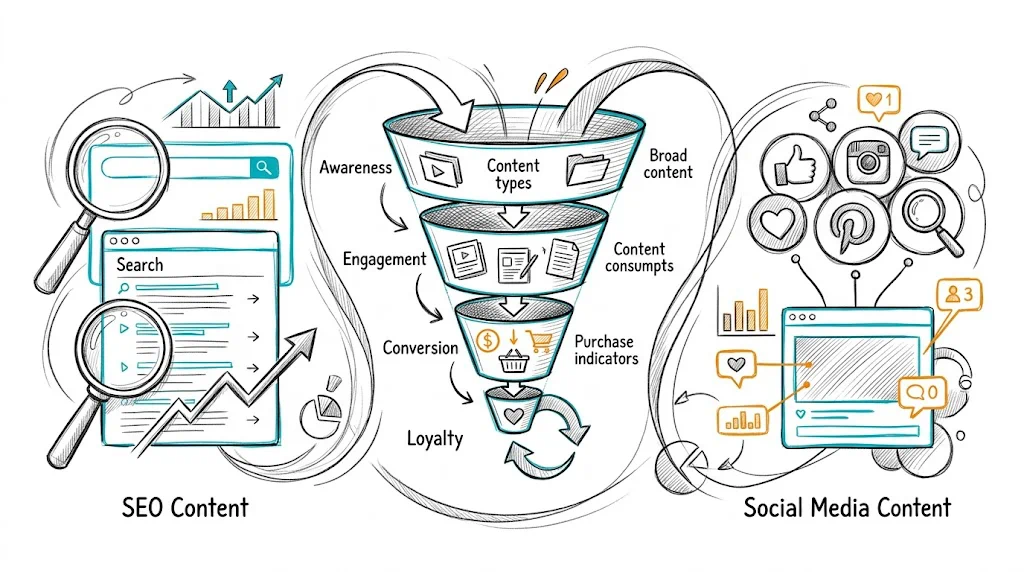
Before creating any content, map the questions your target customer asks at every stage of their journey:
Awareness stage (don't know your brand): "What ingredients are safe for oily skin?" "How do protein supplements work?" "Best COD skincare brands India"
Consideration stage (comparing options): "The Derma Co vs. Minimalist" "How long do adaptogen supplements take to work?" "Mamaearth review honest"
Decision stage (almost ready to buy): "[Your Brand] coupon code" "Does [product] work for dark skin?" "Free shipping [Your Brand]"
Each stage requires different content. Awareness-stage articles build organic traffic. Consideration-stage content captures comparison intent. Decision-stage content removes final purchase barriers.
Most Indian D2C brands can't execute excellent content across 8 channels simultaneously. Choose 2–3 primary channels based on your audience and team capacity:
| Channel | Best For | Effort | Time to Impact |
|---|---|---|---|
| Blog/SEO | Long-term organic acquisition | Medium | 3–6 months |
| Brand building, DTC community | High | 4–8 weeks | |
| YouTube | Product demos, authority | High | 3–6 months |
| Email/WhatsApp | Retention, repeat purchase | Medium | Immediate |
| Discovery (fashion, home, food) | Low | 2–4 months |
For most Indian D2C brands, the highest-ROI combination is: SEO blog + Instagram + email/WhatsApp. The blog builds long-term organic traffic, Instagram builds brand awareness and community, and email/WhatsApp captures that awareness into revenue.
A content calendar is not just a schedule—it's a strategic map of which topics, at which stages of the funnel, on which channels, in which months. Build it quarterly:
Template for one month:
Align the content calendar with the Indian festive calendar. Diwali-relevant content published 4–6 weeks before Diwali captures search and social attention at peak buying intent.
Most global keyword tools underestimate Indian search volume. Supplement Google Keyword Planner with:
Target keywords with 500–5,000 monthly searches and low-to-medium competition as your starting point. "Best protein powder for women India" is more achievable and more commercially relevant than "protein powder" (too competitive) or "protein powder benefits for athletic recovery" (too low volume).
Google's featured snippet boxes are the highest-visibility real estate in search results—and Indian D2C brands are underrepresented in them relative to global brands because most produce thin, generic content.
To earn featured snippets, format your content specifically for extraction:
See our FAQ page guide for how to apply this to your store's FAQ content and earn Google FAQ rich results.
Every blog article should link to 3–5 related articles and 2–3 product or collection pages. This distributes SEO authority across your site and moves readers from educational content to product pages—the conversion rate bridge between content and commerce.
70% educational/entertainment: How-to content, ingredient stories, customer transformations, behind-the-scenes. This is why people follow you.
20% community/conversation: Questions, polls, user-generated content reposts, customer features. This builds engagement.
10% promotional: Sale announcements, new product launches, discount codes. Too much promotional content kills organic reach and audience trust.
Instagram Reels have the highest organic reach of any Instagram format in 2025. The content types that consistently get reach for Indian D2C brands:
The hook in the first 2 seconds determines whether a reel gets seen. "I stopped using imported skincare for 30 days. Here's what happened" outperforms "Our new moisturiser is finally here."
A WhatsApp broadcast list or Community is arguably the highest-ROI retention content channel for Indian D2C. A message from a known brand contact gets opened—unlike email at 20–30% open rates, WhatsApp messages see 80–90% read rates within 24 hours.
Content that works on WhatsApp:
1. Welcome series (5 emails over 7 days): Brand story, bestseller showcase, social proof, FAQ addressing first-purchase hesitations, final discount offer
2. Abandoned cart series (3 emails over 72 hours): Reminder, objection handling (easy returns, COD availability), urgency trigger
3. Post-purchase series (4 emails over 30 days): Delivery confirmation, product usage tips, review request, repeat purchase prompt
4. Win-back series (3 emails for 90+ day inactive customers): "We miss you" + new product, story update, final discount offer
Each series should be written in your brand's tone of voice—not generic template copy. Personalise subject lines with the customer's first name and the specific product they bought.
Organic traffic: Monthly sessions from organic search, tracked in Google Analytics 4. Target 10–15% month-over-month growth in the first 12 months.
Content-to-commerce CTR: What percentage of blog readers click through to product pages? Under 3% means your content doesn't connect to products well enough. Above 8% means your content is highly commercial and well-linked.
Organic revenue attribution: In Shopify Analytics, filter by "Organic" traffic source to see revenue attributed to organic search. Compare this to your content investment (writer costs, tool subscriptions) to calculate content ROI.
Email revenue per campaign: Track revenue generated per email sent, divided by list size. Industry benchmark for D2C: ₹30–₹80 per subscriber per month from email.